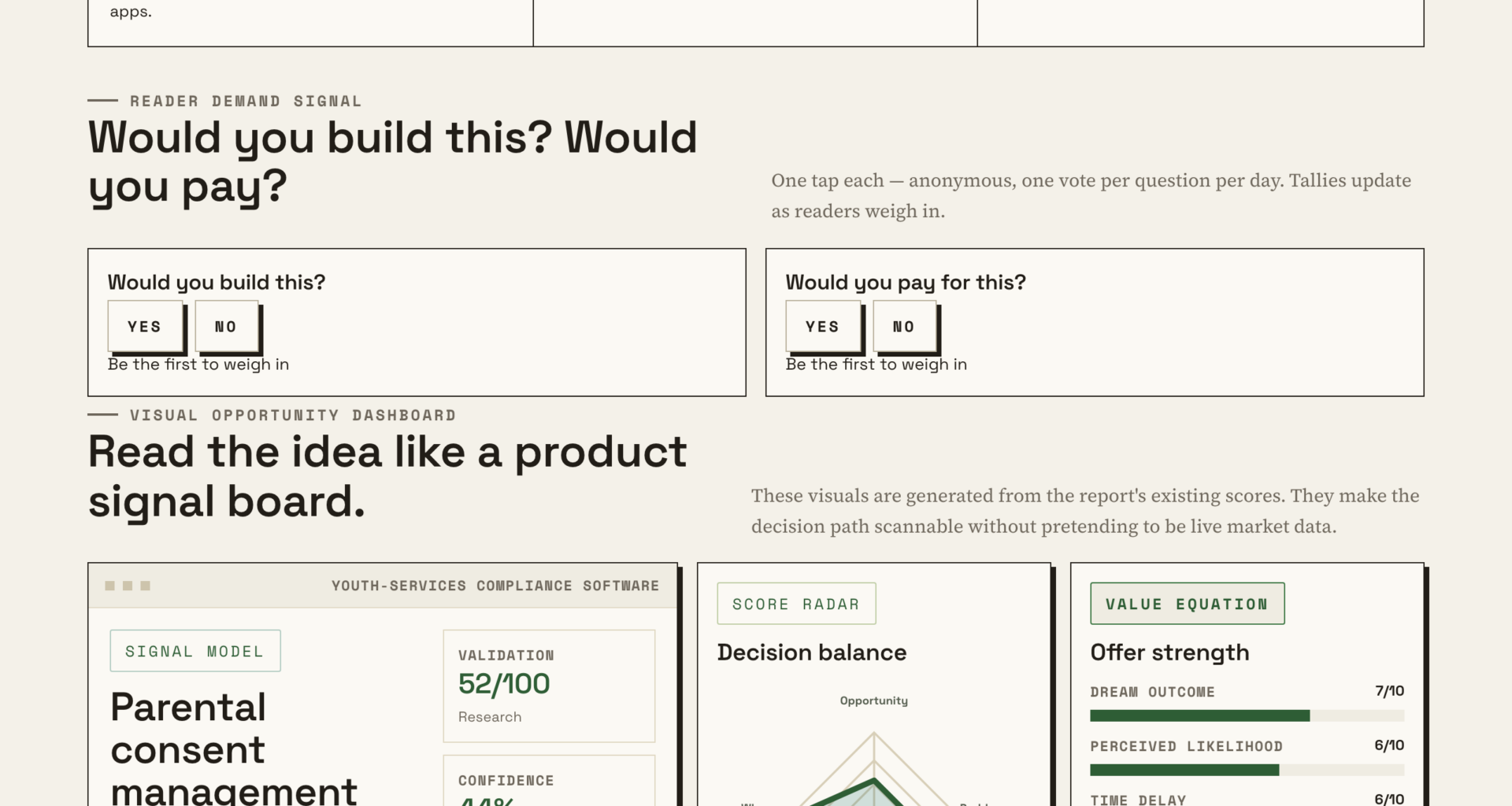

📊 Full opportunity report: Parental Consent Management For Vendors Serving Young People on IdeaNavigator AI — validation score, market gap, and execution plan.

Get baby and family essentials delivered free — and shop member deals
- Fast, free delivery on millions of items
- Access to Prime Big Deal Days deals on October 6–7
- Prime Video, Amazon Music and more included
TL;DR
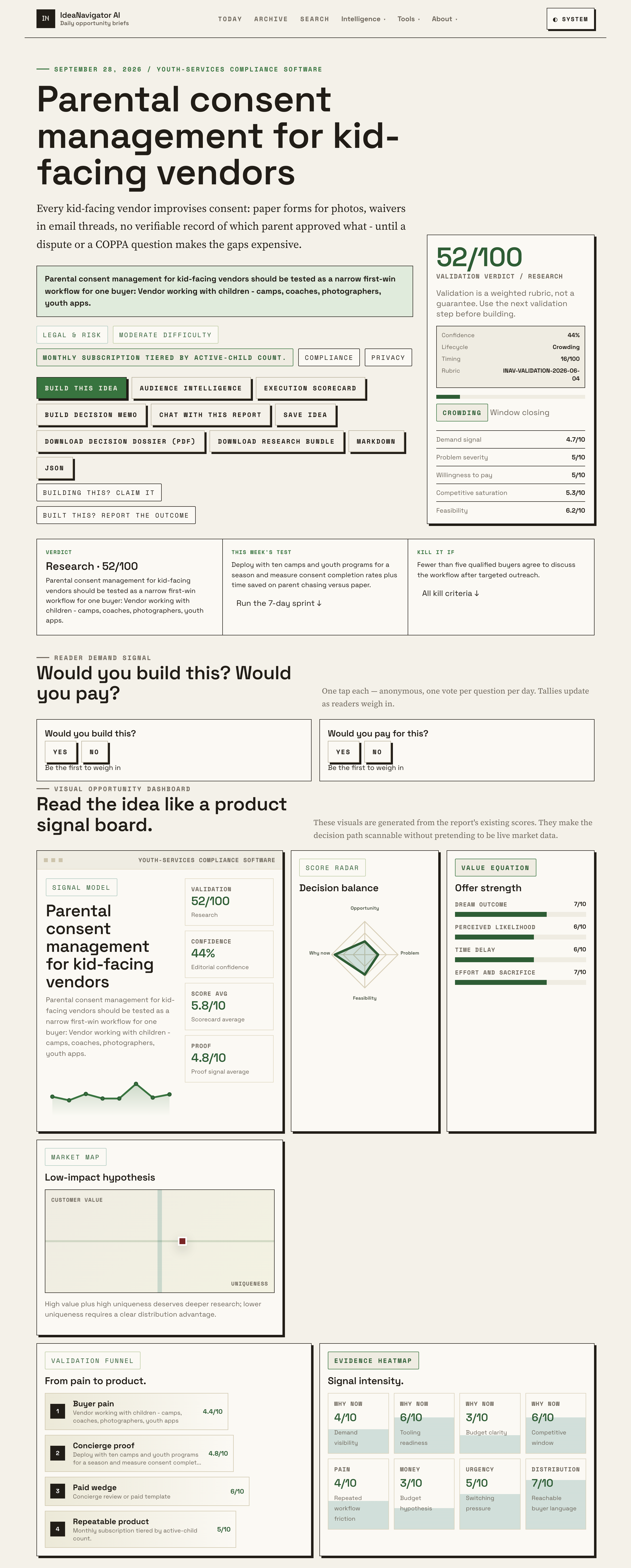
IdeaNavigator AI proposes testing a parental-consent service for camps and other vendors serving children. The suggested product would collect and track permissions on parents’ phones, but no launch, pilot results, or customer adoption are reported.
IdeaNavigator AI has proposed a parental-consent management service for camps and other businesses working with children, with a suggested pilot across ten camps and youth programs. The proposal targets fragmented permission records, but it does not report that a product has launched or that a pilot has begun.
The proposed service would let vendors create branded consent forms that parents complete on their phones. The listed permissions include photo use, data collection, medical information and liability waivers. The proposal also calls for identity checks matched to the risk of each permission, individual records for each child, expiry tracking and an exportable audit history.
The underlying problem described is that youth-serving vendors often manage permission through paper forms and email threads. Those approaches can leave vendors unable to quickly establish which parent approved which use, according to the proposal. No data is provided on how common these gaps are or how often they lead to disputes.
The suggested business model is a monthly subscription priced by active-child count. To assess demand and usefulness, the proposal recommends using the service with ten camps or youth programs for one season, then measuring consent completion rates and time spent following up with parents compared with paper processes. No pricing, participating organizations, or results are given.
Consent Records at Youth Programs
For a camp, coach or photographer, permission records affect whether staff can document approval for a child’s photo, information or participation. A centralized, time-stamped record could make it easier to locate a particular consent and see whether it has expired. That is the practical case for the proposal’s per-child ledger and audit export.
The value would depend on whether families complete forms and whether vendors can use the records in day-to-day work. Identity checks also need to fit the sensitivity of the permission: a simple photo release and authorization involving medical information may call for different handling. The suggested pilot measures completion rates and follow-up time, but does not specify privacy safeguards, security controls or how vendors would manage access to children’s records.
Paper Forms and Privacy Rules
The proposal comes amid attention to children’s privacy, including updates to the U.S. Children’s Online Privacy Protection Rule and state-level requirements. These rules may apply differently depending on the service, the information collected and the parties involved. The proposal does not identify a particular legal requirement or explain how its suggested product would meet one.
It also points to parents challenging the use of children’s photos and data as a reason vendors may seek clearer records. That is a stated rationale for the idea, not a documented trend with figures or named cases. The development described is a product opportunity and validation plan, rather than a regulatory announcement or evidence of a completed business launch.
Pilot and Product Status
It is not clear whether a product is being built, whether any youth programs have agreed to participate, or when a seasonal test might take place. The proposal supplies no customer interviews, trial results, subscription prices or estimates of the market’s size.
Several implementation questions also remain unanswered. These include how parent identity would be verified at each risk tier, how consent could be withdrawn, how long records would be retained, and what security and access protections would apply. No specific legal analysis is provided, so the proposal alone does not establish that a vendor using the service would satisfy applicable privacy rules.
Measures for a Seasonal Test
The proposed next step is a season-long deployment with ten camps or youth programs. The evaluation would compare consent completion and the time staff spend pursuing missing forms against paper-based processes. The proposal does not give a start date, name participating programs, or set a threshold for success.
If such a pilot proceeds, its results could show whether vendors and parents find phone-based forms workable and whether the records reduce administrative follow-up. Until those details are reported, the concept’s adoption, effectiveness and fit with specific legal obligations remain unknown.
Source: IdeaNavigator AI
Key Questions
Has the parental-consent service launched?
The proposal does not say that a product has launched. Its product and pilot are described as ideas to test.
Who is the proposed service for?
It is aimed at vendors working with children, including camps, coaches, photographers and youth apps.
What permissions could parents manage?
The proposed forms cover photo use, data collection, medical information and liability waivers. The proposal does not describe the detailed form language or legal review.
How would the idea be evaluated?
The suggested test involves ten camps or youth programs for a season, measuring consent completion rates and staff time spent following up compared with paper forms.
Source: IdeaNavigator AI
Fall Picks
fall essentials
As an affiliate, we earn on qualifying purchases.