TL;DR

Get baby and family essentials delivered free — and shop member deals
- Fast, free delivery on millions of items
- Access to Prime Big Deal Days deals on October 6–7
- Prime Video, Amazon Music and more included
Kids’ Halloween costume sets usually combine a themed outfit with selected accessories, but shoes, props, and other items may be sold separately. Check the size chart, comfort, included-items list, visibility, care instructions, and current CPSC recalls before buying; then test the full outfit at home and adapt it to your child’s plans.
A child can adore a glittering superhero costume online and refuse to wear it five minutes after the itchy collar touches their neck. That gap between the picture and the real outfit is why choosing a costume set takes more than picking a character.
A kids’ Halloween costume set usually combines a themed outfit with some accessories, but the exact contents vary. You’ll learn how to decode the package, choose a workable fit, check comfort and nighttime visibility, and decide whether a costume is worth its price. A few practical checks can save you from a last-minute hunt for missing shoes—or a costume that stays on the hanger.
Think of the costume as gear for an evening out, not just a photo prop. Your child may wear it at school, to a party, and along dim sidewalks, so movement, warmth, and visibility matter as much as the cape or crown.
Treat the product contents list—not the costume photo—as the authority on what comes in the set.
Compare your child’s measurements with the brand’s size chart and test the outfit with planned layers and shoes.
Try masks, closures, hems, and accessories at home to catch comfort, vision, breathing, or tripping problems early.
Check current CPSC recall notices, follow age guidance, and add visibility for outdoor wear after dark.
Compare care instructions and reuse options; a simple cape, tunic, or secondhand costume may stretch your budget.
What comes in a kids’ Halloween costume set—and what may be missing?
A kids’ Halloween costume set usually combines a themed outfit with selected accessories, such as a cape, hat, mask, belt, gloves, or wings. The phrase doesn’t guarantee a head-to-toe package: shoes, tights, makeup, and toy props may be separate. Check the listed contents before you buy.
That distinction matters because product photos can show a finished look without including every visible piece. For example, a pirate set might include a striped shirt, vest, and bandanna while leaving out the boots, toy sword, and trousers. A child who expects the whole swashbuckling look may feel let down when the box arrives with only half the crew.
Common themes include animals, witches, skeletons, superheroes, pirates, and storybook characters. A licensed character outfit may be instantly recognizable; a generic cape or animal onesie often gives you more room to improvise and reuse it. Either choice can work—the child’s preference, what the set contains, and how often they might wear it matter more than the label.
Before checkout, scan the description for each included item, then compare it with the photograph. Ask yourself: does your child already own the missing pieces, and can they wear the outfit without them? That quick check turns “almost complete” into a choice you can plan for, not a surprise at the door.
kids Halloween costume sets with accessories
As an affiliate, we earn on qualifying purchases.
As an affiliate, we earn on qualifying purchases.
How to choose a size your child can move in
Choose a costume size by comparing your child’s measurements with the manufacturer’s chart, not by assuming their everyday clothing size will match. Costume cuts differ, and a roomy size may help with warm layers, while an oversized hem or loose sleeves can trip or snag. Check garment measurements when the brand provides them.
- Measure first: Use the chart’s directions and write down the measurements you need, such as height, chest, or waist.
- Plan for the weather: Decide whether a base layer will fit beneath the costume without pulling at the shoulders or waist.
- Check the details: Look at the hem, sleeves, closures, and whether your child can move and use the bathroom easily.
- Review the return policy: Seasonal items may have specific deadlines or restrictions, so check before ordering.
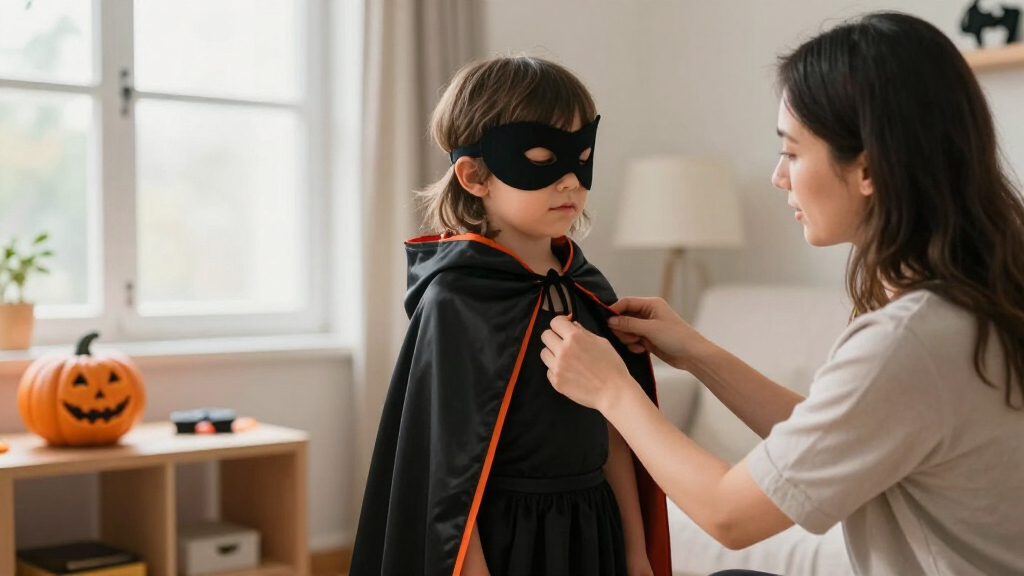
For example, if your child is between sizes and will wear a hoodie under a thin costume, the larger option may feel more comfortable. But if it makes the hem drag, that extra room creates a different problem. Try the full outfit with the shoes and layers your child will actually wear, then have them walk, sit, and lift their arms.
Those few minutes of testing can reveal a stiff collar or a cape that catches on a chair. A costume should let your child move naturally, not require them to shuffle like a tiny robot.
children's Halloween costume safety check
As an affiliate, we earn on qualifying purchases.
As an affiliate, we earn on qualifying purchases.
Which costume set will feel good beyond the first photo?
The most wearable costume set has soft, breathable materials, a cut that allows easy movement, and details your child can tolerate for the whole event. Comfort is more than a preference: discomfort can shorten the evening, distract a child at a school event, or make them pull at a mask while walking. Fabric is only part of the equation; stiff masks, scratchy seams, tight cuffs, and fiddly closures can all create friction over time.
Try the costume on at home before Halloween rather than discovering its rough edges at the school parade. Ask your child to wear it for a few minutes while walking, sitting, and bending—not just posing in front of a mirror. A child who loves a dragon design may still reject its hard facepiece, for instance. If the outfit allows it, replacing a mask with suitable face paint or wearing the hood down can keep the theme while making the costume easier to enjoy. The tradeoff is that an alternative may change the finished look, but a costume your child will actually wear is more useful than a perfect-looking one they refuse.
For children with sensory sensitivities, prioritize soft fabrics, simple closures, and fewer irritating accessories. You can also ask your child to help rank the options: “Would you rather wear the wings or the hat?” That small choice can reveal which pieces feel fun and which feel like a scratchy chore. Removing an accessory can simplify the outfit, though it may mean buying or adapting another piece if that detail is important to the child.
Comfort is personal, so there is no single fabric or feature that works for every child. A breathable animal onesie may suit one kid, while another prefers a loose tunic over familiar clothes. For an infant’s sleep or feeding needs, follow your pediatrician’s guidance rather than relying on costume advice; the outfit should not replace safe sleep or feeding practices.
As an affiliate, we earn on qualifying purchases.
How to check safety and visibility before trick-or-treating
A trick-or-treat costume needs to fit safely, allow clear vision and easy breathing, and help drivers and neighbors see your child after dark. These checks work together: a long hem can trip a child, while a mask that limits peripheral vision can make it harder to notice steps, people, or traffic. A cute accessory is not worth a blocked view or a trip hazard on a dim sidewalk.
Walk the route your child might take—perhaps from the porch to the mailbox, then along a familiar block—and watch for dragging fabric or dangling pieces. This gives you a chance to spot issues that may not show up while standing still. Reflective tape or bright details can help make a dark costume easier to notice, while a flashlight or glow accessory can add light if it leaves your child’s hands and movement unobstructed. Visibility aids complement adult supervision; they do not replace it.
Look for flame-resistant or flame-retardant materials where possible, and keep costumes away from candles and other open flames. These labels are not a reason to let a child near a flame; a porch pumpkin or candlelit display still calls for distance and adult supervision. Avoid props that are sharp, unwieldy, or likely to snag on fences and door handles. A lightweight, soft prop may look less realistic, but it is easier to carry and less likely to cause injury if a child stumbles or swings it.
Before the big night: Check the product and manufacturer against current CPSC recall notices, inspect the outfit for loose or broken parts, and test the mask’s vision and breathing. If the mask is uncomfortable or obstructs sight, choose a suitable alternative rather than asking your child to push through.
Age-appropriateness matters, too. An accessory designed for an older child may have parts or features that are unsuitable for a younger one, so follow age guidance and supervise use. For instance, a toddler’s costume can keep the theme with a soft hat instead of a small detachable prop. Choosing a simpler accessory may sacrifice some detail, but reduces the chance of a piece being mouthed, lost, or misused.
kids Halloween costume visibility accessories
As an affiliate, we earn on qualifying purchases.
As an affiliate, we earn on qualifying purchases.
How to compare costume sets for price, care, and reuse
The best-value costume set is the one that fits your budget and your plans after Halloween, not automatically the cheapest package. A low price can be misleading if important pieces are missing, the costume needs costly add-ons, or it is difficult to clean and unlikely to be worn again. Compare the full cost and likely use: what is included, how the outfit is cared for, whether it can handle repeated wear, and whether your child might use its pieces for dress-up later.
| Option | What you may gain | What to check |
|---|---|---|
| Licensed character set | Recognizable design your child may be excited to wear | Price, included pieces, and whether the interest will last |
| Generic themed set | More room to personalize and reuse | Whether you need to add a few items to finish the look |
| Secondhand or swapped set | Lower-cost reuse of an existing outfit | Condition, fit, cleanliness, and missing accessories |
| Simple base outfit | Can be changed with capes, hats, or other accessories | Whether the add-ons are safe and comfortable |
Imagine a child who wants to be a witch for a school party and again for neighborhood trick-or-treating. A simple dress and hat may be easier to clean and reuse than a highly decorated outfit that only works for one character. That versatility can make a modest costume better value, even if it looks less elaborate in a product photo. Check the care label before washing; some costumes need spot cleaning or hand washing, especially when decorations are attached. If cleaning is difficult, that may limit how often the outfit can be used.
Costume swaps, secondhand shops, and a cape or tunic you can restyle can reduce cost and waste. If you shop used, check seams, closures, and accessories carefully, and verify that nothing is missing or damaged. A lower sticker price only helps if the costume still fits and works for your child’s plans; repairs, cleaning, or replacement pieces can change the real savings.
How to make the final pick without a Halloween-week scramble
Make the final pick by matching the costume to your child’s preferences, your event plans, and the practical details you have checked. Buying earlier gives you more time to compare sizes and availability, but it is not a guarantee that a set will work: your child’s comfort and the package contents still need checking. You can make a thoughtful last-minute choice, too, if you confirm delivery or pickup timing and inspect the package promptly, leaving time to replace anything that does not fit.
For example, suppose your child chooses an astronaut set for a school parade and evening trick-or-treating. Before committing, see whether the package includes the helmet, test whether your child can see comfortably through it, and plan how to add visibility after dark. If the helmet blocks their view, the rest of the costume may still work with a safer alternative. That avoids treating one eye-catching accessory as the deciding factor when the outfit has to serve two different settings.
Use this short checklist while you shop:
- Ask your child what they want to wear, then check that the style suits the planned event.
- Read the contents list and spot anything shown in photos but sold separately.
- Compare measurements with the size chart and allow for suitable layers.
- Review comfort, care, and age guidance, including closures and any detachable accessories.
- Check current CPSC recalls and review the return policy before buying.
Trends tied to films, games, and online characters can change quickly, and availability varies by retailer. Rather than guessing which look leads this year, choose a set your child likes and can use comfortably. When it arrives, do a full try-on: hat, shoes, layers, and all. It is easier to swap a size at home than to negotiate with a stubborn zipper on the way out the door.
Frequently Asked Questions
What comes in a kids’ Halloween costume set?
It varies by product: a set may include an outfit and pieces such as a cape, hat, mask, belt, or wings. Shoes, props, tights, and makeup may be separate, so check the included-items list rather than relying on the product photo.
How do I choose the right costume size?
Measure your child and compare the results with the manufacturer’s size chart; everyday clothing sizes do not always match costume sizing. Consider planned layers and check the return policy, especially if your child falls between sizes.
Are costume sets safe for trick-or-treating?
Check fit, vision, breathing, hems, props, and nighttime visibility before heading out. Keep costumes away from open flames, follow age guidance, and check current CPSC recall notices for the product and manufacturer.
How can I make a costume more comfortable?
Try it on at home and look for itchy seams, stiff masks, tight closures, or fabric that makes movement hard. A suitable base layer or a simpler accessory may help, and children with sensory sensitivities may prefer soft materials and fewer pieces.
Can I wash a kids’ Halloween costume set?
Follow the care label. Some outfits can be machine washed, while attached decorations or delicate pieces may call for spot cleaning or hand washing.
How can I save money on a costume set?
Look at secondhand options, costume swaps, and versatile base pieces such as a cape or tunic. Check the condition and contents carefully, and compare the full cost of any extra accessories before deciding.
Conclusion
Choose the set your child is happy to wear, then make sure it fits, feels comfortable, and works for the actual plans—not just the product photo. Check the contents list, test the full outfit, and review current CPSC recalls before Halloween.
The best costume is the one your child can move in, be seen in, and still be smiling in when the porch lights glow.
Halloween Picks
halloween
As an affiliate, we earn on qualifying purchases.