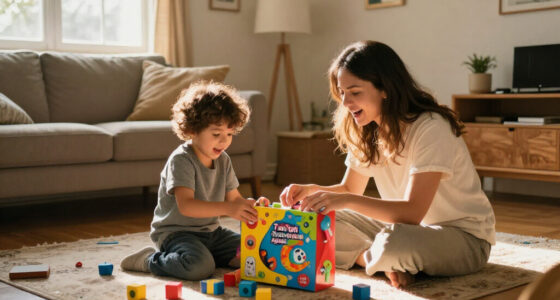

Choose a small set of educational toys that lets a toddler explore, practice useful skills, and play safely. This guide is for parents and caregivers with toddlers around 1 to 3 years old; no specialist knowledge is needed. Allow 30-60 minutes to check the child’s needs, compare toys, inspect safety details, and prepare a play area.

Give the gift of listening to the whole family
- Choose a 1-, 3-, 6- or 12-month membership
- They pick the audiobooks they love
- Easy to send by email

LeapFrog Learning Friends 100 Words Book
- ✔ Age guidance: 18 months and up
- ✔ Vocabulary: More than 100 words
- ✔ Languages: English and Spanish

Airbition Talking Flash Cards for Toddlers Ages 1–4, 224 Words, English, Blue
- ✔ Age description: 1+ years; product title says ages 1–4
- ✔ Vocabulary: 224 illustrated words
- ✔ Language: English, standard American accent

LeapFrog 2-in-1 LeapTop Touch
- ✔ Age guidance: 2–5 years
- ✔ Learning activities: ABCs, numbers, games, music, and messages
- ✔ Keyboard: Letters A–Z and numbers 1–10
Difficulty: Beginner | Time: 30-60 minutes
What You’ll Need
Tools & Materials:
- The toddler’s age and any relevant developmental or sensory needs
- A few minutes to inspect toy labels and parts
- A clear, supervised play space
Knowledge:
- Basic awareness of the child’s interests and abilities
- Ability to follow age labels and product safety instructions
Age labels are safety guidance as well as skill guidance. Check current product warnings and recall information from the manufacturer or your local product-safety authority, especially when buying secondhand. A toy described as educational does not need to teach letters or numbers; toddler learning often happens through movement, imitation, pretend play, and exploration.
LeapFrog Learning Friends 100 Words Book
For toddlers beginning to connect pictures with spoken words, the Learning Friends 100 Words Book offers a simple loop: explore a page, touch an illustration, and hear the word along with sounds or a short fact. Its categories range from animals and food to colors, activities, and opposites, so we can follow a child’s interests rather than move through a fixed lesson. Compared with Airbition’s flash cards, the book keeps the pictures together on pages, making browsing feel more like shared reading than a sequence of separate prompts.Its clearest distinction is English and Spanish audio for words, songs, and instructions. That makes it a stronger fit than the English-only Airbition set for families seeking a bilingual play option. The light-up star adds songs, while Fun Sounds mode can make picture tapping playful. The tradeoff is that much of the interaction depends on electronics: families who want open-ended, quiet pretend play may prefer a non-electronic book. It also needs two AA batteries, and regular use calls for fresh batteries after the included demo set.We place it above the LeapTop because vocabulary and picture recognition are a more direct match for younger toddlers than keyboard-based activities. Its age guidance starts at 18 months, though adults may still need to sit alongside younger children to help them explore the pages and connect spoken words to everyday objects. It is not as compact as Airbition’s card reader, but the book format makes it easier to browse several related words without handling loose cards.
Pros:
- English and Spanish audio across words, songs, and instructions
- More than 100 words organized into familiar categories
- Touch-to-hear interaction links illustrations with spoken vocabulary
- Multiple play modes include facts, sound effects, and songs
Cons:
- Requires two AA batteries, with new batteries recommended for regular use
- Electronic sounds may not suit families seeking quiet play
- Less suited to letter and number practice than the LeapTop
Best for: Families looking for picture-based vocabulary play, especially those who want English and Spanish audio in one toy.
Not ideal for: Buyers who want quiet, screen-free, non-electronic play or a rechargeable toy with minimal battery upkeep.
Bottom line: We rank the Learning Friends book first for its accessible picture-to-word format and bilingual option, with battery-powered audio as its main compromise.
“We rank the Learning Friends book first for its accessible picture-to-word format and bilingual option, with battery-powered audio as its main compromise.”
Airbition Talking Flash Cards for Toddlers Ages 1–4, 224 Words, English, Blue
Airbition turns vocabulary practice into a focused, card-by-card activity. A child inserts an illustrated card into the reader to hear its word, and the device can play animal sounds and repeat the audio. With 224 illustrated words across animals, vehicles, foods, colors, and other everyday subjects, it has the broadest stated word set in this group. That breadth gives it an edge over the Learning Friends book for families who want more pictured vocabulary, though the book offers the more useful choice of two languages.The reader is described as rechargeable, with up to four hours of use on a charge, and its small 4-by-4-inch format makes it the easiest of these three to pack. Volume adjustment and auto-off are practical details for shared spaces and outings. In contrast with LeapFrog’s two toys, it avoids replaceable AA batteries. The cards do require a child or caregiver to insert them one by one, however, so it is less naturally browsable than a bound book and may work best with an adult guiding turns or naming related objects.We give it the Best for Portable Word Practice role, rather than Best Overall, because its strengths are specific: compact size and a large English vocabulary set. The description mentions speech-therapy use, but that alone does not establish suitability for a particular child or replace professional guidance. Its English-only audio is also a meaningful limitation beside the bilingual LeapFrog book. For toddlers who enjoy sorting and matching, the physical cards may be engaging; families who would rather have a self-contained book or pretend-play device may prefer one of the other picks.
Pros:
- 224 illustrated words span a wide range of everyday categories
- Rechargeable battery is described as lasting up to four hours
- Compact reader is suited to packing for travel
- Five-level volume control, repeat button, and auto-off add practical flexibility
Cons:
- English-only audio gives it less language flexibility than the LeapFrog book
- Cards need to be inserted individually and can be easier with adult help
- Sequential word practice may feel less open-ended than browsing book pages
Best for: Families seeking a compact, rechargeable way to practice English vocabulary at home or on trips, with an adult available to help manage the cards.
Not ideal for: Buyers wanting bilingual audio, a book-style browsing experience, or an activity centered on imaginative role-play.
Bottom line: Airbition is our portability pick for broad English word practice, provided a card-by-card activity suits the toddler and family.
“Airbition is our portability pick for broad English word practice, provided a card-by-card activity suits the toddler and family.”
LeapFrog 2-in-1 LeapTop Touch
The LeapTop is the most role-play-focused choice here. It starts as a toy laptop, then swivels into tablet mode, pairing an A–Z keyboard and number buttons with a touch surface. Five modes cover ABCs, numbers, games, music, and messages; children can also pretend to email Scout. Compared with the Learning Friends book, which builds everyday vocabulary from pictures, the LeapTop points toward early letter and number familiarity and imaginative play inspired by adult routines.Its strongest fit is the two-to-five age range, particularly toddlers who are starting to imitate typing or recognize letters and numbers. Parents can customize it to spell a child’s name, which gives the device a more personal learning prompt than either the book or Airbition cards. The take-along handle supports carrying it between rooms or on outings, though at about ten inches wide it is larger than Airbition’s compact reader.We rank it third for a toddler roundup because its computer-style activities are a step beyond basic picture-word exploration, not because it lacks learning variety. Younger toddlers may get less from its modes than from the vocabulary book or simple flash-card interaction. Like the book, it runs on AA batteries—three are required, with new batteries recommended for regular use. Families seeking bilingual vocabulary should also choose the Learning Friends book, while families focused on a broad spoken word set should consider Airbition instead.
Pros:
- Two modes: laptop keyboard layout and swiveling tablet layout
- ABC, number, game, music, and message activities
- Name spelling customization can make letter practice personal
- Carry handle supports moving the toy between play spaces
Cons:
- Age guidance starts at two years, later than the book’s 18-month guidance
- Requires three AA batteries, with new batteries recommended for regular use
- Does not offer the book’s English-Spanish vocabulary option
Best for: Families with older toddlers who enjoy imitation and are ready for playful exposure to letters, numbers, and name spelling.
Not ideal for: Buyers shopping for a younger toddler’s first vocabulary toy, bilingual word learning, or a small rechargeable travel option.
Bottom line: The LeapTop makes most sense for older toddlers drawn to pretend technology and early letters, while younger children may benefit more from picture-led word play.
“The LeapTop makes most sense for older toddlers drawn to pretend technology and early letters, while younger children may benefit more from picture-led word play.”
As an Amazon Associate we earn from qualifying purchases.
Before You Start
Think about how the toddler plays now: what they reach for, repeat, stack, carry, imitate, or try to solve. Choose toys for supervised play and inspect each one before handing it over. Avoid products with small detachable parts, accessible button batteries or magnets, sharp edges, loose cords, or damaged pieces. Keep packaging, storage bags, and long cords out of reach. Ask the child’s pediatrician or therapist for suggestions when a disability, developmental delay, or specific sensory need affects toy choice.
Step-by-Step Instructions
Step 1: Set a practical play goal
Pick one or two skills or play interests to support, such as grasping and releasing, fitting objects together, making marks, moving the body, or copying everyday routines. Choose goals based on what the toddler enjoys and is ready to try. For example, a toddler who likes filling containers may enjoy large blocks or nesting cups; a child who imitates cooking may enjoy simple pretend-play items.
Keep the goal flexible. A toy can support more than one kind of learning, and the child does not need to use it in a prescribed way. Avoid setting a performance target such as counting to ten by a certain date.
Tip: Choose play the child can explore with you nearby. A toy should not require a toddler to sit still or follow lengthy instructions to get started.
Check: You can name an interest or skill the toy could support, and it fits an activity the child already enjoys or is beginning to try.
Step 2: Check the child’s age and abilities
Read the recommended age range and every safety warning on the packaging or product page. Then compare the toy’s actions with the child’s current abilities: can they hold it, reach its controls, and use it without a complicated sequence? Look for a manageable challenge, such as a shape sorter with a few large pieces, rather than a toy that repeatedly frustrates the child.
Consider sensory and physical access as well. Large easy-grip pieces, high-contrast colors, quiet controls, or tactile surfaces may help a particular child. If a feature could pose a concern for the child, check with their clinician or therapist.
Tip: Do not buy a toy labeled for an older age because the child seems advanced. Small parts and other hazards can make it unsafe even when the child understands how to use it.
Check: The age label matches the child, the parts are manageable for their hands, and the play challenge appears reachable with ordinary adult support.
Step 3: Choose a few types of hands-on play
Select a small mix rather than a large collection. Consider large blocks or stacking cups for building; chunky puzzles or large shape sorters for fitting and problem-solving; washable crayons and large paper for making marks; balls or push toys for movement; and simple pretend-play objects for copying routines. Books with sturdy pages can support pointing, naming, and shared attention.
Choose toys with more than one possible use where practical. Blocks can become a tower, road, or pretend food. Simple materials leave room for the child to change the activity as their interests shift. Electronic toys can be one option, but they do not need to dominate the play area.
Tip: Check that art supplies are labeled for the child’s age and are intended for children. Supervise closely; washable does not mean edible or safe to put in the mouth.
Check: The selection offers different ways to move, build, explore, or pretend without relying on one toy to teach everything.
Step 4: Inspect toys before buying or using them
Examine each toy and its instructions. Confirm that pieces cannot fit through a small-parts test cylinder if the product is for a child under three; when in doubt, use the age warning and local safety guidance rather than guessing. Check for secure seams, sturdy construction, smooth edges, and parts that cannot come loose during ordinary use.
For battery-operated toys, confirm the battery compartment closes securely with the required screw or lock. Keep button batteries and loose magnets away from children; swallowing either can cause a medical emergency. Reject toys with damaged wiring, cracked plastic, peeling paint, fraying fabric, or missing pieces. For secondhand toys, confirm the model has not been recalled and that all safety parts are present.
Tip: If a toy’s warning label is missing or you cannot tell whether a part is secure, set it aside until you can verify its safety.
Check: The toy is intact, its warnings are clear, and no small, loose, sharp, or accessible hazardous parts are present.
Step 5: Prepare a simple, supervised play area
Choose a stable, uncluttered surface or floor area with enough room for the child to reach and move. Remove choking hazards, cords, hot drinks, and objects that could tip or fall. Offer only a few toys at a time, placing them within reach and leaving space for the child to explore. Keep toys for older siblings out of the area.
Before using a toy, follow its cleaning and setup instructions. If the toy uses batteries, install them as directed and secure the compartment before play. Stay close enough to supervise, particularly when the child mouths objects, uses art supplies, or plays near furniture.
Tip: A small selection can be easier for a toddler to explore. Store the rest safely and rotate toys when interest fades, after checking each item for wear.
Check: The toddler can reach the selected toys in a clear area, and an adult can supervise without leaving hazards within reach.
Step 6: Play together and watch how the child responds
Show one simple way to use the toy, then pause and let the toddler explore. Describe what the child is doing, take turns, or offer a gentle prompt such as “Where could this piece go?” Follow the child’s lead instead of correcting every attempt. If the child loses interest, becomes upset, or uses the toy in a way that raises a safety concern, stop and adjust the activity.
Notice which actions hold attention and whether the toy feels too easy, too difficult, or comfortable with your help. Keep play sessions short enough to follow the child’s interest. Put the toy away if it breaks, develops a loose part, or becomes difficult to supervise.
Tip: Use play to connect and explore. Praise effort and curiosity rather than asking the child to perform for a correct answer.
Check: The child has a safe opportunity to explore, and you can identify whether the toy held their interest and suited their current abilities.
Common Mistakes to Avoid
- Choosing a toy mainly because it promises early academic skills. — Check whether the child can actively handle, explore, and enjoy it. Movement, pretend play, and simple problem-solving can all support learning.
- Ignoring the age warning because the toddler seems capable. — Follow the safety age range. A child’s ability to understand a toy does not remove risks from small parts, cords, or batteries.
- Buying too many toys at once. — Start with a few varied options, see what the child uses, and rotate safe toys over time.
- Leaving a toddler alone with a toy that needs supervision. — Stay nearby, particularly for toys with parts, batteries, art supplies, or moving components. Stop play if a piece breaks or comes loose.
Troubleshooting
Problem: The toddler ignores the toy.
Solution: Put it away and try again another day, or demonstrate one simple action without insisting the child copy you. Check whether the toy is too complicated, noisy, or unlike the child’s current interests.
Problem: The child becomes frustrated or throws the toy.
Solution: Pause the activity and check whether the task is too difficult, pieces are hard to grip, or the child needs a break. Offer fewer pieces, model one step, or switch to a simpler activity.
Problem: A piece breaks or comes loose during play.
Solution: Take the toy away immediately and collect every piece, especially small parts, batteries, and magnets. Do not use it again until repaired according to the manufacturer’s instructions or replaced.
Problem: The toy seems age-appropriate but does not fit the child’s access needs.
Solution: Look for an easier-to-grip, quieter, larger, or otherwise accessible version. Ask the child’s therapist or clinician for tailored suggestions if needed.
What Success Looks Like
You have a small selection of intact toys that match the toddler’s age, abilities, and interests. The play area is clear of nearby hazards, and you know which activities need close supervision. During play, the child can explore at their own pace, and you can tell whether each toy is engaging, manageable, and safe to keep using.
Next Steps
After play, check toys for cracks, loose parts, and battery access, then store them where the toddler cannot reach items intended for older children. Clean toys according to their care instructions. Rotate safe options when interest changes, and reassess the age label and condition as the child grows. If you are unsure about a product hazard or a child-specific need, consult the manufacturer’s safety information, your local product-safety authority, or the child’s clinician.
Frequently Asked Questions
Which educational toys are good for a 1-year-old?
Choose sturdy, age-labeled toys with large parts that encourage grasping, stacking, filling, movement, or shared book time. Stay close, since many children this age explore by mouthing objects.
Do toddlers need electronic learning toys?
No. Electronic toys are optional. Blocks, books, pretend-play objects, art materials, and opportunities to move can provide hands-on play without screens or complex controls.
How many toys should I put out at once?
There is no required number. Start with a few choices that offer different kinds of play, then rotate them based on the child’s interest and the space available.
Can I use secondhand toys?
Yes, if you can confirm the toy is intact, age-appropriate, and not recalled. Check for missing parts, loose batteries, damaged finishes, and warnings before giving it to the child.
What should I do if my toddler mouths a toy?
Stay nearby and choose only toys designed for the child’s age and safe for the expected use. Remove small or damaged parts immediately, and follow the product’s cleaning instructions after use.