
The best solar science kits for kids pair an engaging build with a clear lesson about sunlight, electricity, or the solar system. My best overall pick is the Sillbird 12-in-1 Solar Robot Building Kit, which offers several ways to build and experiment; the Delinx Fun Physics Science Experiment Kit stands out for exploring solar power alongside other energy sources, while the National Geographic Glow-in-the-Dark Solar System Model Kit suits kids more interested in planets than circuits. The main tradeoff is between hands-on energy experiments and solar system models, with differences in assembly complexity, adult help, and how much the kit can be reused. I’ve ranked the options by learning value, usability, variety, and fit for different ages and interests. Read on for the full breakdown and help choosing the right kind of solar science activity.

Turn the school run and nap time into listening time
- Thousands of audiobooks, podcasts and originals
- Listen on your phone, tablet or Echo — also offline
- Cancel anytime
Complete the kit


Key Takeaways
- The Sillbird 12-in-1 Solar Robot Building Kit leads for build variety, making it a stronger choice for kids who want to reconfigure a project rather than assemble one model.
- Delinx’s physics kit covers solar power alongside wind, hand-cranked generation, and circuits, so it offers a broader energy lesson than solar-only builds.
- Multi-pack kits such as WESAYEE’s fan set, Yutin’s car set, and BeAndge’s robot cars are better suited to siblings or group activities than a single child looking for one detailed project.
- Planetarium and solar system models from National Geographic, 4M, Smartivity, Science Can, and Crayola focus on astronomy and visual learning, not generating power.
- Outdoor light matters for solar-powered builds: a kit can be well designed yet frustrating if a child expects it to work reliably indoors or under weak sunlight.
| Science Can Interactive Talking Solar System Model for Kids |  | Best for Guided Solar System Learning | Brand: Science Can | Age range: 6–12 years | Languages: English and French | VIEW LATEST PRICE | See Our Full Breakdown |
| SCAEMO 4-Piece STEM Science Kit with Solar Car, Solar Plane, Wind-Powered Car, and Electric Fan |  | Best for Energy-Conversion Variety | Brand: SCAEMO | Number of kits: 4 | Included projects: Solar-powered car, solar-powered plane, wind-powered car, electric fan | VIEW LATEST PRICE | See Our Full Breakdown |
| Crayola Solar System Science Kit |  | Best for Creative Astronomy | Brand: Crayola | Age range: 8 years and up | Poster size: 36 inches | VIEW LATEST PRICE | See Our Full Breakdown |
| WESAYEE 8-Pack Solar-Powered STEM Fan Kits for Kids |  | Best for Classrooms and Group Activities | Brand: WESAYEE | Number of kits: 8 | Included project: Solar-powered fan | VIEW LATEST PRICE | See Our Full Breakdown |
| Yutin Solar Car STEM Science Kit, 6-Pack |  | Best for Small-Group Vehicle Building | Brand: Yutin | Model: YT1022 | Quantity: 6 kits | VIEW LATEST PRICE | See Our Full Breakdown |
| Solar Power STEM Kit for Kids, 4-in-1 Science Building Set |  | Best for Mixed-Power Exploration | Brand: CYOEST | Recommended age: 8 years and up | Number of models: 4 | VIEW LATEST PRICE | See Our Full Breakdown |
| BeAndge 4-Pack Solar-Powered Robot Car STEM Kits for Kids |  | Best for Groups and Classrooms | Brand: BeAndge | Number of kits: 4 | Included components: 4 solar car kits, 4 manuals, 4 screwdrivers, 1 color box | VIEW LATEST PRICE | See Our Full Breakdown |
| Sillbird 12-in-1 Solar Robot Building Kit, 190 Pieces |  | Best for Model Variety | Brand: Sillbird | Model number: US-SB-SolarRobot | Number of models: 12 | VIEW LATEST PRICE | See Our Full Breakdown |
| National Geographic Glow-in-the-Dark Solar System Model Kit |  | Best for Solar-System Display | Brand: Blue Marble | Recommended age: 8 years and up | Planets included: 8 | VIEW LATEST PRICE | See Our Full Breakdown |
| Delinx Fun Physics Science Experiment Kit with Windmill, Hand-Cranked Generator, Solar Power, and Electric Circuit |  | Best for Older Physics Learners | Brand: Delinx | Recommended age: 12 years and up | Number of items: 23 | VIEW LATEST PRICE | See Our Full Breakdown |
| 4M Solar System Planetarium Glow-in-the-Dark STEM Kit |  | Best for Creative Astronomy Learning | Recommended age: 8 years and up | Educational focus: STEM | Planets included: 8; Pluto is not included | VIEW LATEST PRICE | See Our Full Breakdown |
| Smartivity DIY Solar System Kit, Gear-Driven Planet Model for Kids Ages 8–14 |  | Best for Showing How Orbits Move | Age range: 8 years and up | Educational objective: STEM | Model number: SMRT1313 | VIEW LATEST PRICE | See Our Full Breakdown |
| Science Can Solar System Projector and Model Kit for Kids |  | Best for Younger Kids and Space Viewing | Age range: 36 months–12 years | Planets: 8 | Slides: 3 disks with 24 images | VIEW LATEST PRICE | See Our Full Breakdown |
| solar science kits for kid | Brand | Material | Recommended age |
|---|---|---|---|
| Science Can Interactive Talkin | Science Can | — | — |
| SCAEMO 4-Piece STEM Science Ki | SCAEMO | Wood | 8–16 years |
| Crayola Solar System Science K | Crayola | Plastic | — |
| WESAYEE 8-Pack Solar-Powered S | WESAYEE | Non-toxic plastic | 8 years and up |
| Yutin Solar Car STEM Science K | Yutin | Plywood | 8 years and up |
| Solar Power STEM Kit for Kids | CYOEST | Wood | 8 years and up |
| BeAndge 4-Pack Solar-Powered R | BeAndge | — | 8–12 years |
| Sillbird 12-in-1 Solar Robot B | Sillbird | ABS | 10 years and up |
| National Geographic Glow-in-th | Blue Marble | Plastic | 8 years and up |
| Delinx Fun Physics Science Exp | Delinx | Plastic | 12 years and up |
| 4M Solar System Planetarium Gl | — | — | 8 years and up |
| Smartivity DIY Solar System Ki | — | MDF | — |
| Science Can Solar System Proje | Science Can | — | — |
More Details on Our Top Picks
Science Can Interactive Talking Solar System Model for Kids
Among these picks, this is the strongest choice for children who want space facts and interactive prompts more than a vehicle-building project. Its 48 facts and 53 quiz questions give kids a structured way to explore the eight planets, while the light-up sun connects sunlight to the model and projected imagery. Three disks add 24 colorful space images, and English and French options make it more flexible for bilingual households than the single-project focus of the WESAYEE solar fan kits. The tradeoff is that it teaches solar-system concepts rather than how to build a solar-powered machine, so it is less hands-on with circuits than the SCAEMO STEM kit. It also needs three AA batteries, which are not included, and its plastic model takes more shelf space than a small build kit.
Pros:- Combines 48 facts with 53 quiz questions for guided learning
- Projects 24 full-color space images from three disks
- Light-up sun supports discussion of sunlight and the planets
- Offers English and French language options
Cons:- Requires three AA batteries, which are not included
- Focuses on solar-system knowledge rather than building a solar-powered device
Best for: Families with children ages 6–12 who want quizzes, spoken learning, and projected space images in English or French.
Not ideal for: Children whose main goal is to assemble a working solar-powered vehicle or experiment with circuits.
- Brand:Science Can
- Age range:6–12 years
- Languages:English and French
- Learning features:48 facts and 53 quiz questions
- Projector images:24 full-color images across 3 disks
- Planets:8
- Power:3 AA batteries; not included
- Dimensions:12.28 x 4.37 x 9.72 inches
Our verdict“Choose this for interactive astronomy lessons and projected images, not for a build-your-own solar machine.”
SCAEMO 4-Piece STEM Science Kit with Solar Car, Solar Plane, Wind-Powered Car, and Electric Fan
The SCAEMO set earns its place by turning energy conversion into four different builds, including a solar car, solar plane, wind-powered car, and electric fan. That range gives kids more ways to compare how energy moves a project than the single-project Yutin Solar Car STEM Science Kit. It is the best fit here for a child who likes assembling mechanisms and wants to see solar power alongside wind and electric-powered examples. Instructions are included, and the projects require no welding, but assembly still calls for patience and adult help may be useful for younger builders. Unlike the Crayola Solar System Science Kit, this is focused on mechanisms rather than astronomy or a finished display. The description does not clarify whether batteries are included, and the solar projects depend on suitable light to run.
Pros:- Includes four distinct projects spanning solar, wind, and electric power
- Lets kids compare different forms of energy conversion
- Assembly requires no welding
- Instructions are included
Cons:- Assembly is required and may need adult support for younger builders
- Battery inclusion is not specified in the product details
- Solar projects need suitable light to operate
Best for: Ages 8–16 who want several different energy-themed builds and an introduction to circuits and energy conversion.
Not ideal for: Younger children or families seeking a mostly ready-to-use astronomy activity with little assembly.
- Brand:SCAEMO
- Number of kits:4
- Included projects:Solar-powered car, solar-powered plane, wind-powered car, electric fan
- Material:Wood
- Recommended age:8–16 years
- Educational subject:Energy conversion
- Assembly:Instructions included; no welding required
- Dimensions:9.1 x 5.9 x 2 inches
Our verdict“Pick SCAEMO when variety across energy-powered builds matters more than a simpler single-project kit.”
Crayola Solar System Science Kit
Crayola takes a craft-first route to space, with paintable planet hemispheres that children mount on a 36-inch galaxy poster. The finished display gives the activity a visible endpoint, making it a better match for kids who like painting and decorating than the quiz-based Science Can Interactive Talking Solar System Model. A learning guide and stickers add astronomy context, but this is not a solar-powered build: it teaches about the solar system rather than solar energy or circuits. That distinction matters in a roundup of solar science kits. Compared with the Yutin Solar Car STEM Science Kit, it offers more room for creative expression but less engineering practice. The washable paints and included craft supplies support an at-home activity, while the 8+ age recommendation and careful painting work make it less suitable for younger children who want quick assembly.
Pros:- Creates a large 36-inch galaxy poster for display
- Includes planet hemispheres, washable paints, stickers, and a learning guide
- Combines astronomy topics with a creative craft activity
- Includes supplies for completing the project
Cons:- Does not build or demonstrate a solar-powered machine
- Painting and mounting the hemispheres require patience and fine motor control
- Recommended for ages 8 and up
Best for: Children ages 8 and up who enjoy painting, astronomy crafts, and making a large display for a bedroom or classroom.
Not ideal for: Buyers specifically seeking a working solar-powered project, circuit practice, or an activity for children under eight.
- Brand:Crayola
- Age range:8 years and up
- Poster size:36 inches
- Included components:9 planet hemispheres, 1 sun hemisphere, 6 washable paint strips, brush, sticker sheet, galaxy poster, double-sided tape, learning guide
- Material:Plastic
- Item dimensions:11.5 x 12 x 2.5 inches
- Model number:74-7408
Our verdict“Choose Crayola for a creative solar-system craft, but pick a build kit if solar energy is the lesson you want.”
WESAYEE 8-Pack Solar-Powered STEM Fan Kits for Kids
For a group of children building at once, the WESAYEE set stands apart with eight individual solar-fan kits and tool-free assembly using double-sided tape. That makes it more classroom-ready than the Yutin six-pack of solar cars, especially when the goal is a shared introduction to basic circuits rather than a moving vehicle. Each child gets the same straightforward project, which can simplify a club or party activity, though it offers less variety than SCAEMO’s four-project kit. The listing says the kits include a fan and instructions, but it does not spell out whether solar panels or other electrical components are included; buyers should verify the full contents before planning a lesson. The single fan design also limits repeat-build variety, and younger children may still need adult or teacher guidance.
Pros:- Provides eight kits for simultaneous group building
- Tool-free assembly and included double-sided tape suit beginner activities
- Introduces basic circuits and engineering
- Instructions are included for each kit
Cons:- Product details do not specify whether solar panels and all needed components are included
- Every kit centers on the same fan project, limiting build variety
- Some children may need adult or teacher guidance
Best for: Teachers, club leaders, and families running an activity for several children ages 8 and up at the same time.
Not ideal for: Solo buyers wanting multiple different projects, or organizers who need clearly itemized component contents before a group session.
- Brand:WESAYEE
- Number of kits:8
- Included project:Solar-powered fan
- Recommended age:8 years and up
- Assembly:Tool-free; double-sided tape included
- Material:Non-toxic plastic
- Model number:BA1019
Our verdict“Choose WESAYEE for a repeatable group activity, after confirming the included components meet your lesson needs.”
Yutin Solar Car STEM Science Kit, 6-Pack
Yutin is the more focused group pick for kids who want to assemble and run a solar-powered car. Six kits support a small class or sibling group, and plug-in connections avoid soldering and special tools, giving it a more accessible build path than SCAEMO’s four-project set. The car also provides a concrete way to discuss solar energy, circuits, and gear transmission, rather than just observing a fan move. The tradeoff is that the project depends on sunlight, so indoor testing or cloudy conditions may stall the activity. Its plywood construction and illustrated instructions suit hands-on builders, but assembly may be challenging for children below the recommended age. Compared with the eight-kit WESAYEE fan set, Yutin includes fewer builds for a group but offers a vehicle project with more direct motion and gearing to explore.
Pros:- Includes six car kits for small-group building
- Plug-in connections require no soldering or special tools
- Introduces solar power, basic circuits, and gear transmission
- Illustrated instructions support the assembly process
Cons:- Cars need sunlight to operate
- Assembly may be challenging for children younger than the recommended age
- All six projects use the same car design
Best for: Families, educators, or clubs with children ages 8 and up who want to build several solar cars and discuss circuits and gears.
Not ideal for: Buyers who need a project that works reliably indoors or who want a variety of different machine builds.
- Brand:Yutin
- Model:YT1022
- Quantity:6 kits
- Recommended age:8 years and up
- Material:Plywood
- Power source:Solar
- Assembly:Plug-in connections; no soldering or special tools required
- Educational skills:Solar energy, circuits, gear transmission, problem-solving, logical thinking, and motor skills
Our verdict“Pick Yutin for a small group focused on building solar cars, provided you have access to bright sunlight for testing.”
Solar Power STEM Kit for Kids, 4-in-1 Science Building Set
I’d choose this kit for kids who want to compare how different models move, rather than build a fleet of solar cars. Its four projects include a solar-powered car and fan, a wind-powered car, and a wooden plane, giving the activity more variety than the BeAndge 4-Pack Solar-Powered Robot Car STEM Kits for Kids, which focuses on cars alone. Simple connections and a magnetic screwdriver make assembly more approachable for its recommended age of eight and up, with no welding required. The tradeoff is that not every model demonstrates solar power, and the solar- and wind-driven builds need suitable conditions to operate. I’d pick this for variety, but choose the Sillbird 12-in-1 Solar Robot Building Kit for a wider selection of solar-powered builds.
Pros:- Includes four distinct models, including solar- and wind-powered builds
- Introduces hands-on STEM and basic circuit learning
- Connections require no welding
- Includes a magnetic screwdriver and instructions
Cons:- Only some models use solar power
- Solar- and wind-powered models depend on suitable operating conditions
Best for: Families with children aged eight and up who want several different build types and a chance to compare solar and wind power.
Not ideal for: Buyers seeking a kit devoted entirely to solar-powered models or projects that work reliably indoors without suitable light or wind.
- Brand:CYOEST
- Recommended age:8 years and up
- Number of models:4
- Included models:Solar-powered car, solar-powered fan, wind-powered car, wooden plane
- Material:Wood
- Dimensions:11.8 x 6.5 x 2 inches
- Weight:0.29 kg
Our verdict“Choose this set if your child will enjoy comparing different kinds of model builds more than focusing solely on solar-powered vehicles.”
BeAndge 4-Pack Solar-Powered Robot Car STEM Kits for Kids
The BeAndge set makes the most sense when several children need their own solar build: it includes four car kits, each with a manual and screwdriver. That one-kit-per-builder format suits a classroom or sibling activity better than the CYOEST 4-in-1 set, where children share a variety of different model types rather than build matching cars. The cars run on sunlight without batteries, offering a straightforward way to connect light with motion. The narrower focus is also its limitation: there’s less model variety than the Sillbird 12-in-1 kit, and the cars need sunlight to run. The recommended age is eight to twelve, so younger children may need adult help with assembly. I’d choose it for parallel building, not for families looking for a broad set of experiments.
Pros:- Four separate car kits support group activities
- Cars use sunlight rather than batteries
- Includes a manual and screwdriver for each kit
- Car-focused builds give children a clear engineering project
Cons:- All four kits center on the same type of model
- Cars require sunlight to operate
- Children younger than eight may need adult guidance
Best for: Teachers, activity leaders, and families with multiple children aged eight to twelve who want each builder to assemble a solar car.
Not ideal for: Solo builders seeking a range of models, or families without a sunny place to operate the cars.
- Brand:BeAndge
- Number of kits:4
- Included components:4 solar car kits, 4 manuals, 4 screwdrivers, 1 color box
- Recommended age:8–12 years
- Power source:Solar
- Set:Solar Robot Car Set
Our verdict“Pick this four-pack when several children need their own solar-car project, rather than one child needing varied builds.”
Sillbird 12-in-1 Solar Robot Building Kit, 190 Pieces
For an older child who likes rebuilding and trying different designs, the Sillbird offers the broadest solar-project menu in this group: 190 pieces can form 12 different models. That variety gives it an advantage over the BeAndge four-pack, which repeats one basic car format, and the instructions support independent or family building. Its solar panel can run models in sunlight or under a strong artificial light source, giving it more indoor flexibility than options that rely on sunlight alone—though an ordinary room light may not be enough. The main tradeoff is age and complexity: it is recommended for children ten and up, older than the CYOEST kit’s eight-plus guidance. I’d favor this for a patient builder seeking repeat projects, but not for a younger child wanting a quick first build.
Pros:- Builds 12 different models from 190 pieces
- Step-by-step instructions support independent or family building
- Solar panel can work with sunlight or a strong artificial light source
- Offers more model variety than the car-only BeAndge set
Cons:- Recommended for ages ten and up, making it less suitable for younger children
- Requires sunlight or a strong artificial light source to operate
- The large range of builds may be a lot for children seeking a simple project
Best for: Children aged ten and up who enjoy rebuilding models and want multiple solar-powered designs from one kit.
Not ideal for: Younger beginners or families expecting the models to run under ordinary indoor lighting.
- Brand:Sillbird
- Model number:US-SB-SolarRobot
- Number of models:12
- Piece count:190
- Power source:Solar panel or strong artificial light
- Material:ABS
- Recommended age:10 years and up
- Dimensions:10.24 x 7.87 x 2.56 inches
Our verdict“Choose the Sillbird for an older child who values repeatable, varied builds and has access to strong light.”
National Geographic Glow-in-the-Dark Solar System Model Kit
This is the astronomy pick in the roundup, not a solar-powered engineering kit. Children build and paint a model of the Sun and all eight planets, then arrange its movable arms for a display; glow-in-the-dark accents add a feature the CYOEST 4-in-1 set and BeAndge solar cars do not offer. Paint, decals, and a facts poster make the activity more about assembling and personalizing a model than experimenting with energy conversion. That distinction matters: if “solar science” means learning how sunlight powers a moving machine, the Sillbird 12-in-1 Solar Robot Building Kit is a closer fit. Here, the payoff is an astronomy-themed craft and display. Assembly and painting take hands-on effort, so it’s less suited to a child who wants a ready-to-use model.
Pros:- Represents the Sun and all eight planets
- Combines model assembly with painting and astronomy learning
- Movable arms let children arrange the planets
- Glow-in-the-dark paint and a fact poster add display and learning elements
Cons:- Does not demonstrate solar power as an energy source
- Assembly and painting require hands-on effort
- Plastic model activity offers less mechanical building than the Sillbird robot kit
Best for: Children aged eight and up who enjoy painting and want a hands-on astronomy model to display.
Not ideal for: Buyers seeking a solar-powered vehicle, energy experiment, or a build that avoids painting and assembly.
- Brand:Blue Marble
- Recommended age:8 years and up
- Planets included:8
- Features:Glow-in-the-dark accents; movable arms
- Included components:6 paint colors, glow-in-the-dark accent paint, brush, palette, decals, fact poster
- Material:Plastic
- Dimensions:7.09 x 2.36 x 12.01 inches
- Weight:0.3 kg
Our verdict“Choose this for a child who wants to paint and display a solar-system model, not build a solar-powered machine.”
Delinx Fun Physics Science Experiment Kit with Windmill, Hand-Cranked Generator, Solar Power, and Electric Circuit
For teenagers ready to study how power generation connects to circuits, the Delinx kit goes beyond building a solar vehicle. Its activities cover solar, wind, and hand-cranked generation, with experiments involving LEDs and a fan. That makes it a more direct physics choice than the Sillbird 12-in-1 kit, which emphasizes assembling different robots and models, and more technically focused than the CYOEST set’s simple solar and wind builds. The tradeoff is accessibility: the recommended age is twelve and up, and the paper instructions are not included—the directions must be downloaded from the item page. I’d shortlist this for a supervised school or home project where energy conversion is the lesson, but skip it for younger children or anyone who needs a complete printed guide in the box.
Pros:- Demonstrates solar, wind, and hand-cranked power generation
- Includes circuit activities involving LEDs and a fan
- Focuses on physics and energy conversion rather than model variety
- Can support hands-on home or school projects
Cons:- Recommended for ages twelve and up
- Paper instructions are not included and must be downloaded
- Less suited to children seeking a simple vehicle-building activity
Best for: Students aged twelve and up who want to explore several ways of generating power alongside basic circuits.
Not ideal for: Younger children, buyers who need printed instructions, or families seeking a simple solar car build.
- Brand:Delinx
- Recommended age:12 years and up
- Number of items:23
- Unit count:16
- Power generation modes:Solar, wind, and hand-cranked
- Material:Plastic
- Dimensions:3 x 3 x 2 inches
- Weight:0.18 kg
- Instructions:Paper instructions not included; download from the item page
Our verdict“Choose Delinx for an older learner focused on physics and circuits, provided downloading the instructions is acceptable.”
4M Solar System Planetarium Glow-in-the-Dark STEM Kit
The 4M kit is the strongest choice here for kids who learn best by making something they can display. Children paint and assemble an eight-planet mobile, then use the included wall chart and quiz questions to connect the craft with astronomy facts. Its glow-in-the-dark finish adds a reason to revisit the model after assembly, while requiring no batteries. Compared with the Smartivity DIY Solar System Kit, which uses gears to demonstrate planetary motion, this one puts more emphasis on painting, planet identification, and decoration than on moving parts. That makes it a better fit for an arts-and-crafts-minded child, but a weaker pick for someone eager to see a mechanical orbit model. Painting and assembly take time, Pluto is not included, and the finished mobile needs space to hang.
Pros:- Combines planet painting and assembly with astronomy learning
- Glow paint gives the completed mobile a display feature after dark
- Wall chart and quiz questions add learning beyond the build
- Runs without batteries
Cons:- Painting and assembly require time and hands-on help for some children
- Pluto is not included
- The finished mobile needs hanging space
Best for: Children ages 8 and up who enjoy painting, craft projects, and displaying an astronomy model in their room.
Not ideal for: Kids who want a working, gear-driven demonstration of planetary motion, or families looking for a project that is ready to use without painting and assembly.
- Recommended age:8 years and up
- Educational focus:STEM
- Planets included:8; Pluto is not included
- Mobile size:16.5 x 16.5 inches
- Included components:Planets, stencils, glow paint pen, rods, string, wall chart, 10 sets of quiz questions, and instructions
- Batteries required:No
- Model:3427
- Manufacturer warranty:1-year replacement
Our verdict“Choose this kit for an older child who wants a creative, glow-in-the-dark astronomy project rather than a moving orbit demonstration.”
Smartivity DIY Solar System Kit, Gear-Driven Planet Model for Kids Ages 8–14
For kids more interested in how planets move than in decorating them, Smartivity’s gear-driven model offers the clearest hands-on focus in this group. Building the mechanism gives the activity a construction challenge, and the rotating model helps make planetary orbits easier to visualize than a static display. Compared with the 4M Solar System Planetarium Glow-in-the-Dark STEM Kit, Smartivity trades painting, glow effects, and quiz materials for moving parts and a more mechanical build. Its stated age range of 8–14 makes it a fit for school-age children ready to follow an assembly project. The tradeoff is that it requires assembly, and the supplied product details identify only a box as an included component, so buyers should not expect listed extras such as a chart or activity cards. It is also a model activity, not a solar-powered vehicle kit.
Pros:- Gear-driven movement offers a visual way to explore planetary orbits
- Combines construction with basic astronomy concepts
- Designed for a broad school-age range, 8–14
- Made from MDF and described as using eco-friendly, child-safe materials
Cons:- Assembly is required before the model can be used
- Product details list only a box as an included component
- Focuses on a model build rather than solar-powered experiments
Best for: Ages 8–14 who enjoy building mechanisms and want a physical model that rotates to illustrate planetary orbits.
Not ideal for: Children who prefer painting and decorative projects, or families seeking a kit with clearly listed supplementary learning materials or solar-powered experiments.
- Age range:8 years and up
- Educational objective:STEM
- Model number:SMRT1313
- Manufacturer part number:SMRT1303
- Material:MDF
- Item dimensions:12.91 x 11.61 x 1.97 inches
- Item weight:650 g
- Included components:Box
Our verdict“Pick Smartivity for a child who wants to assemble a moving orbit model and is less interested in painting or glow-in-the-dark display features.”
Science Can Solar System Projector and Model Kit for Kids
Science Can offers the most varied way to explore space in this set: children can assemble eight planets, project 24 images, and hear astronomy facts in English or Spanish. The projector dome also serves as a night light or flashlight, giving it a use beyond the build. Its listed age range begins at 36 months, making it a more accessible choice for younger children than the 8-and-up 4M Solar System Planetarium or the age-8-and-up Smartivity gear model. In exchange, it relies on three AA batteries that are not included, and some assembly is still needed. The projections and audio make this a better pick for shared viewing and listening than for a child seeking a hands-on mechanism that demonstrates planetary movement. The product information does not specify projection dimensions or audio controls.
Pros:- Projects 24 space images using three slide disks
- Bilingual English and Spanish audio shares astronomy facts
- Eight planets provide a hands-on model-building component
- Projector dome can also serve as a night light or flashlight
Cons:- Requires three AA batteries, which are not included
- Some assembly is required
- Product details do not specify projection dimensions or audio controls
Best for: Families with younger space fans who want a kit combining simple planet assembly, projected images, and English- or Spanish-language audio.
Not ideal for: Buyers who want a battery-free activity or a mechanical model that demonstrates orbits through moving parts.
- Age range:36 months–12 years
- Planets:8
- Slides:3 disks with 24 images
- Languages:English and Spanish
- Power:3 AA batteries, not included
- Included components:Manual, 8 planet axes, planet stickers, projector, and 3 slide disks
- Brand:Science Can
- Model number:1204732021es0001
Our verdict“Choose this for younger children who will enjoy projected space images and bilingual audio more than painting a mobile or building a gear mechanism.”
How We Picked
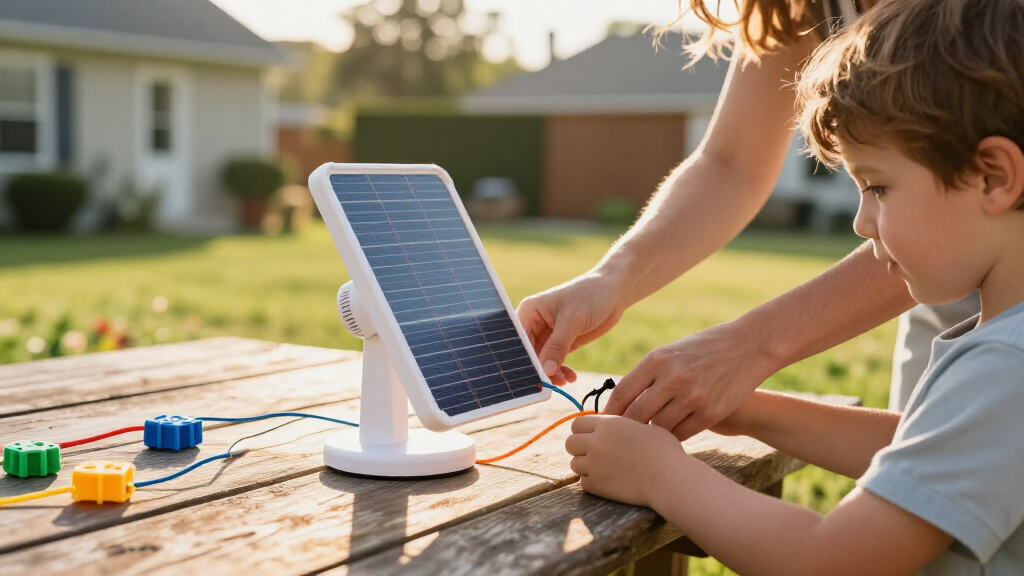
I compared the 13 kits by what children actually get to learn and do: whether they build a working solar-powered device, explore several energy sources, or study planetary motion and astronomy. I also considered the clarity of the activity, the number and variety of projects, likely adult support, and whether the kit offers repeat play or mostly a one-time build. Age guidance and the gap between a kit’s apparent complexity and the skills it asks of a child matter because a project that is too difficult can turn into an adult assembly task.
The ranking favors kits with a clear learning purpose, useful variety, and a good match between the activity and its intended user. That puts multi-build and multi-energy options ahead for broad STEM exploration, while focused planetarium kits rank higher for astronomy-specific interests. Multi-packs earn their place for groups, but they do not automatically outrank a more versatile individual kit; the best choice depends on whether the buyer values collaboration, repeated building, or a focused model.
Factors to Consider When Choosing Best Solar Science Kits For Kids
Before choosing, decide what “solar science” means for your child: learning how solar cells power a motor, or learning about the Sun and planets. Those goals call for different kits, and a planetarium model will not demonstrate electricity just because its subject is the solar system. I’d also match the build to the child’s patience, available workspace, and chances to use daylight.
Separate solar energy from solar system astronomy
Product names can blur two distinct kinds of learning. A solar-powered car or fan uses a photovoltaic panel to turn light into electrical energy, while a solar system model teaches about planets, orbits, or the Sun as an astronomical object. Before buying, look for the activity itself rather than relying on words such as “solar” or “STEM.” If your child wants to see a motor run from light, choose a working energy experiment; if they want to learn planet names and movement, choose a model or planetarium. A mismatch can leave a child with a fun project that does not answer the question they hoped to explore.
Check where the kit will be used
Solar-powered models depend on light reaching their panel, so indoor play can be less reliable than outdoor testing or use beside a bright window. Clouds, shade, the angle of the panel, and the strength of indoor lighting can affect how a motor performs. A child who expects a car to race on a living-room floor may be disappointed if the light source is too weak. Consider whether you have a safe outdoor space and whether the activity can be paused and resumed when conditions change. If that setup is unrealistic, a hand-cranked or model-building activity can provide a more dependable way to explore related science.
Match the build to patience and fine-motor skills
A kit with many small parts or several possible builds may provide more challenge, but it can also ask for careful sorting, precise connections, and sustained attention. Younger children often benefit from a simple first success, with an adult nearby to handle fiddly assembly or explain instructions. Older children may prefer a kit that lets them rebuild, compare designs, or work through a more involved mechanism. Treat age labels as a starting point rather than a guarantee; consider the child’s experience with construction toys and science activities. When in doubt, choose a project that allows adult help without taking the building away from the child.
Decide whether the kit is for one child or a group
Multi-pack kits can make it easier for siblings, classmates, or party groups to build at the same time, but several similar projects do not necessarily offer more depth. Check whether the activities encourage different experiments or simply repeat the same assembly. For a shared household, one adaptable kit can invite turn-taking and redesign, while a set of separate models may reduce arguments over whose turn it is. Think about storage as well: several small builds need space for parts and finished projects. A group kit is most useful when the children can work at similar levels or have an adult available to guide the activity.
Look for learning that continues after assembly
A finished model is only the beginning if a child can test, change, or explain how it works. Before choosing, ask what happens after the first build: can the child compare light conditions, alter a design, move gears, or observe a mechanism? Kits with several configurations can support repeat experiments, while a display model may be a better fit for children who enjoy decorating and showing what they made. Neither format is automatically better; the right choice depends on whether the child likes tinkering or prefers a completed project. A short follow-up question—such as what changed when the panel moved into brighter light—can extend even a simple activity.
Set expectations for adult help and materials
Do not assume a kit is fully self-guided just because it is marketed for children. Assembly instructions, small components, and troubleshooting a solar motor can all call for an adult, especially during the first build. Check the listing and package details for any tools or extra materials needed, and set aside a clear workspace before starting. It is also helpful to decide whether an adult can give occasional guidance or needs to sit with the child throughout. Choosing around the support you can provide is often more successful than choosing the most ambitious-sounding build.
Frequently Asked Questions
Do solar-powered science kits work indoors?
Some may run under strong indoor lighting, but many solar panels need brighter light than a typical room provides. Performance can vary with the lamp, distance, panel angle, and the model’s motor, so indoor results are not guaranteed. A sunny outdoor spot or bright window is usually a better place to test a solar car or fan. If the child will mostly build indoors, look for activities that remain useful even when the motor is not running. A kit that also teaches through assembly or other energy experiments can make light limitations less frustrating.
Should I choose a solar-powered build or a solar system model?
Choose a solar-powered build if the child wants to see light produce electricity and make a motor move. Choose a solar system model or planetarium if the main interest is planets, orbits, and astronomy. These are different learning goals, even when both product types use “solar” in the name. For a child who enjoys both, decide which activity they are more likely to finish and return to rather than assuming one kit will teach both topics equally well. The roundup includes picks for each kind of interest.
Are multi-pack solar kits a better choice for siblings?
They can be, particularly when each child can build a separate model at the same time. Sets such as the fan, car, and robot-car kits offer repeated activities, which can reduce turn-taking disputes during a group session. The tradeoff is that multiple copies of a similar build may provide less variety than one kit with several different configurations. Consider whether the children enjoy building the same thing side by side or would rather share a more complex project. Adult help and enough workspace also affect how smoothly a group activity goes.
How much adult help should I expect to provide?
That depends on the child’s age, construction experience, and the kit’s assembly demands. Younger builders may need help sorting parts, following steps, or troubleshooting connections, while older children may manage more independently but still benefit from support during a first build. Solar-powered projects can need extra guidance when the motor does not run, since light conditions may be the cause rather than a construction mistake. Plan to stay available rather than assuming the child will complete every stage alone. A good fit lets the child do the building while an adult helps with the parts that cause friction.
Which type of kit is most likely to hold a child’s interest after the first build?
Look for a kit that offers more than one way to build, test, or observe a mechanism. Multi-configuration robot kits and experiments that compare different energy sources offer natural ways to keep asking new questions after assembly. A display-focused planetarium can also hold interest for a child who likes astronomy and enjoys presenting a finished model, though it may offer fewer rebuild opportunities. The child’s preferred kind of play matters more than the number of projects alone. If they enjoy modifying and testing, prioritize adjustable builds; if they enjoy visual projects, a well-matched model may be the better lasting choice.
Conclusion
For most families, I’d start with the Sillbird 12-in-1 Solar Robot Building Kit as the best overall choice because its multiple builds give a child room to keep experimenting. For broad energy lessons, the Delinx Fun Physics Science Experiment Kit is my best premium-style pick in scope, with solar, wind, hand-cranked, and circuit activities. For shared projects, the multi-pack WESAYEE fan kits or Yutin solar cars make stronger value picks when several children need their own build. Beginners who want a clear astronomy activity may prefer the Crayola Solar System Science Kit, while planetarium fans can choose between the 4M and Smartivity models based on whether they prefer a glow-in-the-dark display or a gear-driven mechanism. For a child focused specifically on working solar power, pick a car, fan, or robot kit—and plan to test it in bright light.
Cold & flu season Picks
humidifiers
As an affiliate, we earn on qualifying purchases.