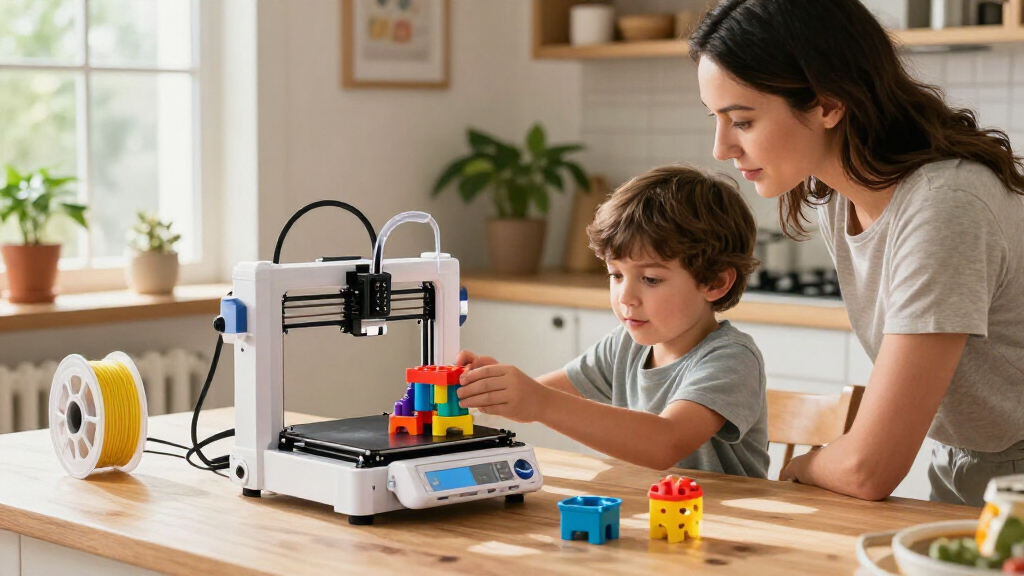
The best 3D printers for kids balance approachable software and dependable printing with adult supervision and sensible safety features. I’d start with the AOSEED AI 3D Printer for its enclosed, child-focused approach; the FLASHFORGE Adventurer 5M CoreXY stands out for families prioritizing speed and room to learn, while the Bambu Lab A1 mini is a compact option for a shared creative space. The main tradeoffs are between guided, enclosed systems and more open-ended printers that can offer greater control but ask more of an adult. Build volume, filament handling, setup, and ongoing supervision also matter as much as the feature list. Read on for the full breakdown and help matching a printer to your child’s age, interests, and your household.

Turn the school run and nap time into listening time
- Thousands of audiobooks, podcasts and originals
- Listen on your phone, tablet or Echo — also offline
- Cancel anytime
Complete the kit


Key Takeaways
- Enclosed, kid-focused models lead on guided use: AOSEED, TKID, Magic Jimmy, and Ugee Funbox are aimed at families seeking a more contained setup, though software and ecosystem fit still deserve scrutiny.
- Speed and learning potential point to different picks: the FLASHFORGE Adventurer 5M CoreXY is the performance-oriented choice, while the Bambu Lab A1 mini offers a smaller footprint for more general creative use.
- Several entries are close variants, not wholly different printer types: the Adventurer 5M appears twice, as do Geeetech M1 and Tina2C-related models, so buyers should compare the exact bundle and included accessories.
- Starter kits can reduce first-day friction: the HEPHI3D Tina2C kit and fully assembled mini kit foreground included supplies or setup, but included filament does not replace checking refill availability and compatibility.
- Kids’ printers still call for adult involvement: enclosures and AI-assisted design may make use more approachable, but supervision, ventilation, hot components, and print removal remain household responsibilities.
| FLASHFORGE Adventurer 5M CoreXY 3D Printer |  | Best for Fast, Larger Projects | Printer type: CoreXY 3D printer | Build volume: 220 × 220 × 220 mm | Maximum travel speed: 600 mm/s | VIEW LATEST PRICE | See Our Full Breakdown |
| AOSEED AI 3D Printer for Kids with Enclosed Design |  | Best for App-Led Creativity | Printing: Single-color | Maximum speed: Up to 400 mm/s | Typical printing speed: 220–250 mm/s | VIEW LATEST PRICE | See Our Full Breakdown |
| TKID Enclosed 3D Printer for Kids and Beginners |  | Best Starter Kit | Model: TCH1.0 | Print speed: 220–250 mm/s; up to 400 mm/s | Print precision: ±0.05 mm | VIEW LATEST PRICE | See Our Full Breakdown |
| Flashforge Adventurer 5M 3D Printer |  | Best for Hands-On Learning | Printer type: CoreXY 3D printer | Build volume: 220 × 220 × 220 mm | Maximum travel speed: 600 mm/s | VIEW LATEST PRICE | See Our Full Breakdown |
| Geeetech M1 Mini 3D Printer with Auto Leveling |  | Best Compact Pick | Print area: 3.94 × 4.33 × 3.94 inches | Maximum printing speed: Up to 250 mm/s | Extruder: Dual-drive direct drive, 1:5 gear ratio | VIEW LATEST PRICE | See Our Full Breakdown |
| Bambu Lab A1 mini 3D Printer with LED Lamp Kit |  | Best for Creative Light Projects | Product type: 3D printer | Included accessory: LED Lamp Kit | Dimensions: 15.21 × 16.77 × 17.94 inches | VIEW LATEST PRICE | See Our Full Breakdown |
| Bambu Lab P1S Combo 3D Printer with AMS |  | Best for Advanced Multi-Color Projects | Printer type: Enclosed CoreXY 3D printer | Included system: AMS | Multi-color printing: Up to 16 colors; AMS required | VIEW LATEST PRICE | See Our Full Breakdown |
| Tkid AI 3D Printer for Kids |  | Best for App- and Voice-Controlled Printing | Model: Tkid01 | Dimensions: 11.42 × 10.43 × 12.2 inches | Weight: 12.47 pounds | VIEW LATEST PRICE | See Our Full Breakdown |
| Entina Tina2C Mini 3D Printer |  | Best Compact Starter Printer | Printer type: Mini 3D printer | Assembly: Fully assembled | Build volume: 3.9 × 3.9 × 3.9 inches | VIEW LATEST PRICE | See Our Full Breakdown |
| Magic Jimmy Spark AI Enclosed 3D Printer for Kids |  | Best for Ready-to-Print AI Projects | Printer type: Single-filament 3D printer | Filament: PLA only | Print colors: One color at a time | VIEW LATEST PRICE | See Our Full Breakdown |
| Ugee Funbox Enclosed 3D Printer for Kids |  | Best for Guided, App-Led Creativity | Recommended age: 8 years and up | Print speed: 220–300 mm/s; up to 500 mm/s | Print precision: 0.05 mm | VIEW LATEST PRICE | See Our Full Breakdown |
| AOSEED X-MAKER JOY AI 3D Printer for Kids |  | Best Starter Bundle | Printer type: Enclosed 3D printer | Maximum printing speed: 400 mm/s | Typical printing speed: 220–250 mm/s | VIEW LATEST PRICE | See Our Full Breakdown |
| HEPHI3D TINA2C Mini 3D Printer with 4-Color PLA Filament Starter Kit |  | Best for Growing Into Design Software | Printer type: FDM | Dimensions: 8.27 × 6.7 × 9.84 inches | Item weight: 8.25 pounds | VIEW LATEST PRICE | See Our Full Breakdown |
| Fully Assembled Mini 3D Printer Starter Kit for Kids and Beginners |  | Best for Simple, Button-Led Setup | Maximum print speed: 250 mm/s | Stated precision: 0.01 mm | Bed: PEI heated bed | VIEW LATEST PRICE | See Our Full Breakdown |
| Geeetech M1 Mini 3D Printer for Kids and Beginners |  | Best Mini Pick for Material Experimentation | Print speed: Up to 250 mm/s | Print area: 3.94 × 4.33 × 3.94 inches | Extruder: Dual-drive metal gear direct drive, 1:5 gear ratio | VIEW LATEST PRICE | See Our Full Breakdown |
| 3D printers for kid | Dimensions |
|---|---|
| FLASHFORGE Adventurer 5M CoreX | 15.83 × 14.29 × 17.64 inches |
| AOSEED AI 3D Printer for Kids | 11.42 × 10.63 × 12.2 inches |
| TKID Enclosed 3D Printer for K | 11.42 × 10.43 × 12.2 inches |
| Flashforge Adventurer 5M 3D Pr | — |
| Geeetech M1 Mini 3D Printer wi | — |
| Bambu Lab A1 mini 3D Printer w | 15.21 × 16.77 × 17.94 inches |
| Bambu Lab P1S Combo 3D Printer | — |
| Tkid AI 3D Printer for Kids | 11.42 × 10.43 × 12.2 inches |
| Entina Tina2C Mini 3D Printer | — |
| Magic Jimmy Spark AI Enclosed | — |
| Ugee Funbox Enclosed 3D Printe | — |
| AOSEED X-MAKER JOY AI 3D Print | 11.42 × 10.63 × 12.2 inches |
| HEPHI3D TINA2C Mini 3D Printer | 8.27 × 6.7 × 9.84 inches |
| Fully Assembled Mini 3D Printe | 10.63 × 10.12 × 15.94 inches |
| Geeetech M1 Mini 3D Printer fo | — |
More Details on Our Top Picks
FLASHFORGE Adventurer 5M CoreXY 3D Printer
For families with an older child ready to move beyond app-led starter printing, the Adventurer 5M offers more room and speed than the compact, enclosed Geeetech M1 Mini. Its 220 × 220 × 220 mm build volume accommodates larger school projects, while automatic bed leveling removes a common setup hurdle. The CoreXY system can travel up to 600 mm/s, but that headline speed is not a promise that every kid-friendly model will finish at that rate; material and print settings still matter. Quick nozzle changes and a dual-sided PEI plate make routine adjustments and model removal easier. The tradeoff is a less child-focused package than the AOSEED AI printer: this model is not described as enclosed or as offering an AI model library, so adult guidance and a suitable printing area matter.
Pros:- Automatic bed leveling reduces first-layer setup work.
- 220 × 220 × 220 mm build volume fits projects too large for the Geeetech M1 Mini.
- Quick nozzle changes and a dual-sided PEI platform simplify maintenance and part removal.
- Flash Studio app supports remote monitoring and status alerts.
Cons:- The description does not specify an enclosed design, so it is less suited to unsupervised young children.
- The 280°C extruder limit restricts use with some higher-temperature materials.
- The maximum travel speed depends on suitable materials and print settings.
Best for: Families with an older, hands-on child who wants to print larger projects and learn more about printer setup and settings.
Not ideal for: Parents seeking an enclosed, app-first printer with built-in kid-focused design tools and less access to moving parts.
- Printer type:CoreXY 3D printer
- Build volume:220 × 220 × 220 mm
- Maximum travel speed:600 mm/s
- Acceleration:20,000 mm/s²
- Maximum extruder temperature:280°C
- Bed leveling:Automatic
- Platform:Dual-sided PEI
- Dimensions:15.83 × 14.29 × 17.64 inches
- Weight:22 pounds
Our verdict“Choose this Flashforge for a supervised young maker who values project size and speed more than an enclosed, kid-oriented interface.”
AOSEED AI 3D Printer for Kids with Enclosed Design
The AOSEED is the clearest fit here for a child who wants to create designs as well as print them. Its enclosed, pinch-resistant design and one-tap app workflow make it more purpose-built for kids than the open-style FLASHFORGE Adventurer 5M. The app adds a library of more than 20,000 models and AI tools for generating designs from voice, text, or image prompts, giving a beginner a low-friction path from idea to object. A built-in camera helps parents check progress, and the included PLA and tools get a first project started. The main limit is single-color printing; multicolor work requires separately printed and assembled parts rather than one integrated print. Families who want to teach hands-on printer adjustments may also find the guided app experience less flexible than a more workshop-oriented machine.
Pros:- Enclosed, pinch-resistant design better suits a kid-focused setup than the open Adventurer 5M.
- AI prompts and a large model library make it easier for beginners to move from ideas to prints.
- Built-in camera supports live monitoring and time-lapse videos.
- PLA filament, tools, and stickers are included for getting started.
Cons:- Single-color printing limits designs that need multiple colors in one print.
- Multicolor effects require separate parts to be printed and assembled.
- The app-centered workflow offers less direct printer control than a more hands-on machine.
Best for: Parents introducing a child to 3D printing who want guided app creation, an enclosed printer, and included starter supplies.
Not ideal for: Families whose main goal is integrated multicolor printing or teaching a child to tune a more open, hands-on printer.
- Printing:Single-color
- Maximum speed:Up to 400 mm/s
- Typical printing speed:220–250 mm/s
- Precision:Up to 0.05 mm
- Model library:20,000+ models
- Connectivity:Wi-Fi
- Compatible platforms:iOS, Android, Windows
- Dimensions:11.42 × 10.63 × 12.2 inches
- Weight:8.82 pounds
Our verdict“Pick the AOSEED for a young beginner who values guided creative tools and an enclosed design over integrated multicolor printing.”
TKID Enclosed 3D Printer for Kids and Beginners
The TKID stands out for families who want guided startup plus more included filament than the AOSEED AI printer. Its leveling-free setup and app-guided filament loading reduce the tasks a beginner has to learn before printing, while the library of more than 20,000 models and AI creation tools offer a ready-made route into design. The live camera and remote pause or cancel controls give parents a way to check on a print without standing beside the machine. Two PLA spools and sticker themes add practical starter value. Compared with the AOSEED, the feature set is similarly app-led, but the TKID listing does not specify a build volume, making it harder to judge whether a particular project will fit. It is also limited to the included two spools unless the family supplies more filament.
Pros:- Leveling-free setup and app-guided filament loading lower the startup learning curve.
- Access to more than 20,000 models and AI creation tools supports both printing and design.
- Live camera and remote pause or cancel controls help parents supervise prints.
- Includes two PLA spools, more starter filament than the AOSEED package lists.
Cons:- The product data does not state a build volume, so project-size planning is difficult.
- The included filament is limited to two PLA spools.
- App-led operation may be less appealing to families seeking manual printer-tuning experience.
Best for: Families buying a first printer for a child who wants guided setup, a ready-to-print model library, and multiple starter PLA spools.
Not ideal for: Parents who need a clearly stated build volume before choosing projects or want a printer with broadly documented material and hardware options.
- Model:TCH1.0
- Print speed:220–250 mm/s; up to 400 mm/s
- Print precision:±0.05 mm
- Model library:More than 20,000 ready-to-print models
- Setup:Leveling-free; app-guided filament loading
- App features:Live camera, remote pause and cancel
- Design:Enclosed
- Included accessories:2 PLA spools; 3 sticker themes
- Dimensions:11.42 × 10.43 × 12.2 inches
Our verdict“Choose the TKID for a beginner who benefits from guided setup and extra starter filament, provided the unstated build volume is not a dealbreaker.”
Flashforge Adventurer 5M 3D Printer
This Adventurer 5M is a better match for a family that wants a capable machine to learn on than for a child who needs a guided, enclosed starter printer. Like the other Adventurer 5M in this roundup, it pairs a 220 mm cube build volume with automatic leveling and fast CoreXY motion, so it can handle larger projects than the Geeetech M1 Mini. Its broad stated material compatibility and four nozzle diameters give an older student room to explore different print goals. That flexibility comes with more to manage: the product lists many materials, but the 280°C temperature ceiling still applies, and maximum speed and flow depend on suitable settings. Remote control is available through the Flash Maker app, but video monitoring requires a separate camera kit. Compared with the AOSEED, it asks more of the user and offers fewer kid-specific creative aids.
Pros:- Automatic bed leveling eases setup despite the more hands-on feature set.
- 220 × 220 × 220 mm build volume allows larger models than the Geeetech M1 Mini.
- Multiple nozzle diameters support different balances of detail and print speed.
- Broad stated material compatibility offers room to explore beyond basic PLA.
Cons:- The camera kit is required for remote video monitoring.
- The product data does not describe an enclosure, so it is less suited to unsupervised young children.
- High speed and flow claims depend on suitable material and print settings.
Best for: Families with a supervised older child or teen who wants to learn about nozzle choices, materials, and printer settings.
Not ideal for: Parents seeking an enclosed, beginner-focused printer with a built-in camera and app-based design tools.
- Printer type:CoreXY 3D printer
- Build volume:220 × 220 × 220 mm
- Maximum travel speed:600 mm/s
- Maximum acceleration:20,000 mm/s²
- Nozzle flow rate:32 mm³/s
- Maximum extruder temperature:280°C
- Build plate:Dual-sided PEI
- Nozzle diameters:0.25, 0.4, 0.6, and 0.8 mm
- Supported materials:PLA, PETG, ABS, ASA and listed variants
Our verdict“Choose this Adventurer 5M for an older learner who wants room to explore settings and materials, not a turnkey kid-focused experience.”
Geeetech M1 Mini 3D Printer with Auto Leveling
The Geeetech M1 Mini earns its place for families who need a smaller, fully assembled machine rather than the larger capacity of either Flashforge Adventurer 5M. Its 16-point auto leveling and removable magnetic PEI plate cut down on setup and cleanup, while a direct-drive extruder supports both PLA and TPU. That makes it a practical home or school option for small models and basic material exploration. The tradeoff is the compact 3.94 × 4.33 × 3.94-inch print area: children will need to scale down or split many larger designs that fit on the Adventurer models. It also lacks the enclosed design, camera, and app-led AI tools offered by the AOSEED and TKID. The listed spool-holder profile may call for adjustment when using a 1 kg spool.
Pros:- Fully assembled design avoids a lengthy build before the first print.
- 16-point auto leveling simplifies bed setup.
- Direct-drive extruder supports both PLA and TPU.
- Flexible magnetic PEI plate helps with model removal and cleaning.
Cons:- Small print area limits project size compared with either Adventurer 5M.
- The product data does not list an enclosure or remote monitoring features.
- A 1 kg filament spool may require adjustment to the supplied holder profile.
Best for: Families or classrooms with limited space that want a fully assembled starter printer for small PLA or TPU projects.
Not ideal for: Children planning larger models or parents who want an enclosed printer with live monitoring and guided design tools.
- Print area:3.94 × 4.33 × 3.94 inches
- Maximum printing speed:Up to 250 mm/s
- Extruder:Dual-drive direct drive, 1:5 gear ratio
- Auto leveling:16-point full-auto leveling
- Build plate:Heated, flexible, removable magnetic PEI
- Display:2.4-inch color LCD
- Compatible filaments:PLA and TPU
- Assembly:Fully assembled
- Item weight:9.8 pounds
Our verdict“Pick the Geeetech M1 Mini for a space-conscious home or classroom focused on small prints, not larger projects or app-guided kid features.”
Bambu Lab A1 mini 3D Printer with LED Lamp Kit
The A1 mini with LED Lamp Kit is the most project-specific pick here: it pairs a compact printer with parts for turning compatible models into decorative lights. Automatic calibration and app-based print management help reduce setup friction for a family learning the basics, while MakerWorld adds a library of models to try. Compared with the Entina Tina2C, it offers a more distinctive route into functional crafts, while the Tina2C is lighter and explicitly supports TF-card printing. Its tradeoff is that the lamp kit only works with compatible designs, so it is not a universal lighting add-on. The compact format also puts a ceiling on project size, making it a better fit for small gifts and desk decorations than larger builds.
Pros:- Automatic calibration and simple setup support a smoother start for beginners.
- Included LED Lamp Kit enables compatible functional light projects.
- MakerWorld access and Bambu Handy app support model discovery and print management.
- Compact design and a stated noise level of no more than 48 dB suit home use.
Cons:- The lamp kit is limited to compatible lamp models.
- Compact printer dimensions restrict the size of projects.
Best for: Families who want beginner-friendly printing focused on small decorative lamps and creative gifts.
Not ideal for: Children planning larger models or families who want the widest choice of lamp designs without checking compatibility.
- Product type:3D printer
- Included accessory:LED Lamp Kit
- Dimensions:15.21 × 16.77 × 17.94 inches
- Weight:12.1 pounds
- Noise level:≤48 dB
- Model number:PF002-M-EU
Our verdict“Choose the A1 mini if compatible decorative lights are a key part of the project plan; choose the Entina Tina2C for a lighter mini printer with TF-card printing.”
Bambu Lab P1S Combo 3D Printer with AMS
The P1S Combo is the most capable choice in this group for families ready to move beyond simple single-color models: its AMS supports up to 16 colors, and its enclosed CoreXY design supports a broad filament range. Automatic bed leveling and a stated setup time of about 15 minutes make the initial process more approachable than its technical feature set might suggest. Compared with the Tkid AI 3D Printer and Magic Jimmy Spark, which print one color at a time, this model can produce color-rich pieces without assembling separate parts. That capability comes with more complexity: the AMS is required for multi-color printing, and the printer weighs 47.5 pounds. Its speed and material support may be more than a young beginner needs, while carbon- and glass-fiber-reinforced polymers are not recommended.
Pros:- AMS supports multi-color and multi-material printing with up to 16 colors.
- Enclosed CoreXY design supports materials including PLA, PETG, TPU, ABS, and ASA.
- Automatic bed leveling reduces manual setup work.
- Advertised maximum speed of 500 mm/s can shorten print times.
Cons:- Multi-color printing depends on the included AMS system.
- At 47.5 pounds, it is difficult for a child to move or reposition.
- Carbon- and glass-fiber-reinforced polymers are not recommended.
Best for: Older children and families with adult guidance who want to explore multi-color prints and a wider range of materials.
Not ideal for: Young first-time users seeking a lightweight, simple, single-color starter printer or families with limited space.
- Printer type:Enclosed CoreXY 3D printer
- Included system:AMS
- Multi-color printing:Up to 16 colors; AMS required
- Maximum print speed:500 mm/s
- Acceleration:20,000 mm/s²
- Bed leveling:Automatic
- Supported filaments:PLA, PETG, TPU, PVA, PET, ABS, ASA; also PA and PC
- Dimensions and weight:15.31 × 18.03 × 15.31 inches; 47.5 pounds
Our verdict“Pick the P1S Combo for supervised, color-rich projects and broader material exploration, but choose a simpler single-color model for a younger beginner.”
Tkid AI 3D Printer for Kids
The Tkid AI 3D Printer puts child-focused controls at the center of the experience, pairing a pinch-resistant enclosure with a leveling-free platform, Wi-Fi, app controls, and voice control. Its built-in camera and filament runout detection give families useful visibility during a print, while two included PLA rolls and tools make it easier to start without gathering as many extras. Compared with the Magic Jimmy Spark, it adds voice control and includes two filament rolls rather than one, but both are enclosed, single-color options. That single-color limit matters: multicolor designs need separate parts and assembly, unlike the Bambu Lab P1S Combo, which uses an AMS for multi-color printing. App printing also depends on a compatible iOS, Android, or Windows device.
Pros:- Enclosed, pinch-resistant body and leveling-free platform suit a beginner-focused setup.
- App and voice controls provide multiple ways to manage printing.
- Built-in camera and filament runout detection add print-monitoring support.
- Includes two PLA rolls, tools, a magnetic build plate, and DIY stickers.
Cons:- Prints one color at a time; multicolor designs require assembling separate parts.
- App printing requires a compatible iOS, Android, or Windows device.
Best for: Families who want a child-oriented enclosed printer with app and voice controls, a camera, and starter filament included.
Not ideal for: Kids who want prints in several colors at once or households without a compatible phone, tablet, or Windows device for app printing.
- Model:Tkid01
- Dimensions:11.42 × 10.43 × 12.2 inches
- Weight:12.47 pounds
- Print speed:220–250 mm/s; up to 400 mm/s
- Precision:0.05 mm
- Printing:Single-color
- Connectivity and compatible devices:Wi-Fi; iOS, Android, and Windows
- Features:Enclosed pinch-resistant body, leveling-free platform, built-in camera, filament runout detection, voice control
- Included accessories:Two PLA filament rolls, tools, magnetic build plate, DIY stickers
Our verdict“Choose the Tkid for its child-focused controls and bundled starter supplies, but choose the P1S Combo if printing multiple colors in one model matters more.”
Entina Tina2C Mini 3D Printer
The Entina Tina2C is the easiest fit for a crowded desk or a small STEM workspace: it arrives fully assembled, weighs just 5.5 pounds, and has a 3.9-inch cubic build volume suited to small models. Automatic bed leveling and guided setup in the Poloprint Cloud app reduce the amount a beginner has to configure, while TF-card printing gives families an offline alternative to Wi-Fi. That makes it a more flexible compact pick than the Bambu Lab A1 mini for buyers who value low weight and a stated offline workflow; the A1 mini instead adds an LED Lamp Kit for compatible projects. The Tina2C’s main compromise is its tight build area, which rules out larger toys and props. Its Wi-Fi support is also limited to 2.4 GHz networks.
Pros:- Fully assembled with automatic bed leveling and guided app setup.
- Supports both 2.4 GHz Wi-Fi and TF-card printing.
- Flexible magnetic build plate helps with print removal.
- Power-loss recovery can resume interrupted prints.
Cons:- The 3.9-inch cubic build volume limits model size.
- Wi-Fi connectivity is specified for 2.4 GHz networks.
Best for: Families seeking a lightweight, fully assembled printer for small STEM models, desk projects, and offline TF-card printing.
Not ideal for: Children who want to print larger toys or props, or households that rely on Wi-Fi networks outside the 2.4 GHz band.
- Printer type:Mini 3D printer
- Assembly:Fully assembled
- Build volume:3.9 × 3.9 × 3.9 inches
- Product dimensions:6.5 × 8 × 10 inches
- Item weight:5.5 pounds
- Connectivity:2.4 GHz Wi-Fi and TF card
- Leveling and recovery:Automatic bed leveling; power-loss recovery
- Build plate:Flexible magnetic
- App and software:Poloprint Cloud; Cura and Simplify3D compatibility
Our verdict“Choose the Tina2C for a lightweight, small-project starter with offline printing; choose the A1 mini if compatible lamp projects are the bigger draw.”
Magic Jimmy Spark AI Enclosed 3D Printer for Kids
The Magic Jimmy Spark is aimed at families who want an enclosed printer with model discovery and design tools built into an app workflow. It arrives fully assembled, includes a spool of white PLA, and has a magnetic build plate that can make finished prints easier to remove. Its AI-powered design tools, access to a library of more than 12,000 models, and time-lapse camera give kids several ways to explore projects beyond importing an STL file. Compared with the Tkid AI 3D Printer, the Spark emphasizes AI design tools and time-lapse recording, while Tkid adds voice control and includes two PLA rolls. Both print one color at a time. The Spark is also restricted to PLA, so it is less adaptable than the Bambu Lab P1S Combo for families interested in other materials.
Pros:- Fully assembled design avoids a lengthy initial build.
- Enclosed body and cool-touch exterior help keep hot components and moving parts away from children.
- App offers model browsing, STL imports, and AI-powered design tools.
- Built-in camera records print time-lapses; magnetic plate supports print removal.
Cons:- Prints one color at a time, so multicolor designs need separate parts or manual coloring.
- Supports PLA only, limiting material choices.
Best for: Families who want a fully assembled, enclosed starter with app-based model browsing, AI design tools, and time-lapse recording.
Not ideal for: Kids who want multi-color prints or families hoping to experiment with filaments beyond PLA.
- Printer type:Single-filament 3D printer
- Filament:PLA only
- Print colors:One color at a time
- Maximum print speed:400 mm/s
- Connectivity:Wi-Fi
- Assembly:Fully assembled
- Camera and build plate:Built-in time-lapse camera; magnetic build plate
- Dimensions and weight:13.7 × 13.15 × 15.47 inches; 8.8 pounds
- Included filament and model library:One spool of white PLA; 12,000+ models
Our verdict“Choose the Spark for an enclosed, app-led PLA starter with AI design tools; choose the P1S Combo for multi-color printing and a broader filament range.”
Ugee Funbox Enclosed 3D Printer for Kids
The Ugee Funbox is the strongest fit here for families who want a guided first printer rather than a machine that asks kids to figure out every step. It arrives assembled and pre-calibrated, while the UFun App pairs printable projects with AI tools that turn text, photos, drawings, or voice into model ideas. That gives it a more creative, structured entry point than the HEPHI3D TINA2C, whose app library is extensive but whose product details emphasize custom-design workflows. The enclosure, cool-touch exterior, anti-pinch door, and stated HEPA-and-carbon filtration also make the Funbox a more safety-focused choice for shared family spaces. Its tradeoffs are reliance on Wi-Fi and the app for the described workflow, plus no stated build volume, so I can’t tell how large its projects can be.
Pros:- Arrives assembled and pre-calibrated, reducing setup work for a first-time family.
- Enclosure includes an anti-pinch door and cool-touch exterior.
- HEPA and activated carbon filters are stated to capture up to 99.5% of ultrafine particles.
- App combines guided projects, model browsing, and AI-assisted creation.
Cons:- The described design-and-print workflow depends on Wi-Fi and the UFun App.
- The supplied product details do not state the build volume.
Best for: Families with children eight and older who want guided app projects, AI-assisted model creation, and an enclosed printer for a shared home space.
Not ideal for: Buyers who want offline printing, prefer desktop design software, or need a clearly specified build volume before choosing a printer.
- Recommended age:8 years and up
- Print speed:220–300 mm/s; up to 500 mm/s
- Print precision:0.05 mm
- Connectivity:Wi-Fi 6
- Filter system:H12 HEPA and activated carbon filters
- Build plate:Magnetic, tool-free removal
- Camera:Built-in HD camera
- App compatibility:iOS, Android, and Windows
Our verdict“Choose the Ugee Funbox for an enclosed, guided first printer with AI creativity tools, but skip it if offline workflows or a stated project size are priorities.”
AOSEED X-MAKER JOY AI 3D Printer for Kids
The AOSEED X-MAKER JOY AI+ makes the most sense for a child who is ready to start printing quickly, with a substantial starter bundle and app-based guidance. Its eight PLA rolls, built-in camera, filament runout detection, leveling-free platform, and one-tap app printing reduce several early hurdles. Compared with the Ugee Funbox, it includes more filament rolls, while the Funbox lists Wi-Fi 6 and specific HEPA and carbon filtration; the AOSEED details specify Wi-Fi but not a filter system. Its 20,000-plus design library and AI tools offer plenty to explore, although the printer is single-color. Kids who want multicolor objects must print separate pieces and assemble them, so this is better for simple projects and creative tinkering than ready-made multicolor output.
Pros:- Includes eight PLA filament rolls, tools, and DIY stickers.
- AI tools, voice control, and one-tap app printing support beginner workflows.
- Built-in camera enables progress monitoring and time-lapse videos.
- Filament runout detection and a leveling-free platform reduce common interruptions.
Cons:- Prints in a single color; multicolor designs require separate prints and assembly.
- Product details specify Wi-Fi but do not list a filter system.
Best for: Families seeking an enclosed, app-driven first printer with plenty of starter PLA and a large ready-to-print design library.
Not ideal for: Kids who want multicolor models printed in one job, or households looking for specified filtration features.
- Printer type:Enclosed 3D printer
- Maximum printing speed:400 mm/s
- Typical printing speed:220–250 mm/s
- Precision:0.05 mm
- Color printing:Single color
- Connectivity:Wi-Fi
- Dimensions:11.42 × 10.63 × 12.2 inches
- Included:Eight PLA filament rolls, tools, and DIY stickers
Our verdict“Pick the AOSEED X-MAKER JOY AI+ for an app-led start with generous filament included, not for one-piece multicolor printing.”
HEPHI3D TINA2C Mini 3D Printer with 4-Color PLA Filament Starter Kit
The HEPHI3D TINA2C is a compact choice for a child who may move from browsing models to making their own. It comes fully assembled with factory-preset auto leveling, but its clearest distinction from the Ugee Funbox is flexibility: families can start with the app library of more than 3,500 models, then use Wiibuilder or Cura and connect by Wi-Fi, USB-C, or TF card. The included four-color PLA gives kids material to begin with, though the product details do not claim multicolor printing in a single job. Its small footprint suits a desk or shelf, but that compact size can constrain project scale. I also can’t compare speed or maximum build volume from the supplied specifications, since neither is stated.
Pros:- Fully assembled with factory-preset auto leveling for a simpler first setup.
- Offers an app library of more than 3,500 models.
- Supports custom workflows with Wiibuilder or Cura and Wi-Fi, USB-C, or TF card.
- Includes four colors of PLA, a magnetic build plate, tools, and pause-and-resume printing.
Cons:- Compact dimensions may limit the size of printable projects.
- The supplied details do not specify maximum build volume or print speed.
Best for: Families with limited desk space whose child wants an easy start now and access to desktop design software and several file-transfer methods later.
Not ideal for: Buyers who need a known build volume or print speed, or children whose main goal is printing larger models.
- Printer type:FDM
- Dimensions:8.27 × 6.7 × 9.84 inches
- Item weight:8.25 pounds
- Assembly:Fully assembled
- Leveling:Factory-preset auto leveling
- Connectivity:Wi-Fi, USB-C, and TF card
- Model library:More than 3,500 models
- Included accessories:Four-color PLA filament, tools, magnetic build plate, and TF card
Our verdict“Choose the TINA2C for a small printer that can grow with a child’s software skills, but not when project size or speed must be clear up front.”
Fully Assembled Mini 3D Printer Starter Kit for Kids and Beginners
This fully assembled mini printer keeps the first steps straightforward: one-button auto-leveling, one-touch filament loading, and automatic nozzle cleaning reduce the number of procedures a new user has to learn. Its stated 250 mm/s maximum speed and PEI heated bed add practical capability, while the included test PLA and SD/TF card help a family get started. Compared with the Geeetech M1 Mini, it also offers a heated bed and similarly beginner-focused setup, but the Geeetech lists a defined print area, 16-point leveling, and support for TPU as well as PLA. This model’s stated 0.01 mm precision is a listed specification, not a guarantee of overall print results. A practical limitation: using 1 kg filament spools requires printing a separate holder.
Pros:- Fully assembled and designed for beginner setup.
- One-button auto-leveling and one-touch filament loading simplify routine steps.
- PEI heated bed supports model removal.
- Includes test PLA, an SD/TF card, and accessories.
Cons:- A separate holder must be printed to use 1 kg filament spools.
- The supplied product details do not specify a maximum build volume or supported materials.
Best for: First-time families who want a ready-to-use printer with automatic setup and filament-loading steps rather than a printer built around manual controls.
Not ideal for: Buyers who need a stated build volume, want flexible-material support, or plan to use 1 kg spools without printing an accessory.
- Maximum print speed:250 mm/s
- Stated precision:0.01 mm
- Bed:PEI heated bed
- Setup:Fully assembled
- Included:Test roll of PLA filament, SD/TF card, and accessories
- Dimensions:10.63 × 10.12 × 15.94 inches
- Item weight:6.61 pounds
- Support:30-day return/replacement policy, 12-month free repair service, and lifetime technical support
Our verdict“Pick this mini printer for button-led setup and included starter supplies, but look elsewhere if you need a stated project size or broad material support.”
Geeetech M1 Mini 3D Printer for Kids and Beginners
The Geeetech M1 Mini stands out among these compact printers for a child who wants to try more than standard PLA. Its direct-drive extruder supports TPU and PLA, giving families a route to flexible-material projects that the supplied details for the HEPHI3D TINA2C do not specify. Auto-leveling, a heated flexible magnetic plate, one-button filament loading, and knob controls keep the core routine approachable, while the 2.4-inch color LCD gives the child a direct way to operate it. The tradeoff is a clearly small print area of 3.94 × 4.33 × 3.94 inches, which rules out larger projects. It also prints from a TF card rather than listing Wi-Fi or app control, so families wanting guided, connected workflows may prefer the Ugee Funbox.
Pros:- Direct-drive extruder supports both PLA and TPU.
- 16-point auto-leveling helps simplify bed setup.
- Heated flexible magnetic build plate aids model removal.
- Knob controls, a color LCD, and one-button filament loading offer direct operation.
Cons:- Small 3.94 × 4.33 × 3.94-inch print area limits model size.
- The listed workflow uses a TF card and does not specify Wi-Fi or app control.
- A filament holder is recommended when using 1 kg spools.
Best for: Families with a beginner who wants a compact, hands-on printer for PLA and TPU experiments and is comfortable using TF-card files.
Not ideal for: Children who want larger models or app-based browsing and printing, and households that need a larger project area.
- Print speed:Up to 250 mm/s
- Print area:3.94 × 4.33 × 3.94 inches
- Extruder:Dual-drive metal gear direct drive, 1:5 gear ratio
- Supported materials:TPU and PLA
- Auto-leveling:16-point full-auto leveling
- Build plate:Heated, flexible magnetic
- Display and controls:2.4-inch color LCD with knob operation
- Connectivity:TF card
Our verdict“Choose the Geeetech M1 Mini for a small, direct-control printer that supports TPU as well as PLA, but skip it if your child needs larger projects or app-led printing.”
How We Picked
I ranked these 15 options around the needs of a child-and-adult team, not headline specifications alone. My criteria include how approachable the setup and software appear, whether an enclosure can add a layer of separation from moving or hot parts, the printer’s likely learning curve, versatility for projects, and practical details such as included accessories and ongoing filament needs. I also distinguish compact, guided printers from faster or more expandable machines, since those strengths serve different families.
The order gives priority to a useful balance of kid-oriented access, adult oversight, and room for repeat projects. Enclosed models designed for children rise when guided operation is the main goal; performance-focused and open-format models rank higher for households ready to take a more active role. Similar product names and bundles are not treated as proof of identical specifications, so I call attention to the exact model and kit rather than assuming accessories or software match across versions.
Factors to Consider When Choosing Best 3D Printers For Kids
Choosing a family 3D printer is less about finding a machine a child can run alone and more about deciding which work adults are willing to share. I’d weigh the household’s space, supervision, software comfort, and project ambitions before choosing a printer class.
Match the printer to the child’s role
Think about whether your child will mainly choose designs and watch prints, or learn to model and troubleshoot them. Guided apps and ready-made projects can help a younger beginner get to a first successful print without learning slicing software immediately. Older children may enjoy direct access to design and print settings, but that also creates more chances for confusing failures. A common mistake is to buy for the child’s age while overlooking the adult’s willingness to manage setup and maintenance. Pick a workflow your family can support repeatedly, not just one that looks simple in a product demo. Adult help remains part of the process even when a printer is marketed for kids.
Treat an enclosure as one safety layer, not a babysitter
An enclosed design can put a barrier between curious hands and moving parts or a hot nozzle, which may suit shared family spaces. It does not make a printer safe to operate without supervision: the print head and bed heat up, and the machine still has moving components. Consider where the printer will sit, who can reach it, and whether the maker gives clear guidance on ventilation and operation. Avoid placing it where it can be knocked, covered, or used as a toy. Check whether the enclosure is built into the printer or is a separate add-on, since that affects setup and footprint. The right safety plan includes an adult handling hot parts and failed prints.
Choose a workflow before choosing a feature list
Some family printers emphasize app-based design libraries and guided printing, while others expect users to work more directly with files and slicer settings. Neither approach is automatically better: a guided system can reduce early friction, while a more open workflow can support experimentation and skill-building. Ask whether the software works on the devices your household already uses and whether children can find age-appropriate projects within it. Check how designs reach the printer, what account or network setup is required, and whether the printer can still be useful if a preferred app changes. A common buying error is focusing on an AI label without checking what the feature actually does. Favor clear workflows over novelty claims.
Size the build area around real projects
A compact printer takes up less desk space and can be a sensible way to try the hobby, but it limits the size of one-piece objects. Larger capacity can help with models, organizers, or school projects, though it can also encourage longer prints that need more time and oversight. Before paying for a bigger machine, list the projects your child is likely to make and check their dimensions. Many designs can be split into smaller parts, but that adds assembly work and can frustrate a new user. Desk stability and safe clearance around the printer matter as much as the stated build volume. A smaller machine is often the better fit when space is shared.
Look beyond the first roll of filament
Starter bundles can make the first project easier, but the included filament is only a beginning. Verify the recommended material, spool format, and whether replacements are easy to source before settling on a model. Different materials can call for different print conditions, so a child’s first experiences are usually simpler when the household sticks with the maker’s recommended beginner filament. Multi-color capabilities may add creative choices, but they can also add setup steps, material handling, or waste. Do not assume a kit’s accessories are included with every version of a similarly named printer. Compare the exact bundle and plan for replenishment rather than treating a starter pack as a long-term supply.
Pay for capability your family will use
Faster printing, extra automation, or multi-color options can be useful when a household has clear plans for them. Those features may add complexity that a first-time user does not need, and a more capable printer still requires someone to prepare files and handle problems. If your child is just exploring, a straightforward compact machine may leave more room in the budget for filament and project materials. Families with an older, committed maker may value faster iteration or more advanced control because those features support frequent experimentation. Check what maintenance the machine calls for and whether replacement parts or help are accessible. The best upgrade is the one that removes a recurring frustration, not the one with the longest feature list.
Frequently Asked Questions
Can a child use a 3D printer without an adult?
I would not plan on unsupervised use, even with an enclosed, child-focused model. A printer has hot components and moving parts, and an adult may need to prepare a file, address a failed print, or remove a finished object safely. The child can still take an active role by choosing designs, starting an approved job, and observing the process under supervision. Set household rules about who can open the printer and handle prints. The right level of help depends on the child’s maturity and the specific machine.
Should I choose an enclosed printer or an open-frame model for a first family printer?
An enclosure is a useful barrier in a home where children may approach the machine, but it does not remove the need for adult oversight. Open-frame models can be attractive when an adult wants direct access and a more hands-on learning setup. Think about where the printer will live and whether the space can be kept clear of curious hands. Also check the manufacturer’s safety and ventilation instructions rather than treating the enclosure as a complete safety solution. For many families, the better choice is the one that fits both the room and the adults’ supervision habits.
Is an AI design feature necessary for a child’s first 3D printer?
No. AI-assisted features may make it easier to create or find designs, but a child can start with ready-made models and learn the printing process first. Before choosing a printer for AI tools, check whether the feature is genuinely available in the included software, how it works, and whether it needs an account or internet access. Consider whether your child would rather customize existing projects or learn a modeling program. A guided library can be more useful than a flashy feature if it gives the family a reliable path from idea to print. Treat AI as a workflow option, not a substitute for checking usability.
How much build volume does a child actually need?
For early projects, small figures, tokens, and simple classroom objects, a compact build area may be enough. Larger designs can often be printed in pieces and assembled, though that adds design and finishing work. Before choosing a larger printer, compare its usable build space with the projects your child already wants to make. Bigger prints also take longer, so they can mean more waiting and more time for an adult to monitor the job. If the printer will share a desk or bedroom, the machine’s overall footprint may matter more than occasional large prints.
What should I check when two listings use nearly the same printer name?
Compare the full model name and package contents rather than assuming similar names mean identical machines. Bundles may differ in included filament, accessories, software, or other kit components, while a base printer listing may omit items shown in another package. Check the manufacturer’s documentation for the exact version and confirm which materials and replacement parts it supports. This matters in this roundup, where the Adventurer 5M, Geeetech M1, and Tina2C names appear in more than one listing or bundle. If a particular accessory matters to your child’s projects, confirm it is included in the exact version you plan to buy.
Conclusion
For a balanced family starting point, I’d choose the AOSEED AI 3D Printer as best overall, especially when an enclosed, child-focused workflow is the priority. The FLASHFORGE Adventurer 5M CoreXY is my performance-oriented pick for families ready to supervise a faster, more open-ended learning experience, while the Bambu Lab P1S Combo is the premium direction for households seeking a more advanced setup and willing to manage added complexity. For beginners who want a compact machine, compare the Bambu Lab A1 mini with the Geeetech M1 Mini and choose based on the exact bundle and workflow that suits your home. For a kid-focused enclosed alternative, look at the TKID, Magic Jimmy Spark, or Ugee Funbox; for starter supplies, the HEPHI3D Tina2C kit merits a closer look. My final choice would come down to how much adult help your household can offer, where the printer will sit, and whether guided use or room to experiment matters more.