
The best interactive character robots balance engaging responses with controls and features that suit the person using them. I would put the Loona AI Interactive Robot Pet first for buyers seeking voice and gesture interaction with a charging dock, while the WhalesBot Pubbo Air stands out for coding-focused play and the Casio Moflin for an emotional-AI pet experience. Those choices serve very different needs: programmable toys prioritize hands-on activities, while AI companions lean on responsive interaction and may rely more on apps or connected features. Age fit, setup, privacy, durability, and how much interaction happens without a phone are all meaningful tradeoffs. Read on for the full comparison and guidance on which style fits your household.

Turn the school run and nap time into listening time
- Thousands of audiobooks, podcasts and originals
- Listen on your phone, tablet or Echo — also offline
- Cancel anytime
Complete the kit


Key Takeaways
- Loona, Pubbo Air, and Moflin lead in different ways: Loona emphasizes pet-like voice and gesture interaction, Pubbo Air centers on coding, and Moflin focuses on emotional companionship.
- Programming is not the same as AI conversation. Models such as the Ruko 6088 and KingsDragon are better matched to command-based play and user-created sequences than to open-ended companion interaction.
- Screen-based interaction changes the experience. The 7-inch touchscreen robot may suit children who enjoy visual prompts, but buyers should weigh screen time and setup against screen-free choices.
- Many kid-focused robots prioritize active play over lifelike behavior. Dancing, remote control, gesture response, and LED expressions can be engaging, but they do not necessarily provide sustained conversation or emotional interaction.
- Choose by the interaction you want to repeat. Coding challenges, movement and tricks, voice conversation, and responsive pet behavior are distinct uses; a robot with more listed features is not automatically a better fit.
| Ruko 6088 Programmable Robot Toy with Gesture, Remote, and App Control |  | Best for Programmable Play | Recommended age: 3–6 years | Control methods: Remote, app, gravity-sensitive, and infrared gesture sensing | Programmable content: Up to 200 app icons; 50-function program button on remote | VIEW LATEST PRICE | See Our Full Breakdown |
| EMOPET EMO AI Desk Robot Companion with Voice Commands, ChatGPT Connectivity, and Dancing |  | Best for Connected Conversation | Recommended age: 15 years and up | Connectivity: Network connection and EMO app | Conversation feature: ChatGPT-powered conversations | VIEW LATEST PRICE | See Our Full Breakdown |
| Ozega Interactive Smart Robot Dog with Remote and App Control |  | Best Interactive Robot Pet | Recommended age: 3 years and up | Control methods: 2.4 GHz remote, app, voice, and touch | Remote range: Up to 100 feet | VIEW LATEST PRICE | See Our Full Breakdown |
| Contixo R1 Kids Robot Toy – Blue Interactive Smart Robot with Voice Control, Dancing and Learning Features |  | Best for Simple, Screen-Free Interaction | Age range: 3 years and up | Control: Voice commands and touch sensors | Functions: Walking, singing, and dancing | VIEW LATEST PRICE | See Our Full Breakdown |
| AI Robot Toy for Kids with Voice Interaction and 7″ Touchscreen |  | Best for Screen-Based Learning | Screen: 7 inches; 1024 × 600 HD | RAM: 1 GB | Internal storage: 16 GB | VIEW LATEST PRICE | See Our Full Breakdown |
| WhalesBot Pubbo Air Interactive Coding Robot for Kids |  | Best for Creative Coding | Brand and model: WhalesBot Pubbo Air | Recommended age: 6 years and up in item details; product copy also mentions ages 5–12 | Controls: Touch, voice, app, and remote | VIEW LATEST PRICE | See Our Full Breakdown |
| AI-Powered Desktop Robot with Multi-Model Support, 7-Color Light Show, Bilingual Chat and Daily Assistant |  | Best for Bilingual AI Conversation | Connectivity: Wi-Fi and 2.4 GHz network support | Languages: Chinese and English | Supported models: Doubao, Wenxin Yiyan, DeepSeek, and Tongyi Qianwen | VIEW LATEST PRICE | See Our Full Breakdown |
| Casio Moflin AI Pet Robot Companion with Emotional AI and MofLife App, Silver |  | Best for Gentle Emotional Companionship | Brand and model: Casio PE-M10SR-IJ | Character and color: Moflin, Silver | Recommended age: 13 years and up | VIEW LATEST PRICE | See Our Full Breakdown |
| emotoBOT COR‑A Interactive Robot – Touch and Sound Responsive Toy |  | Best for Offline Character Play | Brand and model: Just Play emotoBOT COR-A (Pink), model 81687 | Recommended age: 6 years and up | Height: 6 inches | VIEW LATEST PRICE | See Our Full Breakdown |
| KingsDragon Gesture-Controlled Programmable Robot Toy |  | Best for Programmable Movement | Brand and model: KingsDragon 822 | Recommended age: 6–10 years | Dimensions and weight: 5.91 x 3.54 x 10.24 inches; 1.2 pounds | VIEW LATEST PRICE | See Our Full Breakdown |
| Ruko 1088 Interactive Programmable Robot Toy, Pink, Ages 4–9 |  | Best for Creative Movement Play | Recommended age: 4–9 years | Height: 15.8 inches | Expressions: 10 | VIEW LATEST PRICE | See Our Full Breakdown |
| Hamourd RC Robot Toy with Walkie-Talkie, Gesture Control, Programming, Dance Moves, and LED Eyes |  | Best for Remote-Control Play | Manufacturer-recommended age: 16 years and up | Model: SQN-049 | Robot model name: SQN008 | VIEW LATEST PRICE | See Our Full Breakdown |
| VATOS Smart Talking Voice-Controlled Robot Toy |  | Best for First-Time Robot Owners | Recommended age: 3 years and up | Dimensions: 11.22 × 3.78 × 5.71 inches | Weight: 250 g | VIEW LATEST PRICE | See Our Full Breakdown |
| Loona AI Interactive Robot Pet with Voice and Gesture Control and Charging Dock |  | Best Premium AI Companion | Age range: 6 years and up | AI platforms: Amazon Lex and ChatGPT | Sensors: HD RGB camera and ToF depth sensor | VIEW LATEST PRICE | See Our Full Breakdown |
| Ruko 18011 Interactive Programmable Robot Dog with LED Expressions |  | Best Compact Robot Pet | Age range: 3 years and up | Dimensions: 8.86 × 8.86 × 9.84 inches | Animated expressions: More than 30 | VIEW LATEST PRICE | See Our Full Breakdown |
| interactive character robot | Recommended age |
|---|---|
| Ruko 6088 Programmable Robot T | 3–6 years |
| EMOPET EMO AI Desk Robot Compa | 15 years and up |
| Ozega Interactive Smart Robot | 3 years and up |
| Contixo R1 Kids Robot Toy | — |
| AI Robot Toy for Kids with Voi | — |
| WhalesBot Pubbo Air Interactiv | 6 years and up in item details; product copy also mentions ages 5–12 |
| AI-Powered Desktop Robot with | — |
| Casio Moflin AI Pet Robot Comp | 13 years and up |
| emotoBOT COR‑A Interactive Rob | 6 years and up |
| KingsDragon Gesture-Controlled | 6–10 years |
| Ruko 1088 Interactive Programm | 4–9 years |
| Hamourd RC Robot Toy with Walk | — |
| VATOS Smart Talking Voice-Cont | 3 years and up |
| Loona AI Interactive Robot Pet | — |
| Ruko 18011 Interactive Program | — |
More Details on Our Top Picks
Ruko 6088 Programmable Robot Toy with Gesture, Remote, and App Control
The Ruko 6088 stands out for children who want to direct a robot, not just watch it dance. Its four control methods—remote, app, gravity-sensitive control, and infrared gestures—give young users several ways to make it respond, while programmable routines add room to create and repeat their own sequences. Compared with the Contixo R1, which emphasizes simple voice interaction and recorded messages, the Ruko offers more structured control and app-based learning quizzes. Its listed up to 120 minutes of play also avoids disposable batteries, though that time requires a two-hour charge. The tradeoff is that some learning and programming functions rely on the companion app, so it is less appealing for families seeking a completely app-free toy.
Pros:- Four control methods let children try different ways to direct the robot.
- Programming supports up to 200 app icons and a 50-function remote button.
- Rechargeable battery provides up to 120 minutes of play.
- Nine expressions and nine music options support varied performances.
Cons:- A two-hour charge is required for up to 120 minutes of play.
- Some learning and programming features depend on the companion app.
Best for: Children ages 3–6 who enjoy experimenting with controls, building simple routines, and using an app for learning activities.
Not ideal for: Families who want a fully app-free robot or children who need a toy ready for immediate play without a charging wait.
- Recommended age:3–6 years
- Control methods:Remote, app, gravity-sensitive, and infrared gesture sensing
- Programmable content:Up to 200 app icons; 50-function program button on remote
- Expressions and music:9 expressions; 9 music options
- Charging time:2 hours
- Play time:Up to 120 minutes
- Material:ABS
- Dimensions:3.4 × 4.4 × 10.6 inches
Our verdict“Choose the Ruko 6088 for a young child who wants hands-on programming and varied controls rather than the Contixo R1’s simpler voice-and-touch play.”
EMOPET EMO AI Desk Robot Companion with Voice Commands, ChatGPT Connectivity, and Dancing
EMO is the most conversation-focused choice in this group, aimed at older users who want a desk companion rather than a toy built around movement programming. Its voice interaction and ChatGPT-powered conversations give it a different role from the Ruko 6088, whose appeal is creating actions and routines for younger children. A camera, multiple sensors, touch and gesture responses, app games, and dancing add ways to interact beyond chat. The app can also record shared milestones, giving the experience a continuing companion element. That connected approach comes with real limits: conversation features require a network connection, and the package does not include a charging station. With a recommended age of 15 and up, EMO is also a poor match for buyers looking for a preschool robot.
Pros:- ChatGPT-powered conversations give voice interaction a central role.
- Camera and multiple sensors support responses to users, touch, and gestures.
- Dancing and app-based games add activities beyond conversation.
- The app can record shared milestones.
Cons:- Connected conversation features require network access.
- A charging station is not included.
- Recommended for ages 15 and up, limiting its fit for younger children.
Best for: Teens and adults who want a connected desk companion for voice conversations, app games, and responsive activities.
Not ideal for: Parents shopping for a young child’s first robot, or buyers who need offline conversations or a charging station included.
- Recommended age:15 years and up
- Connectivity:Network connection and EMO app
- Conversation feature:ChatGPT-powered conversations
- Sensors and interaction:Camera, multiple sensors, voice commands, touch, and gestures
- Activities:Dancing and app-based games
- Included components:EMO robot, adapter, skateboard, smart light, and user manual
- Charging station:Not included
Our verdict“Pick EMO for a network-connected desk companion and conversation, not for the programmable, child-focused play offered by the Ruko 6088.”
Ozega Interactive Smart Robot Dog with Remote and App Control
The Ozega gives robot-dog play more depth than a simple voice-and-touch toy: children can issue 13 voice commands, use touch, control it by app or remote, and save up to 50 movement sequences. Its dog form and LED expressions make the interaction feel pet-like, while the up-to-100-foot remote range suits play that involves moving around a room or open area. Compared with the Contixo R1, which is smaller and simpler, Ozega offers more control options and stored routines; compared with the Ruko 6088, its appeal is character-driven dog play rather than a humanoid robot’s music and quiz activities. USB-C charging is convenient, but the available data gives no specific playtime, making it harder to plan sessions.
Pros:- Responds to 13 voice commands as well as touch, app, and remote input.
- Stores up to 50 programmed movement sequences.
- LED face expressions add character to dog-style interaction.
- USB-C charging and anti-slip wheel paws support practical play across surfaces.
Cons:- No specific battery playtime is provided.
- App-based control requires use of a companion app.
Best for: Children age 3 and up who want a robot pet they can command, touch, control remotely, and program with repeatable movements.
Not ideal for: Families who need a stated battery runtime or want a compact humanoid robot with music and learning quizzes.
- Recommended age:3 years and up
- Control methods:2.4 GHz remote, app, voice, and touch
- Remote range:Up to 100 feet
- Voice commands:13
- Programmable sequences:Up to 50
- Charging:USB-C
- Materials:Non-toxic, BPA-free
- Included components:Robot dog, remote control, instruction manual, and USB-C charging cable
Our verdict“Choose Ozega for command-driven robot-dog play and stored movement routines; choose the Ruko 6088 instead for a humanoid character with music and learning activities.”
Contixo R1 Kids Robot Toy – Blue Interactive Smart Robot with Voice Control, Dancing and Learning Features
The Contixo R1 is a straightforward pick for younger children who want a robot that responds without leaning on a companion app or a long list of control modes. It can walk, sing, and dance, react to voice commands and touch, and record and replay a child’s own messages. That recorder gives it a personal touch the Ruko 6088 does not emphasize, while the Ruko offers more extensive programming, app quizzes, and rechargeable play. The R1’s compact, portable build is easy to carry and put away, but its small size also means it is less suited to elaborate movement play than the larger Ruko. It runs on three AAA batteries, which are not included, so families need to supply them before play can begin.
Pros:- Voice commands and touch sensors make interaction accessible to young children.
- Voice recording lets children personalize messages and hear them replayed.
- Compact dimensions make storage and carrying easy.
- Can sing, dance, and walk for varied basic play.
Cons:- Requires three AAA batteries, which are not included.
- Offers less programming depth than the Ruko 6088.
- The listed description does not provide battery runtime.
Best for: Young children ages 3 and up who want an easy-to-carry robot that responds to voice and touch and can replay their recorded messages.
Not ideal for: Families seeking rechargeable power, extensive programming features, or a robot with included batteries.
- Age range:3 years and up
- Control:Voice commands and touch sensors
- Functions:Walking, singing, and dancing
- Voice feature:Records and replays messages
- Dimensions:Approximately 5.12 × 3.94 × 3.39 inches
- Material:Plastic
- Battery type:3 AAA batteries
- Batteries included:No
Our verdict“Choose the Contixo R1 for compact voice-and-touch play with message recording, but pick the Ruko 6088 for rechargeable power and more involved programming.”
AI Robot Toy for Kids with Voice Interaction and 7″ Touchscreen
This robot is closer to a small Android learning device with a character interface than a movement-led robot toy. Its 7-inch touchscreen supports drawing, coloring, educational games, and storytelling, while AI voice chat in over 20 languages gives children another route into activities. Google Play access expands what it can do beyond the built-in experience, a different proposition from the Ruko 6088’s focused movement programming or the Contixo R1’s simple voice-and-touch responses. The listed 4–6 hours of battery life supports use away from an outlet, but the 1 GB of RAM may limit performance with more demanding apps. Families should also note that its broad stated age range spans very different learning needs, so the available app selection will matter to fit.
Pros:- Seven-inch HD touchscreen supports drawing, coloring, games, and storytelling.
- AI voice chat supports more than 20 languages.
- Android and Google Play access allow a broad choice of educational apps.
- Listed battery life is 4–6 hours.
Cons:- The 1 GB of RAM may restrict performance in more demanding apps.
- Screen-based activities make it less focused on movement and physical robot play than the Ruko 6088.
- Wi-Fi is limited to 2.4 GHz.
Best for: Families seeking a touchscreen-based learning companion for drawing, storytelling, educational apps, and multilingual voice interaction.
Not ideal for: Buyers who want a robot focused on physical movement and character responses, or children who need demanding apps to run smoothly.
- Screen:7 inches; 1024 × 600 HD
- RAM:1 GB
- Internal storage:16 GB
- Expandable storage:TF card support
- Battery capacity:4000 mAh
- Battery life:4–6 hours
- Connectivity:Wi-Fi 2.4 GHz and Bluetooth
- Age range:1–12 years
- Warranty:1 year parts
Our verdict“Choose this model when touchscreen learning and multilingual voice chat matter more than the movement-focused play of the Ruko 6088.”
WhalesBot Pubbo Air Interactive Coding Robot for Kids
Pubbo Air earns its place for combining a lively character display with activities that give children something to build and direct. Kids can customize dances, sounds, and emojis, then use the app for coding quests, line following, and maze navigation. Compared with the KingsDragon Gesture-Controlled Programmable Robot, which emphasizes recorded movements and remote play, Pubbo Air puts more of the play into app-based coding and creative customization. Its touch, voice, app, and remote controls also give children several ways to interact as their confidence grows. The tradeoff is that many of its most distinctive activities depend on the Pubbo app, so it is less appealing for families who want screen-free play. Age guidance is also inconsistent: the description says 5–12, while the item details say 6 and up.
Pros:- Touch, voice, app, and remote controls offer flexible ways to interact.
- Children can customize dances, sound effects, and emojis.
- Line following and maze activities introduce hands-on coding concepts.
- Light and sound responses make the robot interactive beyond its screen.
Cons:- Coding quests and creative customization require the Pubbo app.
- The product copy and item details give different minimum-age guidance.
Best for: Families with children around age 6 and up who want a character robot that mixes expressive play with app-guided coding challenges.
Not ideal for: Buyers seeking a fully app-free robot, or caregivers who need one unambiguous age recommendation before choosing.
- Brand and model:WhalesBot Pubbo Air
- Recommended age:6 years and up in item details; product copy also mentions ages 5–12
- Controls:Touch, voice, app, and remote
- Display:Emoji and animation display
- Coding activities:Coding quests, line following, and maze navigation
- Responses:Responds to light and sound
- Battery:Lithium-ion
- Included components:Map, quick start card, remote controller, robot, and user manual
Our verdict“Choose Pubbo Air for app-supported creative coding and varied controls, but skip it if you want the main activities to work without an app.”
AI-Powered Desktop Robot with Multi-Model Support, 7-Color Light Show, Bilingual Chat and Daily Assistant
This desktop robot is the conversation-focused pick in this group: it supports Chinese and English chat, daily information, study guidance, poems, and riddles, with several named language models available. That gives it a different purpose from Casio Moflin, whose appeal is emotional, pet-like response rather than spoken answers. Its seven-color music-synced eyes and rotatable joints add visible character, while custom role definition lets owners shape the conversational persona. The compromises are practical. Full functionality relies on Wi-Fi or a 2.4 GHz network, and the rechargeable battery is specified for up to two hours of use. Compared with the offline emotoBOT COR-A, this model offers more open-ended conversation but is less suitable for unplugged play or a child’s portable toy routine.
Pros:- Supports Chinese and English conversation with multiple named language models.
- Can provide news updates, study guidance, poems, riddles, and health tips.
- Seven-color eye lights synchronize with music.
- Rotatable joints and customizable roles add expressive character.
Cons:- Full functionality requires Wi-Fi or a 2.4 GHz network.
- Battery runtime is limited to up to 120 minutes.
- Its connected assistant format is less suited to screen-free, child-led play than Pubbo Air.
Best for: Bilingual households or desk users who want a connected robot for conversation, study prompts, and expressive light-and-motion effects.
Not ideal for: Families who need offline interaction, longer untethered sessions, or a simple play-focused robot for younger children.
- Connectivity:Wi-Fi and 2.4 GHz network support
- Languages:Chinese and English
- Supported models:Doubao, Wenxin Yiyan, DeepSeek, and Tongyi Qianwen
- Battery:3.7V 500mA rechargeable lithium
- Runtime:Up to 120 minutes
- Charging:Type-C; red indicator and automatic shutoff when full
- Lights:Seven-color eye lights synchronized with music
- Movement:Rotatable joints
Our verdict“Pick this model for connected bilingual conversation and desk companionship, not for offline play or extended battery-powered sessions.”
Casio Moflin AI Pet Robot Companion with Emotional AI and MofLife App, Silver
Moflin is a robot pet rather than a talking assistant: it reacts to touch, speech, light, and movement with soft sounds and small head motions, but does not record or understand spoken words. That makes its interaction quieter and more nurturing than the chat-oriented desktop robot, which is designed to answer prompts and provide information. Its emotional AI develops a distinct personality over about 50 days, and the MofLife app lets an owner follow emotion updates, give it a name, and keep a journal. The included charging bed gives it a natural place to return between sessions. The tradeoff is a relatively short up-to-five-hour play time, plus an app requirement for emotion tracking. Compared with emotoBOT COR-A, Moflin is less about games and jokes and more about gentle, ongoing companionship.
Pros:- Responds to petting, hugs, speech, light, and movement with sounds and head motions.
- Emotional AI develops a distinct personality over about 50 days.
- MofLife app provides emotion updates, naming, and a journal.
- Charging bed and AC adapter are included.
Cons:- Does not record or understand spoken words.
- Play time is up to five hours per charge.
- App compatibility requires iOS 15 or later or Android 8.0 or later.
Best for: Older teens and adults who want a small, quiet-feeling robot pet that responds to touch and builds a changing personality.
Not ideal for: Buyers who expect spoken conversation, frequent active play without recharging, or a robot intended for children under the listed age recommendation.
- Brand and model:Casio PE-M10SR-IJ
- Character and color:Moflin, Silver
- Recommended age:13 years and up
- Sensors:Touch, microphone, light, and motion
- App compatibility:iOS 15 or later; Android 8.0 or later
- Charging time:About 3.5 hours
- Play time:Up to 5 hours
- Dimensions and weight:Approximately 5.1 x 3.5 x 7.1 inches; 9 ounces
- Included components:Charging bed and AC adapter
Our verdict“Choose Moflin for gentle, evolving pet-like interaction, but not if you want a robot that understands and answers conversation.”
emotoBOT COR‑A Interactive Robot – Touch and Sound Responsive Toy
emotoBOT COR-A makes the most sense for families who want a responsive character robot without a network connection or AI setup. Touch and music prompt animated expressions, movement, jokes, and games, with more than 100 play modes described in the product details. Its English, German, and French voice options add variety, while the included pretend phone, drink, and kitty-ear headphones encourage imaginative play away from the robot’s interactions. Compared with the Wi-Fi-dependent AI-Powered Desktop Robot, COR-A gives up open-ended assistant conversation in favor of simpler offline entertainment. It is also more compact than the 10.2-inch KingsDragon, though its 2-inch LED display and single-language-at-a-time operation limit how much it can show or say at once. A USB-C charging cable is not included.
Pros:- Works offline, without Wi-Fi or AI requirements.
- Touch and sound responses support more than 100 play modes.
- Voice options include English, German, and French.
- Rechargeable USB-C battery avoids disposable batteries.
Cons:- USB-C charging cable is not included.
- Only one language can be used at a time.
- The 2-inch LED display is smaller than the screen experience offered by larger interactive robots.
Best for: Caregivers of children age 6 and up who want a small, offline robot with multilingual voices and pretend-play accessories.
Not ideal for: Buyers looking for AI conversation, a larger display, or a robot that can switch languages during the same session.
- Brand and model:Just Play emotoBOT COR-A (Pink), model 81687
- Recommended age:6 years and up
- Height:6 inches
- Display:2-inch LED display
- Languages:English, German, and French
- Power:Rechargeable battery; USB-C cable not included
- Interaction:Touch and sound responsive; more than 100 play modes
- Included accessories:Kitty-ear headphones, pretend drink, and pretend cell phone
Our verdict“Choose COR-A for offline, accessory-rich character play, but look elsewhere for open-ended chat or a larger display.”
KingsDragon Gesture-Controlled Programmable Robot Toy
For children who want to direct a robot’s body rather than build an app-based coding project, KingsDragon is the movement-first choice. It responds to hand gestures or a remote, and can record up to 50 programmed moves alongside singing, dancing, speech, and LED effects. Collision detection helps it respond to obstacles during indoor play, while volume control gives caregivers a way to manage sound. Compared with WhalesBot Pubbo Air, KingsDragon focuses more on physical sequences and less on line-following or maze-based coding quests; that distinction makes it easier to pick based on the kind of play a child prefers. Its 10.2-inch height gives it a more substantial presence than the compact emotoBOT COR-A, but it is indoor-only and still needs charging after roughly 1.5–3 hours of play.
Pros:- Gesture sensing and remote control provide two ways to direct it.
- Records up to 50 programmed moves.
- Combines walking, singing, dancing, speech, and LED lights.
- Collision detection and adjustable volume add useful play controls.
Cons:- Play time is approximately 1.5–3 hours per charge.
- Designed for indoor use only.
- Movement programming is less focused on coding quests than Pubbo Air.
Best for: Children ages 6–10 who enjoy controlling movement, choreographing sequences, and switching between gesture and remote play.
Not ideal for: Families who need an outdoor-capable robot, app-based coding lessons, or long play sessions without recharging.
- Brand and model:KingsDragon 822
- Recommended age:6–10 years
- Dimensions and weight:5.91 x 3.54 x 10.24 inches; 1.2 pounds
- Controls:Hand gestures and remote control
- Programmable moves:Up to 50
- Features:Walking, singing, dancing, speech, LED lights, collision detection, and volume control
- Charging time:Approximately 2 hours by USB
- Play time:Approximately 1.5–3 hours
- Use:Indoor
Our verdict“Pick KingsDragon for gesture-led movement and recorded routines, but choose Pubbo Air instead for app-based coding challenges.”
Ruko 1088 Interactive Programmable Robot Toy, Pink, Ages 4–9
The Ruko 1088 is a strong fit for kids who want a character robot they can direct, not just watch. Its 200 programmable movements, stories, music, dance, and gymnastics give children several ways to make play their own, while remote, app, and voice control offer more variety than the remote-focused Hamourd SQN-049. At 15.8 inches tall, it also has a more substantial presence than the compact Ruko 18011 robot dog. The tradeoff is a fairly long recharge: about 150 minutes for up to 100 minutes of play, so spontaneous repeat sessions may need planning. The age range is clearly listed as 4–9, but this is a feature-rich choice rather than the simplest first robot. Its USB charging cable also has a compatibility limitation: USB-C to USB-C cables are not supported.
Pros:- Up to 200 programmable movements encourage kids to create and repeat their own routines.
- Remote, app, and voice controls provide more ways to interact than a remote-only robot.
- Stories, music, dance, and gymnastics support varied play beyond basic movement.
- Up to 100 minutes of play per charge is longer than the Ruko 18011 robot dog’s stated runtime.
Cons:- A full charge takes about 150 minutes.
- USB-C to USB-C cables are not supported; the included cable is recommended.
- Its many functions may feel complicated for children who want very simple controls.
Best for: Children ages 4–9 who enjoy making up movement routines and want remote, app, and voice control options.
Not ideal for: Families looking for a low-complexity first robot or a quick-charge toy; its many modes may take practice, and charging takes about 150 minutes.
- Recommended age:4–9 years
- Height:15.8 inches
- Expressions:10
- Flexible joints:9
- Programmable movements:200
- Control methods:Remote control, app, and voice command
- Charging time:About 150 minutes
- Play time:Up to 100 minutes
Our verdict“Choose the Ruko 1088 for a child who wants a large, programmable robot with several kinds of play and can wait through its lengthy charge.”
Hamourd RC Robot Toy with Walkie-Talkie, Gesture Control, Programming, Dance Moves, and LED Eyes
The Hamourd SQN-049 puts its emphasis on direct remote play: its tracked base moves forward, backward, left, and right, and the robot adds gesture sensing, programmed motion, music, and dance. The walkie-talkie mode gives it a communication angle that the Ruko 1088 and VATOS R967 do not list, though it takes a specific button sequence to activate. Its flexible head and arms and multi-mode LED eyes add character without making it a camera-based companion like Loona. That simpler control setup may appeal to buyers who want physical movement and clear remote commands, but the age guidance is a real point of caution: the manufacturer lists 16 years and up even though the listing presents it as a children’s toy. I would compare that guidance with the intended user’s needs before choosing it for a young child.
Pros:- Tracked base moves in four directions for direct, remote-controlled play.
- Combines gesture sensing, programmable motion, dancing, and music.
- Walkie-talkie functionality gives it a communication feature not listed for the Ruko 1088.
- Flexible head and arms and multi-mode LED eyes provide visible character cues.
Cons:- The manufacturer-recommended age is 16 years and up, despite child-focused wording in the description.
- Walkie-talkie mode requires a specific sequence of button presses.
- The supplied details do not state battery runtime or charging time.
Best for: Older teens or adults who want a tracked character robot with remote driving, gesture play, and a walkie-talkie feature.
Not ideal for: Parents shopping specifically for a young child’s first robot; the manufacturer-recommended age is 16 years and up, and walkie-talkie activation requires a button sequence.
- Manufacturer-recommended age:16 years and up
- Model:SQN-049
- Robot model name:SQN008
- Control type:2.4 GHz remote control
- Movement:Tracked base; forward, backward, left, and right
- Features:Walkie-talkie, gesture sensing, programmable motion, dancing, music, and multi-mode LED eyes
- Charging cable:USB-C cable included
Our verdict“Pick the Hamourd for older users who value tracked remote movement and walkie-talkie play, not as an unambiguous toy for young children.”
VATOS Smart Talking Voice-Controlled Robot Toy
The VATOS R967 is the most approachable pick here for a young child who wants a robot that reacts in several recognizable ways. It can repeat spoken phrases, respond to gestures, react to chest touches, tell stories, dance, and avoid obstacles, so play does not depend on programming custom routines as it does with the Ruko 1088. Its two movement styles—traditional walking and smooth sliding—also add variety for a small, lightweight robot. Compared with Loona, VATOS offers a simpler interaction package: no listed face recognition, charging dock, or conversational AI, but also fewer setup demands. The main limitation is missing battery information: the listing says USB rechargeable but gives no runtime or charging time, making it hard to plan play sessions. Buyers wanting richer conversation should look at Loona instead.
Pros:- Voice repeat, gesture sensing, and touch responses give young children several simple interaction cues.
- Storytelling, dancing, and obstacle avoidance provide variety without requiring programming.
- Walking and smooth-sliding movement offer two distinct ways for the robot to travel.
- At 250 g, it is lighter than the 1.1 kg Loona robot pet.
Cons:- Battery runtime and charging time are not specified.
- USB recharging means play depends on keeping the robot charged.
- It lacks the face recognition and real-time conversational features listed for Loona.
Best for: Families with children ages 3 and up seeking a small robot that responds to speech, gestures, and touch without requiring custom programming.
Not ideal for: Buyers who want open-ended AI conversation, a charging dock, or clearly stated battery runtime; Loona provides a more advanced companion experience.
- Recommended age:3 years and up
- Dimensions:11.22 × 3.78 × 5.71 inches
- Weight:250 g
- Control features:Remote control and gesture sensing
- Functions:Voice repeat, programmable actions, dancing, storytelling, and obstacle avoidance
- Movement:Traditional walking and smooth sliding
- Expressions:Three electronic eye expressions
- Power:USB rechargeable
Our verdict“Choose VATOS as a lightweight first character robot for simple voice, gesture, and touch interactions, but not for AI conversation or predictable battery planning.”
Loona AI Interactive Robot Pet with Voice and Gesture Control and Charging Dock
Loona is the most companion-like option in this group: its RGB camera and depth sensor let it recognize faces and gestures, follow people, and respond to voice commands with support from Amazon Lex and ChatGPT. Games, object play, and home monitoring broaden its role beyond a robot that performs preset dances. Compared with the VATOS R967, Loona offers a more advanced interaction layer and an included dock it can return to along preset routes; VATOS is lighter and has a simpler feature set. Those capabilities bring practical constraints. The dock needs clear space, sensors work best when clean and in a well-lit room, and voice interaction benefits from quiet surroundings and clear speech. Its approximately 2.5-hour charge also calls for planning, so this is better suited to a prepared play area than casual use anywhere.
Pros:- RGB camera and depth sensor support face and gesture recognition and following behavior.
- Voice interaction with Amazon Lex and ChatGPT offers a more conversational experience than the VATOS R967.
- Games, object play, and home monitoring give it uses beyond movement routines.
- Charging dock and preset return routes reduce the need to plug it in manually after every session.
Cons:- The dock needs an open, unobstructed area.
- Camera and depth-sensor performance depends on clean sensors and good lighting.
- Voice interaction works best with clear speech in a quiet space, and charging takes about 2.5 hours.
Best for: Families with children ages 6 and up who want a sensor-driven robot pet for following, voice interaction, games, and a dedicated docking area.
Not ideal for: Households without open floor space or with dim, noisy play areas; its camera, depth sensor, dock, and voice features work best in suitable surroundings.
- Age range:6 years and up
- AI platforms:Amazon Lex and ChatGPT
- Sensors:HD RGB camera and ToF depth sensor
- Control:Voice and gesture
- Charging:Automatic return to charging dock
- Charging time:Approximately 2.5 hours
- Dimensions:19 × 18 × 18 inches
- Weight:1.1 kg
Our verdict“Choose Loona for a more advanced, interactive robot pet if you have room for its dock and a well-lit, quiet play area.”
Ruko 18011 Interactive Programmable Robot Dog with LED Expressions
The Ruko 18011 swaps a humanoid form for a compact robot dog that walks, spins, dances, wags its tail, and reacts to head touches. More than 30 animated expressions give its LED face a broader range of visible responses than the Ruko 1088’s 10 expressions, while remote and hand-gesture controls let children play without relying on an app. Its obstacle-avoidance sensors add some freedom to move around furniture, and programming up to 50 moves gives kids a way to build simple routines. The main compromise is endurance: it runs for up to 45 minutes after a three-hour charge, far less play time than the Ruko 1088’s stated 100 minutes. The remote also needs two AAA batteries, not included. This is the better pick for dog-like interaction and a smaller footprint, not long sessions.
Pros:- More than 30 animated expressions make its character cues more varied than the Ruko 1088’s 10 expressions.
- Responds to head touches and supports both remote and hand-gesture control.
- Up to 50 programmable moves let children create simple routines.
- Obstacle-avoidance sensors help it move around walls and furniture.
Cons:- Up to 45 minutes of play is shorter than the Ruko 1088’s stated runtime.
- A full charge takes about three hours.
- The remote needs two AAA batteries, which are not included, and USB-C to USB-C charging cables are not supported.
Best for: Children ages 3 and up who prefer a compact robot pet with expressive lights, touch responses, and simple programmed routines.
Not ideal for: Families who want long play sessions between charges or do not want to supply separate remote batteries; its runtime is up to 45 minutes and charging takes three hours.
- Age range:3 years and up
- Dimensions:8.86 × 8.86 × 9.84 inches
- Animated expressions:More than 30
- Programmable moves:Up to 50
- Control:2.4 GHz remote and hand gestures
- Remote range:Up to 98 feet
- Charging time:About 3 hours
- Play time:Up to 45 minutes
Our verdict“Pick the Ruko 18011 for a compact, expressive robot dog, provided its shorter playtime and separate remote batteries fit your routine.”
How We Picked
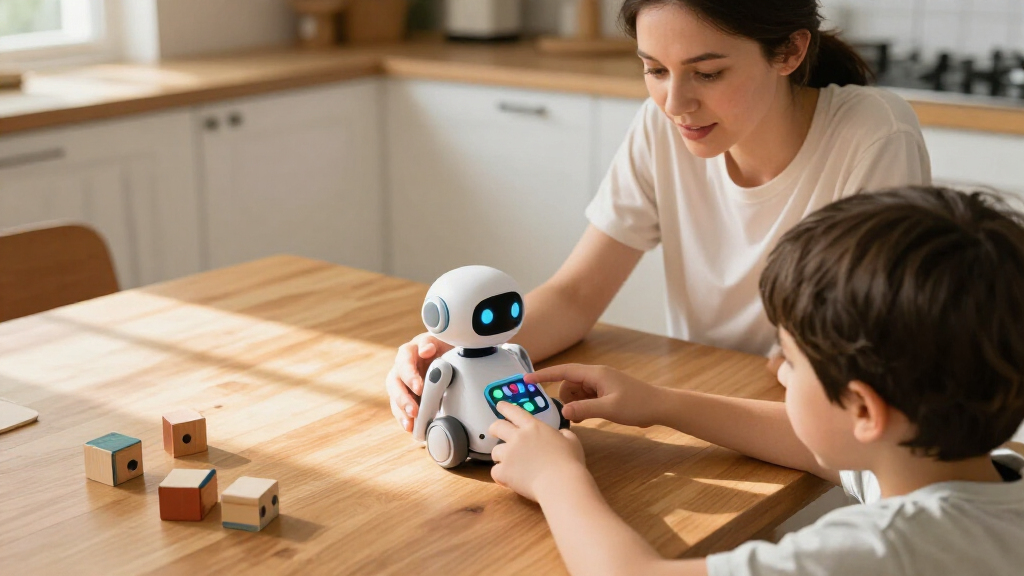
I compared these 15 robots by the kind of interaction they offer, not by feature count alone. The main criteria were how clearly each product supports its intended play style—such as programming, voice commands, gesture control, learning activities, or companion-style responses—and how approachable its controls appear for the intended user. I also considered whether interaction depends on a remote, app, touchscreen, or connected AI feature, since those requirements affect setup and everyday use.
The ranking gives priority to products with a distinct, useful role and a clear match between their interaction style and likely buyer. Companion-oriented picks rank higher for readers seeking responsive character behavior; coding models rise for families who want structured learning and repeatable activities. Lower-ranked options may still suit particular ages or play preferences, but more limited interaction, overlapping functions, or a narrower use case makes them less versatile as general recommendations. Product details can vary by version, so I would check the current manufacturer listing for age guidance, connectivity, and supported features.
Factors to Consider When Choosing Best Interactive Character Robots
Before choosing a character robot, decide what you want the interaction to do for the person using it. The same label can describe a coding toy, a remote-controlled performer, a voice-enabled assistant, or a simulated pet. These broader checks help prevent paying for features that will rarely be used—or expecting a toy to behave like a fully conversational companion.
Match the interaction style to the play goal
Start by deciding whether the robot should teach, entertain, or provide a companion-like presence. A programmable model is a stronger fit for children who enjoy giving instructions and seeing a sequence play out; a dancing or gesture-controlled toy suits short, active play sessions. Companion robots are designed around ongoing responses, which can feel different from a toy that only reacts to a set command. A common mistake is treating these modes as interchangeable because both use the word “interactive.” Ask what the user would choose to do repeatedly after the first few days, then prioritize that activity over the longest feature list.
Check what interaction works without an app or network
App control, connected AI, and voice features can add flexibility, but they may also add setup steps and depend on a compatible device or network. Before buying, check which functions work on the robot itself and which require an app, account, or internet connection. This distinction matters most in homes where a child will use the robot independently or where Wi-Fi access is limited. A remote-controlled model can be easier to operate offline, while a connected companion may offer a broader range of responses when its services are available. Do not assume a robot’s advertised voice interaction means every feature works offline.
Set expectations for AI and character behavior
AI companion language can suggest a conversational depth that varies from product to product. Look for clear information about supported languages, response limits, connectivity, and whether the robot adapts over time or mainly plays preset behaviors. A toy with programmed replies may be predictable and easy for younger users, while an AI-connected robot may offer more varied interaction but bring questions about accounts, data, and service availability. Ask whether the user wants dependable routines or less predictable conversation. The more a purchase depends on AI services, the more useful it is to check how the maker describes ongoing support.
Use age guidance as a starting point, not the whole decision
Age labels can help narrow the field, but a child’s reading, motor, and problem-solving skills also affect whether controls feel manageable. Programming interfaces and app setup may need adult help even when a child is old enough to enjoy the activities. Younger children may get more from clear physical responses, simple commands, or visible movement than from menus and extended setup. Consider who will pair the robot, charge it, and troubleshoot it. A more advanced robot is not a better gift if the person receiving it cannot access its main activities without frequent assistance.
Think about care, space, and play conditions
Moving robots need clear floor space, while desktop companions and screen-based models take up less room but still need a safe place to sit or charge. Check the maker’s care instructions and whether the design includes moving parts, fabric, sensors, or a charging dock that needs a dedicated spot. Homes with pets, small objects on the floor, or crowded play areas may call for a compact or stationary option. Also consider whether loud effects, lights, or repeated movement will suit shared rooms and quiet hours. These practical details shape how often a robot can be used more than a novelty feature does.
Pay for the feature the user will return to
A higher-feature model makes sense when its main capability matches a lasting interest, such as coding challenges or ongoing pet-like interaction. It is less useful to pay extra for connected services, a screen, or multiple control modes if the user mainly wants dancing or simple remote play. Compare the core activity first, then treat secondary features as bonuses rather than proof of better value. Think about whether the robot offers varied activities or repeats a small set of responses; repetition can be welcome for younger users but limiting for older ones. The right choice is the one whose central interaction remains appealing after the initial surprise fades.
Frequently Asked Questions
Which type of interactive robot is best if I want both play and learning?
Look for a robot with a clear learning activity, such as programming, rather than relying on dancing or voice commands alone to provide educational value. The WhalesBot Pubbo Air is the most directly coding-focused option in this lineup, while programmable Ruko and KingsDragon models offer command-based play. Compare how a child enters instructions and whether the activities can grow beyond copying preset moves. If the child mainly wants a character to chat or perform, a learning-oriented robot may feel more like a project than a companion. Choose the activity that matches their existing interests, not just the word “educational.”
Do AI robot companions need Wi-Fi or a phone to work?
Requirements differ by model and feature, so check the product’s current setup details rather than assuming every function works independently. Voice or AI-connected interactions may rely on an app, account, or network, while movement, lights, and preset responses can sometimes work through on-device controls. Ask which functions remain available if the phone is not nearby or the connection is unavailable. This matters if the robot is meant for a child to use alone or in a room with limited connectivity. For any connected model, review the maker’s privacy and account information before setup.
Is a robot pet a good substitute for a real pet?
A robot pet can offer responsive play without the feeding, cleaning, and daily care a real animal needs, but it does not provide the same relationship or responsibilities. Models such as Moflin and Loona are aimed at companion-style interaction, while many other products here behave more like toys that perform commands. Think about whether the goal is a playful character, a low-maintenance companion, or preparation for caring for an animal; those are different expectations. A robot can be a useful choice where allergies, housing rules, or schedules make a live pet impractical. It should not be presented as equivalent to animal companionship.
How can I tell whether a robot will hold a child’s interest?
Focus on repeatable activities and the child’s preferred way to play, not on the number of features listed. A child who likes building sequences may return to programming, while one who enjoys performance may favor dancing, movement, and gesture controls. Check whether the robot offers variety within its main activity and whether controls are simple enough for the child to use without constant adult help. A screen or AI chat can attract attention, but it does not guarantee long-term engagement. If possible, choose a robot whose core activity already resembles something the child enjoys.
What should I check before buying a robot with a touchscreen or connected AI?
Review the age guidance, app or account requirements, supported languages, and which features need a network connection. For a touchscreen model, consider whether the display adds useful interaction or mainly increases screen time compared with a screen-free toy. For an AI-connected model, check how voice data and account information are handled and whether a parent can manage access. Also confirm the charging method and whether the robot can still perform basic activities without the connected features. These checks help set realistic expectations for setup, privacy, and everyday use.
Conclusion
My best overall pick is the Loona AI Interactive Robot Pet for buyers who want voice and gesture interaction in a companion-style design. For best value in learning-focused play, I would start with the WhalesBot Pubbo Air, especially for a child drawn to coding rather than open-ended conversation. The Casio Moflin is my best premium-style companion choice for buyers prioritizing emotional-AI pet behavior, while a simple programmable option such as the Ruko 6088 is a more approachable starting point for command-based play. For specific needs, consider the touchscreen robot for screen-based activities, or a gesture-controlled model for movement and performance play. Choose the robot whose central interaction matches how its user actually likes to play; a narrower fit can be better than a longer list of features.