TL;DR

Turn the school run and nap time into listening time
- Thousands of audiobooks, podcasts and originals
- Listen on your phone, tablet or Echo — also offline
- Cancel anytime
Roughly 90% of brain growth happens before age 5, but research shows simple, open-ended toys like blocks, puzzles, and pretend-play sets beat most flashy electronic ‘learning’ toys because they spark more conversation and child-led problem-solving. Match toys to your child’s developmental stage, check safety recalls, and remember: the best learning happens when the child leads the play, not the toy.
Your preschooler just spent forty minutes turning a cardboard box into a rocket ship, a turtle shell, and a drive-through bank. Meanwhile, the $60 electronic tablet that promises to teach Spanish sits untouched in the toy bin. Sound familiar?
Here’s the good news: you don’t need to outspend other parents to raise a sharp, curious kid. You need to out-think the marketing. Educational toys for preschoolers are a multi-billion-dollar industry, and the label ‘educational’ is slapped on everything from genuinely brilliant building sets to plastic noisemakers with an alphabet sticker.
In this guide, you’ll learn what actually makes a toy educational, which categories build which skills, the best picks for ages 3, 4, and 5, and how to check any toy for safety before it lands in your living room.
Simple, open-ended toys (blocks, puzzles, pretend-play sets) produce more parent-child conversation and better developmental outcomes than most electronic ‘lea…
Match the toy to your child’s exact age and stage — age 3 for fine motor and repetition, age 4 for sequencing and turn-taking, age 5 for multi-step games and k…
Before buying any child product, search the CPSC recall database at SaferProducts.gov and do the toilet-paper-tube test for choking hazards.
Build a balanced toy shelf across seven categories (STEM, fine motor, language, pretend, arts, math, gross motor) rather than doubling up on one type.
Rotate a small collection of toys every few weeks instead of accumulating more — household items like muffin tins and cardboard boxes often teach as well as st…
Why Ages 3-5 Are a Learning Goldmine (And Why Play Runs the Show)
The preschool years are critical for brain development — roughly 90% of brain growth happens before age 5. Between ages three and five, your child’s brain is wiring connections at a pace it will never match again, and play is the primary way that wiring gets done [1].
The American Academy of Pediatrics is blunt about this: unstructured, play-based learning beats academic drilling at this age. Flashcards don’t build a four-year-old’s brain. Stacking blocks, negotiating who gets the red crayon, and pretending to run a veterinarian’s office do.
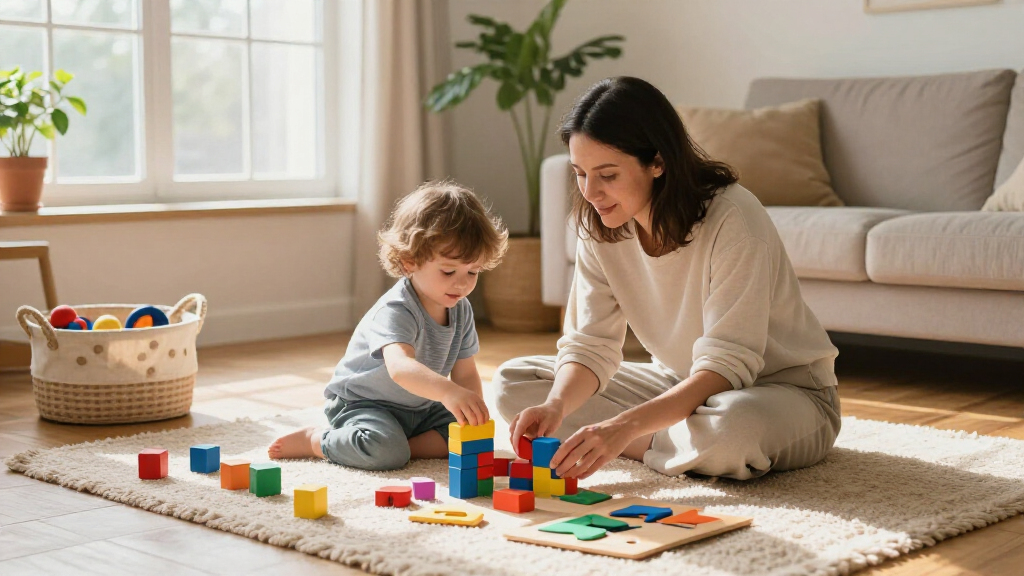
Picture a five-year-old running a pretend grocery store. She’s counting play money (math), writing a lopsided ‘OPEN’ sign (early literacy), telling her little brother he’s out of apples (language), and handling it when he melts down anyway (self-regulation). One wooden lemon, four skills.
Play isn’t a break from learning for preschoolers — it IS the learning.
The Marketing Myth: Why Flashy Toys Often Teach Less
No — a toy with lights, sounds, and an ‘educational’ label often teaches less than a plain set of blocks. Research comparing electronic toys with traditional ones found that blocks and puzzles promoted more parent-child conversation, while chatty electronic toys actually reduced verbal back-and-forth because the toy did the talking [1].
Think of it this way: when the toy narrates itself, you go quiet. When the toy says nothing, you fill the silence — ‘What are you building? A tower? How tall can it go before it falls?’ That conversation is where the learning lives. A toy that sings the alphabet at your child is entertainment. A toy that makes her wonder is education.
This doesn’t mean every battery-powered toy is garbage. It means the child should lead, not the toy. If a toy only does one thing when you press one button, it’s a single-use product. If it can become twenty things depending on your child’s imagination, it’s a tool.
The most expensive trap parents fall into? Assuming price equals learning value. A $12 set of counting bears routinely outperforms a $90 ‘learning system’ — and studies and expert commentary increasingly warn that educational marketing outpaces the evidence [1].
7 Toy Categories and the Skills They Actually Build
The best educational toys fall into seven categories, each targeting different developmental skills. Knowing which category fills which gap helps you build a balanced toy shelf instead of owning four versions of the same puzzle.
| Category | Examples | Skills Built |
|---|---|---|
| STEM/STEAM | Magnetic tiles, building blocks, screen-free coding robots | Problem-solving, spatial reasoning, sequencing logic |
| Fine motor | Lacing beads, play dough, pegboards, puzzles | Hand strength, pincer grip (pre-writing skills) |
| Language & literacy | Alphabet puzzles, phonics games, puppets | Vocabulary, letter recognition, storytelling |
| Pretend play | Kitchen sets, dress-up, dollhouses, tool benches | Social-emotional skills, self-regulation, narrative thinking |
| Arts & crafts | Crayons, clay, stickers, paints | Creativity, fine motor, self-expression |
| Math readiness | Counting bears, sorting games, pattern blocks | Counting, sorting, pattern recognition |
| Gross motor | Balance boards, ride-on toys, obstacle items | Coordination, balance, body awareness |
Two of these deserve a spotlight. Block play correlates with later math skills and spatial reasoning [1]. And pretend play is linked to both language development and self-regulation — that’s why pediatricians keep recommending wooden kitchens and dress-up capes, not worksheets.
The Right Toys for Age 3, 4, and 5 — Without Guessing
Matching a toy to your child’s developmental stage matters more than the brand on the box. Here’s what works at each age, and why:
- Age 3: Chunky puzzles (4-12 pieces), big lacing beads, play dough, pretend food, push toys. Three-year-olds are all about hands and repetition — they’ll do the same puzzle eleven times because their brain is thirsty for mastery.
- Age 4: Magnetic tiles, counting bears, simple board games with turn-taking, dress-up kits, beginner scissors and paper. Four is when sequencing logic kicks in, making it the sweet spot for screen-free coding toys like robotic mice [1].
- Age 5: Complex puzzles (24-48 pieces), pattern blocks, puppets for storytelling, science kits, balance boards. Five-year-olds can follow multi-step games and are ready for genuine kindergarten-readiness skills — counting, letter sounds, and losing a board game without a meltdown (mostly).
Age-appropriateness isn’t about limiting your child — it’s about hitting the challenge sweet spot. Too easy and she’s bored; too hard and she’s frustrated. When a child hits that ‘just right’ difficulty, you’ll see it: the furrowed brow, the lip-biting, the triumphant shout.
How to Pick a Safe Toy in 5 Minutes (Checklist Included)
A safe educational toy for a preschooler means non-toxic materials, no choking-hazard small parts for children under 3, sturdy construction, and a clean recall record. You can verify most of this in five minutes.
- Check the age label — and take the ‘3+’ choking warning seriously even if your three-year-old is advanced.
- Search the CPSC recall database at SaferProducts.gov for the exact product name before buying, especially for secondhand toys [1].
- Do the toilet-paper-tube test — if a part fits inside a toilet paper tube, it’s a choking hazard for under-3s (or any child who still mouths objects).
- Inspect for breakage points — seams, battery doors, magnets, and button batteries are the big risks.
- Look for non-toxic certifications — ASTM F963 labeling on the packaging means it meets US toy safety standards.
Button batteries and small magnets are the two hidden hazards that send preschoolers to the ER — check battery doors with your fingernail before handing over any electronic toy.
Great Learning Without a Big Budget (Yes, Cardboard Counts)
You do not need expensive toys — everyday household items often teach as well as anything in a catalog, and Montessori-style natural materials prove it. A mixing bowl of dried beans and a scoop is a sensory bin. Muffin tins become sorting trays. Your kitchen is already stocked.
- Free: Cardboard boxes, plastic containers and lids, wooden spoons, a water bin with cups
- Under $15: Play dough, chunky puzzles, counting bears, sidewalk chalk
- Under $30: Wooden blocks, magnetic tile starter sets, dress-up box basics
Two more budget hacks. First, toy rotation: stash half the toys in a closet and swap them every few weeks — your child will react to ‘old’ toys like new ones, and you’ll cut clutter. Second, consider how many toys a preschooler actually needs: fewer than you think. A dozen well-chosen, open-ended toys beat a room of single-purpose plastic.
The current shift toward wooden, plastic-free, and eco-friendly toys isn’t just about sustainability either — it often means simpler designs that do more of the developmental heavy lifting [1].
Frequently Asked Questions
Are educational toys actually better than regular toys?
Sometimes yes, often no. The label ‘educational’ is marketing, not a guarantee — research shows simple toys like blocks and puzzles generate more parent-child conversation than electronic learning toys, and simple toys frequently outperform flashy ones [1]. Judge toys by whether your child can direct the play, not by the box claims.
Are electronic learning tablets good for preschoolers?
The AAP recommends limiting screen time for ages 2-5 to about one hour per day of high-quality content [1]. If you use a learning tablet, treat it as one tool among many, not the main one — traditional toys and hands-on play build language and motor skills more reliably. And defer to your pediatrician on screen decisions for your specific child.
What toys help prepare my child for kindergarten?
Focus on puzzles, pattern blocks, counting bears, alphabet puzzles, and turn-taking board games. These build the actual kindergarten skills teachers look for: counting, letter recognition, fine motor control for holding a pencil, and the self-regulation to wait your turn. Pretend play builds the same social-emotional muscles.
How do I know if a toy is safe for my preschooler?
Check the age label, search the CPSC recall database at SaferProducts.gov for the product name, avoid small parts for any child under 3 (use the toilet-paper-tube test), and verify the ASTM F963 safety marking on the package. Check battery doors on electronic toys — button batteries are a serious hazard.
How many toys does a preschooler actually need?
Fewer than most homes contain — roughly a dozen well-chosen, open-ended toys covering different skill areas is plenty. Use toy rotation: store half away and swap every few weeks. ‘Old’ toys feel new again, play gets deeper, and you spend nothing.
Conclusion
Here’s the crisp version: the best educational toy is the one your preschooler controls, not the one that controls her. Buy simple, buy open-ended, and then do the part no toy can do — sit down and play with her. Your voice, questions, and silliness are the single most educational element in the room.
So the next time your kid ignores the fancy gadget and adopts a cardboard box, don’t sigh. That box is a rocket ship, a bank, and a turtle shell — and it just outperformed the entire educational toy aisle for free.
Fall Picks
fall essentials
As an affiliate, we earn on qualifying purchases.