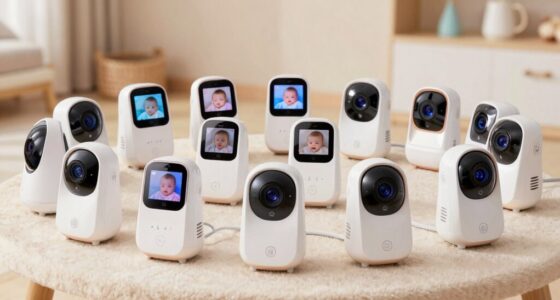

Shopping for baby safety monitors in 2026 mostly means choosing between two camps: no-WiFi video monitors that can’t be hacked remotely, and simpler audio-only units that cost less and run longer on a charge. The VTech Baby Monitor No WiFi takes my best overall spot thanks to a rare 19-hour video battery, 1000ft range, and a full feature set including temperature monitoring and two-way talk. If budget is the priority, the HelloBaby 3.2″ model covers the essentials for far less, while the Babysense 7 is the standout for newborns because it tracks breathing movement, something no camera in this lineup does. The main tradeoffs you’ll face are screen size versus battery life, and video features versus price. Keep reading for the full breakdown of all 13 monitors.
Complete the kit


Key Takeaways
- The VTech No WiFi monitor wins best overall almost entirely on battery life — its 19-hour video runtime is roughly double what most HelloBaby models offer, which matters most for overnight use without a charger.
- This lineup is dominated by no-WiFi 2.4GHz monitors, so the real differentiators are screen size, battery capacity, and extras like temperature sensors and lullabies — not connectivity.
- Audio-only options (VTech DM221, VTech DECT 6.0, Motorola DECT) are the cheapest and most secure picks here, and the Motorola adds cry detection, making them better value than the cheapest video models if you don’t need to see your baby.
- The Babysense 7 is the only movement monitor in the group — it monitors breathing motion rather than video or sound, so it serves a different buyer: anxious parents of newborns, not parents of toddlers.
- HelloBaby appears five times with nearly identical core features; the differences come down to screen size (2.4″ to 6″) and battery (up to 30 hours on the 4.3″ model), so picking within the brand is about screen preference, not quality gaps.


| baby safety monitor | Range | Night Vision | Connectivity |
|---|---|---|---|
| VTech Baby Monitor No WiFi | 1000 feet | Automatic infrared | 2.4GHz FHSS encrypted, no WiFi |
| HelloBaby 2.4" Video Baby Moni | Up to 1000 feet | Infrared, black-and-white | — |
| HelloBaby 6" No WiFi Video Bab | — | Infrared | 2.4GHz FHSS digital-encrypted, no WiFi |
| Babysense 7 Baby Sleep Movemen | — | — | No WiFi |
| HelloBaby HB30 Video Baby Moni | 1000 ft | Auto IR night vision | No WiFi, 2.4GHz FHSS |
| GoodBaby 5-Inch Baby Monitor w | 1,000 ft | Automatic infrared | FHSS, no WiFi |
| Motorola Nursery Audio Baby Mo | 1000 ft | — | — |
| VTimes Baby Monitor with Camer | 1000 feet | Yes | — |
| HelloBaby 4.3” Video Baby Mon | Approximately 1000 feet | Automatic infrared | 2.4GHz FHSS, no WiFi |
| HelloBaby 3.2" Baby Monitor wi | — | Yes | — |
| VTech Audio Baby Monitor | Up to 1000 feet (outdoors, line of sight) | — | No WiFi, closed-loop wireless |
| VTech DM221 Audio Baby Monitor | Up to 1000 feet | — | — |
| Motorola MBP33S Wireless Video | — | Infrared | — |
More Details on Our Top Picks
VTech Baby Monitor No WiFi – 19Hr Video Battery, 1000ft Range, Night Vision, Two-Way Talk
This VTech model earns the top spot because it gets the fundamentals right where parents feel them most: up to 19 hours of video battery and a private 2.4GHz FHSS connection that never touches the internet. Compared with the HelloBaby 2.4″ model, the longer battery life means fewer overnight charging laps, and the sound-activated screen wakes only when your baby stirs rather than glowing all night. The infrared night vision is automatic, so there’s nothing to fiddle with at 3 a.m.
The tradeoff is the 2.8-inch display — fine for a glance, small for parents who want detail. There’s also no smartphone access at all, which is the price of the airtight privacy. If you want a bigger picture, the HelloBaby 6″ model solves that; if you want set-and-forget reliability, this is the stronger pick.
Pros:- Up to 19 hours of video streaming battery life
- Encrypted FHSS connection with no internet exposure
- Automatic night vision and sound-activated screen
- Built-in lullabies and white noise soother
Cons:- Small 2.8-inch screen compared with 5-6 inch rivals
- No WiFi, app, or remote access of any kind
- Real-world battery life drops with continuous screen-on use
Best for: Parents who want a dependable, hack-proof video monitor with all-night battery and no app setup
Not ideal for: Parents who want to check in from work or travel — there’s no WiFi or smartphone access
- Battery Life:Up to 19 hours video streaming
- Range:1000 feet
- Display:2.8-inch LCD
- Night Vision:Automatic infrared
- Two-Way Talk:Yes
- Temperature Sensor:Yes
- Soothing Sounds:2 lullabies, white noise, trickling stream
- Connectivity:2.4GHz FHSS encrypted, no WiFi
Our verdict“The safest default choice for families who value privacy and battery endurance over screen size and remote access.”
HelloBaby 2.4″ Video Baby Monitor with Camera and Audio
For budget-conscious shoppers, this HelloBaby unit covers the essentials — secure FHSS video, night vision, two-way talk, and temperature alerts — at a price that undercuts the VTech No WiFi monitor while matching its 1000-foot range. What makes it a value play rather than just a cheap one is the Smart ECO mode, which dims the screen and stretches battery life between charges, plus practical extras like feeding reminders that pricier rivals often omit.
The compromises are visible the moment you turn it on. The 2.4-inch display is the smallest in this lineup, and night vision renders in black-and-white only, which is less detailed than the VTech’s output. There’s no pan or tilt, so camera placement matters more. Compared with the HelloBaby HB30, you also lose expandability to multiple cameras.
Pros:- Very affordable while keeping core video features
- Smart ECO mode extends battery life
- Includes feeding reminders and temperature alerts
- True plug-and-play setup in minutes
Cons:- Smallest screen in the roundup at 2.4 inches
- Fixed camera with no pan, tilt, or zoom
- Black-and-white night vision lacks detail
Best for: First-time parents or gift-givers who want a capable no-frills video monitor without spending much
Not ideal for: Anyone wanting a larger, more detailed view or multi-room coverage later — the fixed camera and tiny screen cap its growth
- Display Size:2.4 inches
- Connection:FHSS secure, no WiFi
- Range:Up to 1000 feet
- Night Vision:Infrared, black-and-white
- Features:Two-way talk, temperature detection, feeding reminders, lullabies
- Power Saving:Smart ECO mode
Our verdict“A smart budget buy that delivers the 80% of features most parents actually use at a fraction of the price.”
HelloBaby 6″ No WiFi Video Baby Monitor with Camera and Audio
If squinting at a 2.4-inch screen sounds miserable, this model is the antidote: a 6-inch IPS display more than double the viewing area of the VTech No WiFi monitor, with colors that stay readable from an angle. The remote pan-tilt-zoom (355° horizontal, 120° vertical) lets you sweep the whole crib from bed — something neither the smaller HelloBaby units nor the VTech can do.
Battery life stretches to 30 hours in ECO mode, though heavy screen use pulls it closer to 16. The tradeoffs are real: the bigger footprint makes the parent unit less pocketable, and expandability stops at two cameras, while the HelloBaby HB30 supports four. Like everything else here, it’s WiFi-free, so grandparents watching the monitor in the next room will love it — parents checking from the office will not.
Pros:- Large 6-inch IPS screen with wide viewing angles
- Remote pan-tilt-zoom covers the entire crib
- Up to 30 hours of battery in ECO mode
- Secure FHSS connection with no internet exposure
Cons:- Bulky parent unit compared with pocket-sized rivals
- Limited to two cameras maximum
- Battery life varies sharply with screen brightness and use
Best for: Parents and grandparents who want a large, easy-to-read picture and remote camera control from another room
Not ideal for: Multi-child households planning more than two cameras, or anyone wanting app-based remote viewing
- Screen Size:6 inches IPS
- Battery Life:16-30 hours
- Night Vision:Infrared
- Pan and Tilt:355° horizontal, 120° vertical
- Connectivity:2.4GHz FHSS digital-encrypted, no WiFi
- Expandability:Up to 2 cameras
- Additional Features:Two-way audio, lullabies, temperature sensor, feeding timer
Our verdict“The pick for anyone whose priority is seeing their baby clearly rather than carrying the monitor around.”
Babysense 7 Baby Sleep Movement Monitor for Newborns and Infants
This one plays a completely different position than every camera in this roundup. The Babysense 7 uses two under-mattress sensor pads to detect your baby’s micro-movements and sounds an alarm if no movement is detected for 20 seconds — a layer of protection no video monitor, including the VTech No WiFi, can replicate. Because it’s non-contact and non-wearable, there’s nothing on the baby and nothing to charge on their body.
The catch: it does nothing else. No audio, no video, no app — so most families pair it with a camera rather than replacing one. It also demands correct placement under the mattress on a firm surface, and setups with memory foam or uneven bases can trigger false alarms or missed readings. Think of it as insurance, not a monitor.
Pros:- Non-contact, non-wearable design with nothing attached to baby
- Two sensor pads for full crib coverage
- Enhanced sensitivity reduces false alarms
- 20-second no-movement alert provides peace of mind
Cons:- Movement detection only — no audio or video at all
- Requires careful placement under the mattress on a firm base
- May behave inconsistently with soft or foam mattresses
Best for: Anxious parents of newborns who want movement-based apnea alerts alongside their existing camera monitor
Not ideal for: Anyone expecting a complete monitoring solution — it has no audio or video and can’t work alone
- Sensor Type:Under-mattress passive sensors
- Coverage:Full crib or bed area with 2 pads
- Alert:Alarm after 20 seconds of no movement
- Connectivity:No WiFi
- Contact:Non-wearable, non-contact
- Power:Wired sensor unit
Our verdict“A supplemental safety layer for newborn months, not a substitute for an audio or video monitor.”
HelloBaby HB30 Video Baby Monitor with Digital Camera and Audio, No WiFi
The HB30’s claim to a slot is expandability: up to four cameras with 360° horizontal and 120° vertical remote rotation — more coverage than the HelloBaby 6″ model’s two-camera ceiling, and full remote steering that the base 2.4″ HelloBaby lacks entirely. For a growing household with a nursery, a toddler room, and maybe a playroom, this is the most scalable WiFi-free option in the batch.
The 2.4-inch screen is its weak point — you’re steering four cameras from the smallest display here, which means lots of cycling between feeds. The FHSS connection can also suffer interference in WiFi-dense homes, a limitation shared across the category but more noticeable when juggling multiple feeds. VOX power-saving mode partly compensates, keeping the unit quiet until noise triggers it.
Pros:- Supports up to 4 expandable cameras
- Full 360°/120° remote pan and tilt
- VOX power-saving mode preserves battery
- 8-language menu system for multilingual households
Cons:- Small 2.4-inch screen strained by multiple camera feeds
- FHSS signal can experience interference in crowded RF environments
- No app or remote access of any kind
Best for: Parents of multiple children who want one parent unit to monitor several rooms on a private connection
Not ideal for: Single-nursery buyers who’d be paying for expansion they never use while tolerating a small screen
- Display:2.4 inch
- Night Vision:Auto IR night vision
- Range:1000 ft
- Expandable Cameras:Up to 4
- Rotation:360° horizontal, 120° vertical
- Connectivity:No WiFi, 2.4GHz FHSS
- Power Saving:VOX mode
- Languages:8
Our verdict“The right pick only if multi-camera coverage is the plan; single-room buyers get more screen elsewhere.”
GoodBaby 5-Inch Baby Monitor with Camera and Audio, No WiFi
Among the no-WiFi video monitors in this roundup, the GoodBaby 5-inch display is the standout if screen real estate matters to you. Compared with the HelloBaby 3.2″ monitor, the extra display size makes it far easier to glance across a room and see whether your baby is stirring or just shifting position — a real quality-of-life difference during 3 a.m. wake-ups. The remote pan, tilt, and zoom paired with up to 30 hours of battery in VOX mode means it covers a full day of naps and nighttime on a single charge, something audio-only options like the Motorola Nursery Audio monitor can’t match in terms of visual reassurance. The tradeoff is straightforward: no app, no remote access, and you’re tethered to the parent unit. For privacy-focused families who stay home, that’s a fair exchange.
Pros:- Large 5-inch HD display is easy to read at a glance
- Up to 30 hours of battery life in VOX mode
- Remote pan, tilt, and zoom cover the whole nursery
- Hack-proof FHSS connection with no WiFi exposure
Cons:- No WiFi or app connectivity limits remote monitoring
- Parent unit must stay within 1,000 ft of the nursery
Best for: Stay-at-home parents who want a large, easy-to-read screen and all-day battery without any WiFi security concerns
Not ideal for: Parents who travel frequently or want to check in from work — there’s no app connectivity at all
- Display:5-inch HD LCD
- Range:1,000 ft
- Battery:3500mAh rechargeable
- Battery Life:Up to 30 hours in VOX mode
- Remote Pan/Tilt/Zoom:Yes
- Night Vision:Automatic infrared
- Connectivity:FHSS, no WiFi
- Extra Features:Lullabies, feeding timer, temperature sensor
Our verdict“The pick for families who prioritize a big, clear picture and marathon battery life over smart features.”
Motorola Nursery Audio Baby Monitor, No WiFi, Long Range 1000 ft, DECT Privacy Connection, Cry Detection, Portable Battery Parent Unit
Not everyone needs video, and this Motorola audio monitor makes a persuasive case for keeping things simple. Its DECT connection is arguably more secure and interference-free than the 2.4GHz FHSS signal used by the VTimes and HelloBaby video models, because DECT operates on a dedicated frequency band that neighbors’ devices don’t share. The cry detection filters out background hum and only alerts you to genuine distress, which means fewer false alarms than a raw audio feed. The obvious sacrifice: no picture, no night vision, no temperature reading. Compared with the VTech DM221, this model offers a longer effective range and smarter alerting, but be aware the parent unit runs on AAA batteries that aren’t included — budget for rechargeables or you’ll be buying them constantly.
Pros:- DECT technology provides private, interference-free audio
- 1000 ft range covers most homes and yards
- Cry detection reduces false alerts from background noise
- Compact, portable parent unit with belt-carry flexibility
Cons:- Requires two AAA batteries that aren’t included
- Audio only — no video, night vision, or temperature data
Best for: Minimalist parents or caregivers of older babies who only need reliable, private audio monitoring
Not ideal for: Parents of newborns who want visual confirmation of sleep position or breathing movements
- Technology:DECT
- Range:1000 ft
- Microphone:High-sensitivity with cry detection
- Power:Battery-powered parent unit (AAA x2, not included)
- WiFi:None
Our verdict“A smart choice when you want set-and-forget audio monitoring with the strongest privacy in the lineup.”
VTimes Baby Monitor with Camera and Audio, No WiFi, 2.4″ LCD Screen, Two-Way Talk, Night Vision, 1000ft Range, Temperature Sensor, Alarm and Lullaby
This is the roundup’s value play: you get two-way talk, night vision, a temperature sensor, lullabies, and an alarm at a price well below the GoodBaby 5-inch or even the HelloBaby 4.3″. The compromise is the 2.4-inch screen — fine for confirming your baby is asleep, cramped if you want detail. Setup is genuinely quick, which makes it a better first monitor for new parents than more feature-laden units that demand menu-diving. Its 2.4GHz FHSS connection keeps the feed private and off the internet, matching the security posture of every WiFi-free model here. Compared with the HelloBaby 2.4″ monitor, the VTimes adds the temperature sensor and alarm functions, which genuinely matter for nursery comfort. The main annoyances are fussy battery charging habits and a screen that’s small enough that you’ll sometimes squint.
Pros:- Very affordable while including two-way talk and night vision
- Temperature sensor and alarm at a budget price point
- Quick, tool-free setup ideal for nervous first-time parents
- Private 2.4GHz FHSS connection with no internet exposure
Cons:- 2.4-inch screen is small for detailed viewing
- Battery charging requires careful handling to avoid degradation
Best for: First-time parents on a tight budget who want core video features without paying for a big screen
Not ideal for: Anyone with weak eyesight or who wants to see fine detail — the 2.4-inch display is the smallest video format here
- Screen Size:2.4 inches
- Range:1000 feet
- Connection:2.4GHz FHSS
- Night Vision:Yes
- Two-Way Talk:Yes
- Temperature Sensor:Yes
- Extras:Alarm, lullaby, ECO mode
Our verdict“The most feature-per-dollar video option in the roundup, as long as a small screen doesn’t bother you.”
HelloBaby 4.3” Video Baby Monitor No WiFi, 30 Hours Battery
This HelloBaby 4.3-inch splits the difference between the small-screen budget models and the larger GoodBaby: enough display to see clearly, but a lighter, more portable unit than the 5-inch flagship. Its 350° pan and 120° tilt range is the widest in this batch, meaning one camera can track a toddler who roams the crib — or follow them to a floor mat during playtime, something the fixed-tilt budget units struggle with. The 30-hour ECO-mode battery matches the GoodBaby’s endurance while the IP54 splash resistance adds a layer of durability no sibling model offers. Be aware the sound-activated screen goes dark when the room is quiet — great for battery, disorienting if you expect a constant feed like the VTimes provides. One real limitation: this is an indoor-only camera, so garage or covered-porch monitoring is out.
Pros:- 350° pan and 120° tilt covers more of the room than rivals
- Up to 30 hours of battery life in ECO mode
- IP54 water resistance adds durability
- Bright 4.3-inch IPS screen with wide viewing angles
Cons:- Indoor use only — not suited to garages or covered outdoor areas
- Screen turns off automatically when no sound is detected
Best for: Parents who want a mid-size screen, maximum camera mobility, and multi-day battery in one package
Not ideal for: Anyone who wants an always-on continuous video feed — the ECO screen sleeps when the nursery is silent
- Screen Size:4.3 inches
- Battery:3500mAh, up to 30 hours in ECO mode
- Range:Approximately 1000 feet
- Pan-Tilt-Zoom:350° rotation, 120° tilt, zoom
- Night Vision:Automatic infrared
- Connectivity:2.4GHz FHSS, no WiFi
- Waterproof Rating:IP54
Our verdict“The best all-around blend of screen size, camera range, and battery life for typical nursery monitoring.”
HelloBaby 3.2″ Baby Monitor with Camera and Audio, No WiFi, Night Vision
There’s a lot to like here for a secondary monitor — the one that lives in a diaper bag or gets packed for Grandma’s house. The 3.2-inch screen is a real step up in usability from the 2.4-inch VTimes and HelloBaby HB30, while the whole unit stays light enough to move between rooms or homes without fuss. The audio-only mode is a thoughtful touch: kill the screen, keep the sound, and stretch battery further than the always-on video models manage. The 288° pan and 120° tilt is slightly narrower than the HelloBaby 4.3-inch’s range but still covers a standard crib easily. Its drawbacks mirror the rest of the no-WiFi field — no app access, and the smaller screen demands closer attention than the GoodBaby 5-inch when you’re checking sleep position.
Pros:- Audio-only mode extends battery life on demand
- Lightweight and simple enough for less tech-savvy caregivers
- Remote pan and tilt covers a standard nursery
- Rechargeable parent unit with sound-level LED indicators
Cons:- 3.2-inch screen is small for checking sleep position from across a room
- No WiFi connectivity or smartphone integration
Best for: Families who need a portable second monitor for travel, childcare visits, or splitting between floors
Not ideal for: Tech-savvy parents who want smartphone alerts and remote viewing — this unit has zero app support
- Display:3.2-inch TFT LCD
- Wireless Technology:2.4GHz digital encryption
- Camera Pan/Tilt:288° horizontal, 120° vertical
- Night Vision:Yes
- Extras:Temperature monitor, lullabies, sound level LED, audio-only mode
- Power:Rechargeable parent unit
Our verdict“The grab-and-go choice when you need dependable video monitoring in more than one location.”
VTech Audio Baby Monitor — DECT 6.0, No WiFi, 8-Hour Battery, 1000ft Range
For parents who just want to hear their baby without fuss, this VTech audio monitor is the simplest entry point in this roundup. The DECT 6.0 connection means zero static and, because there’s no WiFi involved, there is nothing to hack — a genuine advantage over app-based rivals. The 8-hour battery outlasts the VTech DM221 on a charge, and the 5-level sound indicator lets you mute the audio entirely and still glance at lights to know whether your baby is stirring. Compared with the Motorola MBP33S, you give up video, night vision, and temperature readings entirely — but you also give up the pairing headaches and interference sensitivity that come with 2.4 GHz video systems. The tradeoff is honest: audio-only simplicity in exchange for a fraction of the price.
Pros:- Crystal-clear DECT 6.0 audio with no static or interference
- No WiFi means no hacking risk and no app setup
- 8-hour rechargeable battery plus included AAA backup
- 5-level sound indicator allows fully muted monitoring
- Belt clip makes the parent unit genuinely portable
Cons:- Audio only — no video, night vision, or temperature data
- Real-world range drops noticeably with walls and floors in the way
Best for: Budget-conscious parents or caregivers in small homes who only need dependable audio and value privacy over visuals
Not ideal for: Anxious first-time parents who want to see their baby sleeping — there is no camera, no night vision, and no way to check visually
- Technology:DECT 6.0 digital audio
- Connectivity:No WiFi, closed-loop wireless
- Range:Up to 1000 feet (outdoors, line of sight)
- Battery Life:8 hours rechargeable
- Backup Power:AAA batteries included
- Sound Indicator:5-level visual sound lights
- Portability:Belt clip on parent unit
Our verdict“If you trust your ears and want the cheapest hack-proof monitoring in this lineup, this is the pick; if you need eyes on your baby, step up to the Motorola MBP33S.”
VTech DM221 Audio Baby Monitor with Vibrating Alert, Talk-Back Intercom & Night Light
The DM221 earns its spot by doing something the cheaper VTech audio monitor above cannot: two-way talk-back. Being able to soothe your baby with your voice from another room — without sprinting down the hall — changes how you use a monitor day to day, especially during sleep training. It also adds a gentle night light loop on the nursery unit, a small touch the bare-bones VTech skips, and a vibrating sound alert that helps hearing-impaired caregivers or anyone wearing headphones. The tradeoff is battery: unlike the 8-hour flagship VTech, the DM221 runs through its charge faster and really wants to live on AC power for overnight shifts. Compared with the Motorola MBP33S, you still get no video, but the MBP33S costs considerably more and its 2.4 GHz signal is more prone to interference than this DECT connection.
Pros:- Two-way intercom lets you calm baby without entering the room
- Vibrating sound alert works when audio is muted
- Built-in night light on the nursery unit
- DECT 6.0 audio with noise reduction and 1000 ft range
Cons:- Shorter real-world battery life than competing VTech models
- Needs AC power for reliable overnight use
- No video capability at this price point
Best for: Parents who want to soothe their baby remotely by voice — light sleepers, sleep trainers, and hearing-impaired caregivers
Not ideal for: Anyone wanting visual confirmation of the crib, or those planning to run the parent unit unplugged for long stretches
- Technology:DECT 6.0 digital audio
- Range:Up to 1000 feet
- Intercom:Two-way talk-back
- Sound Indicator:5-level with vibration alert
- Night Light:Yes, on baby unit
- Power:Rechargeable Ni-MH battery and AC
- WiFi Required:No
Our verdict“The strongest choice in this roundup for voice-based soothing on a budget — buy it for the talk-back feature, skip it if you need a camera.”
Motorola MBP33S Wireless Video Baby Monitor with 2.8-Inch Color LCD, Zoom & Two-Way Audio
Among the video options in this roundup, the MBP33S occupies a sensible middle ground: more capable than the HelloBaby 2.4-inch basic model, less expensive than larger-screen units like the HelloBaby 6-inch. The 720p feed on the 2.8-inch LCD is sharp enough to see chest movement and sleep position, and infrared night vision means the camera works in a dark nursery without waking anyone. The remote zoom, room temperature display, and five built-in lullabies push it past pure video-and-audio rivals like the VTimes 2.4-inch, which matches range and night vision but lacks Motorola’s polish on two-way audio clarity. The honest tradeoff is the 2.4 GHz FHSS signal: it carries no hacking risk since there’s no WiFi, but thick walls, baby monitors nearby, and other 2.4 GHz devices can cause dropouts and pairing hiccups the DECT-based VTech units simply don’t experience.
Pros:- 720p color video with infrared night vision for dark rooms
- Remote zoom and pan-free framing from the parent unit
- Room temperature monitoring and five soothing lullabies
- Enhanced two-way audio with clear parent-baby communication
Cons:- 2.4 GHz signal degrades with obstructions and nearby devices
- 2.8-inch screen feels small against 5- and 6-inch competitors
- No remote viewing — closed-circuit only, no smartphone access
Best for: Parents who want video, night vision, and talk-back in one affordable no-WiFi package without subscription fees
Not ideal for: Homes with dense walls or crowded 2.4 GHz environments — expect interference; also not for anyone wanting app-based remote viewing from outside the house
- Technology:2.4 GHz FHSS wireless (no WiFi)
- Display:2.8-inch color LCD
- Video Resolution:720p
- Night Vision:Infrared
- Zoom:Remote zoom
- Two-Way Audio:Yes, enhanced
- Extras:Room temperature monitor, five lullabies
Our verdict“The best value video monitor in this lineup for parents who want eyes and ears on the nursery with zero WiFi risk — as long as your walls aren’t too thick.”
How We Picked
Because nearly every monitor in this category is a no-WiFi 2.4GHz system, I focused on the factors that actually separate them in daily use. Battery life came first — a parent unit that dies at 3 a.m. defeats the purpose, so models with 19–30 hour runtimes ranked above those needing overnight charging. Range and signal reliability mattered next, since a 1000ft rating only helps if the connection holds through walls and floors in a real home. Privacy was a hard filter: every pick here uses closed-loop FHSS or DECT connections rather than cloud streaming, which removes the remote-hacking risk entirely.
From there, I weighed feature depth against price. Extras like two-way talk, temperature sensors, sound-activated screens, and lullabies justify a higher price only when they work reliably, so I favored models where those features felt standard rather than gimmicky. I also made room for two specialist picks — a movement monitor for newborn safety and audio-only units for budget buyers — because a roundup of thirteen near-identical video monitors wouldn’t help anyone choose. The final ranking balances capability, battery endurance, and value, with each product assigned a distinct role so you can match it to your situation.
| baby safety monitor | Night Vision |
|---|---|
| VTech Baby Monitor No WiFi | Automatic infrared |
| HelloBaby 2.4" Video Baby Moni | Infrared, black-and-white |
| HelloBaby 6" No WiFi Video Bab | Infrared |
| Babysense 7 Baby Sleep Movemen | — |
| HelloBaby HB30 Video Baby Moni | Auto IR night vision |
| GoodBaby 5-Inch Baby Monitor w | Automatic infrared |
| Motorola Nursery Audio Baby Mo | — |
| VTimes Baby Monitor with Camer | Yes |
| HelloBaby 4.3” Video Baby Mon | Automatic infrared |
| HelloBaby 3.2" Baby Monitor wi | Yes |
| VTech Audio Baby Monitor | — |
| VTech DM221 Audio Baby Monitor | — |
| Motorola MBP33S Wireless Video | Infrared |
Factors to Consider When Choosing Baby Safety Monitors
Before settling on a specific model, it helps to understand the broader decisions that shape this category. Most buyers overpay for features they’ll never use, or underestimate the one spec that actually matters for their home layout.WiFi vs. No-WiFi: The Safety Tradeoff That Defines This Category
Every monitor in this roundup is deliberately no-WiFi, and that’s worth understanding before you buy. WiFi monitors stream video through cloud servers, which means they can be viewed from your phone anywhere — but they also introduce hacking risk, require a stable internet connection, and often carry subscription fees for recorded footage. Closed-loop 2.4GHz and DECT systems can’t be accessed remotely by anyone, period. The tradeoff is that you must carry a dedicated parent unit and stay within range, typically around 1000ft in open air and considerably less through walls. If you travel frequently or want to check in from work, WiFi may still suit you better — but for overnight monitoring at home, no-WiFi is the safer and more reliable choice, and it’s why this list is built the way it is.
Battery Life: The Spec Parents Most Often Regret Ignoring
A common mistake is buying based on screen size and image quality, then discovering the parent unit dies mid-nap. Battery ratings in this category range from about 8 hours on audio-only units in talk mode to 30 hours on the HelloBaby 4.3″ model, and that gap changes how you use the monitor entirely. Units under 10 hours effectively need to live on their charging dock overnight, which is fine if you have an outlet by your bed but frustrating if you move around the house. Also note that manufacturers quote battery life in power-saving screen-off mode, where the display wakes only when sound is detected — continuous video viewing drains far faster than the headline number. Match the rating to your routine: all-day portability demands 15+ hours, while bedside-only use forgives a smaller battery.
Screen Size vs. Portability
The HelloBaby lineup alone spans 2.4″ to 6″ screens, and the right choice depends on where you’ll actually hold the parent unit. A large 5–6″ display makes it easy to see whether your baby’s eyes are open from across the room, which reduces unnecessary trips to the nursery — but these units are bulkier in a pocket and heavier on the battery. A 2.4–3.2″ screen clips easily to a waistband or sits unobtrusively on a counter, and most parents find it perfectly adequate for answering one question: is the baby awake or asleep? Zoom functions partially close the gap on smaller screens, but digital zoom degrades image quality quickly on budget models. If you’re torn, err smaller — portability complaints are rarer than ‘I never needed this big screen’ ones.
Audio-Only Monitors Are Underrated
Many first-time parents assume video is mandatory, but audio-only monitors like the VTech DM221 and Motorola DECT model solve the core problem — knowing when your baby needs you — for a fraction of the price. They also run on DECT technology, which offers clearer sound with essentially zero interference and stronger encryption than the FHSS video systems use. The honest tradeoff: you can’t see whether a noise was a sigh or a cry for help, and you can’t glance over to confirm the baby just rolled over. Parents who respond to every peep anyway may find video adds anxiety rather than reducing it. A reasonable middle path is starting audio-only for the newborn months, then upgrading to video once mobility makes visual checks more valuable.
Movement Monitoring: A Different Category Entirely
The Babysense 7 sits in this list because buyers often compare it against video monitors, but it answers a different question. Movement monitors use sensor pads under the crib mattress to detect breathing motion and alert you if movement stops — a function aimed at newborn safety and parental peace of mind, particularly for preemies. What it doesn’t do: show you video, play lullabies, or let you talk to your baby. Some parents layer both systems, using a movement pad for the first six months and a video camera beyond. Be aware that movement monitors can produce false alarms if the baby rolls off the sensor pad zone, which some parents find more stressful than reassuring. Approach this category if breathing monitoring specifically addresses your concern, not as a fancier substitute for a camera.
Night Vision and Range: Read Between the Spec Numbers
Every video monitor here claims auto night vision and 1000ft range, so those headline numbers shouldn’t drive your decision — the real-world performance behind them varies. Infrared night vision on budget models tends to wash out detail beyond 8–10 feet, which is usually fine for a crib shot but worth checking in reviews for your room size. Range is quoted as line of sight without obstruction; a 1000ft rating might translate to 150–300ft through multiple interior walls, which still covers most homes but can struggle in large houses with basements or thick masonry. Sound-activated screens and temperature sensors, by contrast, are features where cheap implementations genuinely differ from good ones — a temperature reading you can’t trust is worse than none. Prioritize verified real-home performance over spec-sheet maximums.
Frequently Asked Questions
Are no-WiFi baby monitors really safer than WiFi monitors?
For home use, yes — the security advantage is structural rather than marginal. A closed-loop monitor transmits directly between camera and parent unit over 2.4GHz FHSS or DECT, so there is no internet connection to hack and no cloud account to compromise. WiFi cameras, by contrast, have a documented history of breaches when passwords are weak or firmware goes unpatched. The honest counterpoint is that a WiFi system lets you check on your baby from anywhere, and modern ones with two-factor authentication and reputable brands are reasonably secure. If your monitoring happens inside your house, the no-WiFi approach removes an entire category of risk while also being immune to router outages.
Which monitor has the best battery life in this lineup?
The HelloBaby 4.3″ model leads with a 30-hour rating, followed closely by the VTech No WiFi video monitor at 19 hours — both measured in screen-off, sound-activated mode. That distinction matters: keep either display lit continuously and you’ll see a fraction of that runtime, typically 5–7 hours. Audio-only units like the VTech DM221 quote 8–18 hours depending on mode, which is impressive for their price but still short of the video leaders. If you want a unit that survives a full day and night off its charger, the HelloBaby 4.3″ is the clear pick; if you charge nightly at your bedside, battery differences become far less important.
Do I need a video monitor, or is audio-only enough?
Audio-only works well for many families, especially during the newborn months when you’ll respond to every sound regardless of what a screen shows. The VTech and Motorola audio models in this lineup also use DECT, which delivers cleaner sound and stronger privacy than the video systems’ FHSS connections. Video earns its cost once babies become mobile — you’ll want to see whether that thud was a fall or a stuffed animal, and whether a fussy baby is settling back down or escalating. Video also reduces nursery trips, which can mean fewer woken babies. A practical approach: start with a quality audio monitor, then add video around the 4–6 month mark if you find yourself wanting eyes on the crib.
Is a movement monitor like the Babysense 7 worth it for a newborn?
It depends on what worry you’re addressing. The Babysense 7 uses sensor pads to detect breathing movement and alerts you if it stops — a function no camera or audio monitor provides, and one that many parents of preemies or anxious first-time parents find genuinely reassuring. The tradeoffs are real: expect occasional false alarms when a baby rolls off the sensor zone, and know that it monitors movement, not video or sound, so you’ll still want a camera or audio unit alongside it for complete coverage. Pediatric guidance generally says healthy full-term infants don’t require movement monitoring, so treat it as a peace-of-mind purchase rather than a medical device. If it helps you sleep during those first fragile months, that alone can justify the cost.
With five HelloBaby models on this list, which one should I actually buy?
The differences between them come down to screen size and battery, since the core camera and connection hardware are nearly identical across the lineup. The 4.3″ model with 30-hour battery is the strongest all-around choice if you want maximum time off the charger with a reasonably large display. The 6″ model suits parents who prioritize a big, glanceable screen and keep the unit mostly stationary. The 2.4″ and 3.2″ versions are the value picks — perfectly capable, just smaller — and the HB30 sits in the middle with multilingual menus as its distinguishing extra. Unless a specific feature like the 30-hour battery matters to you, the cheapest HelloBaby that has your preferred screen size is the sensible buy.
Conclusion
After comparing all thirteen, the right choice comes down to your priorities rather than a single ‘best’ monitor. For best overall, the VTech Baby Monitor No WiFi combines the strongest battery in a full-featured video monitor with temperature sensing, two-way talk, and lullabies — the most complete package here. The HelloBaby 4.3″ model takes best value with its 30-hour battery at a mid-tier price, and the HelloBaby 3.2″ is the pick if your budget is tight. For beginners who want simplicity over features, the VTech DM221 audio monitor does one job extremely well for very little money. Parents seeking a premium-feeling large display should look at the HelloBaby 6″ or the GoodBaby 5″. And for a specific need — newborn breathing monitoring — the Babysense 7 is in a category of its own and pairs well with any camera on this list. Whatever you choose, staying within the no-WiFi systems gathered here means your monitor stays private, reliable, and free of subscription fees.