

When your family travels, camps, or simply survives a power outage, keeping phones, tablets, and handheld games alive becomes a group problem — and not every power bank solves it well. After comparing capacity, output power, port variety, and everyday usability, the Anker SOLIX C300 stands out as the best overall pick for families, with enough output to run small appliances and enough USB ports to charge several devices at once. If your priority is a low-cost way to arm every family member with their own charger, the GOODaaa three-pack with charging dock is the strongest value play, while the Moihosso 50,000mAh charger with built-in cables suits families who are tired of hunting for missing cords. The main tradeoff in this category is between high-capacity power stations (heavier, but they can power lights and fans) and lighter power banks (easier to pack, but phone-and-tablet only). Keep reading for the full breakdown of all 13 options and which one fits your family’s style of adventure.

Turn the school run and nap time into listening time
- Thousands of audiobooks, podcasts and originals
- Listen on your phone, tablet or Echo — also offline
- Cancel anytime
Complete the kit


Key Takeaways
- Capacity alone didn’t determine the ranking — the Anker SOLIX C300 beat larger-capacity rivals because its mix of AC output, multiple ports, and trusted build quality matters more for families than raw watt-hours.
- Built-in cables were the biggest convenience differentiator among power banks: the Moihosso, SOARAISE, and IAPOS models all eliminate cord chaos, but they differ sharply in charging speed and whether they can refill a tablet twice.
- The multi-charger GOODaaa set is the only option that treats a family as multiple people rather than one shared battery, making it the clear choice for households where ‘who has the power bank’ is a recurring argument.
- Solar charging on the SOARAISE and Nuynix models is a genuine backup for camping, but both recharge far faster from a wall outlet — solar should be viewed as insurance, not a primary charging method.
- Small power stations under 100Wh (the MARBERO, R101 Lite, and Apowking) are the most airline-friendly and car-friendly options here, but their limited AC runtime makes them better for day trips than weekend camping.
| EnginStar Portable Power Station, 300W, 296Wh |  | Best for Family Camping Trips | Capacity: 296Wh | AC output: 300W across 2 pure sine wave outlets (110V) | USB-C output: 18W | VIEW LATEST PRICE | See Our Full Breakdown |
| Moihosso 50000mAh Portable Charger with Built-In Cables |  | Best Big-Capacity Travel Charger | Capacity: 50,000mAh | Charging speed: 22.5W max | Ports: 3 total; built-in USB-C and iOS cables plus USB-C port | VIEW LATEST PRICE | See Our Full Breakdown |
| Portable Power Bank with 100W AC Outlet and 65W USB-C PD, 27,000mAh |  | Best for Laptop-Toting Parents | Capacity: 27,000mAh (98Wh) | AC output: 100W, 110V | USB-C PD: 65W input and output | VIEW LATEST PRICE | See Our Full Breakdown |
| GOODaaa Portable Charger Set with Three 10,000mAh Power Banks and Charging Dock |  | Best for Multi-Kid Households | Capacity: 10,000mAh per bank | Quantity: 3 power banks plus charging dock | Built-in cables: USB-C and iOS on each bank | VIEW LATEST PRICE | See Our Full Breakdown |
| IAPOS 60,000mAh 22.5W Portable Charger with 3-in-1 Cable |  | Best for Whole-Family Device Juggling | Capacity: 60,000mAh | Max output: 22.5W | Devices: Up to 5 simultaneously | VIEW LATEST PRICE | See Our Full Breakdown |
| Anker SOLIX C200 DC Portable Power Station, 192Wh, 200W |  | Best for USB-Heavy Family Charging | Battery capacity: 192Wh | Output: 200W | Battery type: LiFePO4 | VIEW LATEST PRICE | See Our Full Breakdown |
| SOARAISE 48,000mAh Solar Power Bank with Wireless Charging and 4 Built-In Cables |  | Best All-in-One Backpack Charger | Battery capacity: 48,000mAh | Battery type: Lithium-polymer | Solar panels: 4 | VIEW LATEST PRICE | See Our Full Breakdown |
| Anker SOLIX C300 Portable Power Station, 288Wh |  | Best for Weekend Camping Trips | Capacity: 288Wh | Output: 300W (600W surge) | Ports: 3 AC outlets, 1 car socket, 3 USB-C, 1 USB-A | VIEW LATEST PRICE | See Our Full Breakdown |
| Jackery Explorer 300 Portable Power Station, 292Wh |  | Most Durable Long-Term Pick | Capacity: 292Wh | Peak surge: 600W | AC outlets: 2 | VIEW LATEST PRICE | See Our Full Breakdown |
| Apowking Portable Power Station, 146Wh, 100W | 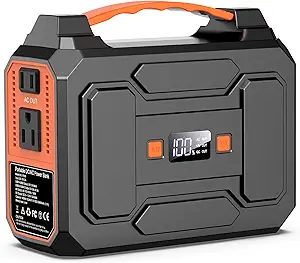 | Best Budget Backup Power | Battery capacity: 146Wh / 39,600mAh | Output wattage: 100W (200W peak) | Weight: 3.3 lb | VIEW LATEST PRICE | See Our Full Breakdown |
| MARBERO Portable Power Station, 88Wh, 120W Surge, 24,000mAh |  | Best Budget Power Station for Weekend Camping | Capacity: 88Wh (24,000mAh) | Output wattage: 80W continuous, 120W surge | Ports: 8 (AC, USB-A, USB-C PD, car DC) | VIEW LATEST PRICE | See Our Full Breakdown |
| Nuynix 49,800mAh Solar Power Bank with 15W USB-C Fast Charging |  | Best Rugged Backup for Emergency Kits | Battery capacity: 49,800mAh | Output: 15W USB-C | Ports: 3 (USB-A and USB-C) | VIEW LATEST PRICE | See Our Full Breakdown |
| R101 Lite Portable Power Station, 89.6Wh, 100W |  | Best Lightweight Power Station for Longevity | Capacity: 89.6Wh LiFePO4 | AC output: Dual 100W outlets, 200W peak | USB-C: 65W input / 100W output (C1), 30W (C2) | VIEW LATEST PRICE | See Our Full Breakdown |
| portable power banks for familie | Capacity | Weight | Ports | Warranty |
|---|---|---|---|---|
| EnginStar Portable Power Stati | 296Wh | 6.5 lbs | — | 12 months |
| Moihosso 50000mAh Portable Cha | 50,000mAh | — | 3 total; built-in USB-C and iOS cables plus USB-C port | 3-year replacement plan |
| Portable Power Bank with 100W | 27,000mAh (98Wh) | 300g (10.6 oz) | 4 total | — |
| GOODaaa Portable Charger Set w | 10,000mAh per bank | 6.42 oz each | — | — |
| IAPOS 60,000mAh 22.5W Portable | 60,000mAh | 15.5 oz | 2 USB-A, 1 USB-C, plus integrated USB-C/iOS/Micro-USB connectors | — |
| Anker SOLIX C200 DC Portable P | — | — | — | 3 years |
| SOARAISE 48,000mAh Solar Power | — | — | 2 USB-A outputs, 1 USB-C input/output | — |
| Anker SOLIX C300 Portable Powe | 288Wh | — | 3 AC outlets, 1 car socket, 3 USB-C, 1 USB-A | 5 years |
| Jackery Explorer 300 Portable | 292Wh | Approximately 7.1–7.5 lbs | 100W USB-C PD, 2 USB-A, 120W car port | — |
| Apowking Portable Power Statio | — | 3.3 lb | — | 12 months |
| MARBERO Portable Power Station | 88Wh (24,000mAh) | 3.2 lbs | 8 (AC, USB-A, USB-C PD, car DC) | — |
| Nuynix 49,800mAh Solar Power B | — | — | 3 (USB-A and USB-C) | 12 months |
| R101 Lite Portable Power Stati | 89.6Wh LiFePO4 | 2.5 lbs | — | 12 months |
More Details on Our Top Picks
EnginStar Portable Power Station, 300W, 296Wh
Families who camp together drain batteries fast — a tablet marathon in the tent, a portable fan at night, a laptop for the parent on call. The EnginStar 296Wh station is the option in this lineup that treats those needs as household-scale, not phone-scale. Its two pure sine wave AC outlets can safely run a CPAP machine or a small projector, something no power bank here can do, and the 80% recharge in two hours means it’s ready again before the next evening. Compared with the Jackery Explorer 300, it matches the capacity class while adding regulated 12V/24V DC outputs for car-style accessories. The honest tradeoff: at 6.5 pounds, this is a basecamp item, not a pocket item, and the solar panel costs extra. It also overlaps with the Anker SOLIX C200, which is lighter but caps out at 200W — the EnginStar handles hungrier appliances.
Pros:- Two pure sine wave AC outlets safe for sensitive electronics like CPAP machines
- Charges via wall, car socket, or a compatible solar panel
- 80% recharge in about two hours
- Multiple output types let the whole family charge at once
Cons:- Solar panel sold separately, so off-grid setups cost more
- 300W ceiling rules out kettles, hair dryers, and similar appliances
Best for: Families who camp or face frequent outages and need AC power for multiple devices at a base camp or home base
Not ideal for: Day-trippers and theme-park parents who need something pocketable; 6.5 pounds is too much to carry all day
- Capacity:296Wh
- AC output:300W across 2 pure sine wave outlets (110V)
- USB-C output:18W
- DC outputs:2 regulated outputs, 12V/24V
- Weight:6.5 lbs
- Recharge time:80% in 2 hours (65W max input)
- Charging methods:AC outlet, car socket, compatible 12–25V solar panel
- Warranty:12 months
Our verdict“The pick for families whose power needs go beyond phones and into laptops, fans, and medical devices on multi-day trips.”
Moihosso 50000mAh Portable Charger with Built-In Cables
When one parent is shepherding kids through an airport, the last thing needed is a tangle of cables. The Moihosso P8 solves that with built-in USB-C and iOS cables plus a spare USB-C port, so three family devices can charge from one brick with zero accessories. Its 50,000mAh capacity sits near the top of this roundup — only the IAPOS 60,000mAh is larger — and that headroom means a full weekend of kid tablets without hunting for an outlet. Compared with the Moihosso’s closest rival here, it trades the IAPOS’s five-device throughput for a slimmer one-inch profile and a genuinely useful emergency flashlight. The catch is physics: this much battery is heavy and thick for a pocket, and 22.5W fast charging only kicks in on compatible gear. A three-year replacement plan softens the risk of a big single purchase.
Pros:- Built-in USB-C and iOS cables eliminate cable clutter in transit
- 50,000mAh capacity covers a full weekend of family devices
- 22.5W fast charging for compatible phones
- Emergency flashlight and battery percentage display add travel utility
Cons:- Large and heavy by power bank standards, better in a backpack than a pocket
- Fast charging speeds only apply to compatible devices
Best for: Multi-device families on long travel days who want maximum phone charges without carrying separate cables
Not ideal for: Anyone wanting truly pocketable power; this is a bag-size brick, and light packers will feel the weight
- Capacity:50,000mAh
- Charging speed:22.5W max
- Ports:3 total; built-in USB-C and iOS cables plus USB-C port
- Battery type:Lithium-ion
- Dimensions:6.5 x 3.5 x 1 inches
- Extras:Emergency flashlight, battery percentage display
- Warranty:3-year replacement plan
Our verdict“A high-capacity, cable-free brick for families who charge many devices across long days away from outlets.”
Portable Power Bank with 100W AC Outlet and 65W USB-C PD, 27,000mAh
Most family power banks stop at phones. This one doesn’t: the 100W AC outlet and 65W USB-C PD mean a parent can keep a laptop alive during a soccer-tournament workday while the kids’ tablets top up on the other ports. At 98Wh, it sits deliberately under the TSA’s 100Wh carry-on limit, which the Moihosso 50,000mAh and IAPOS 60,000mAh cannot claim — those are land-and-road options only. The 1.5-hour recharge via USB-C is also the fastest turnaround in this batch by a wide margin, a real quality-of-life upgrade for forgetful packers. The tradeoffs are real though: 100W AC rules out anything with a heating element or a bulky charger brick, and 27,000mAh runs dry faster than the big bricks once you’re feeding a laptop. Four devices can charge at once, but heavy AC use drains it quickly.
Pros:- 100W AC outlet and 65W USB-C PD support laptops, cameras, and tablets
- 98Wh capacity stays under the TSA 100Wh carry-on limit
- Recharges in about 1.5 hours via USB-C
- Four output ports for simultaneous family charging
Cons:- AC outlet caps at 100W, excluding higher-draw appliances
- Noticeably less total capacity than 50,000mAh+ rivals in this lineup
Best for: Working parents who need to charge a laptop alongside kids’ devices, especially when flying
Not ideal for: Families needing weekend-long capacity for tablets and phones; 27,000mAh shrinks fast when a laptop is in the mix
- Capacity:27,000mAh (98Wh)
- AC output:100W, 110V
- USB-C PD:65W input and output
- Ports:4 total
- Recharge time:About 1.5 hours via USB-C
- Weight:300g (10.6 oz)
- Certifications:FCC, CE, RoHS
Our verdict“The flyer’s choice — laptop-grade power in a carry-on-legal package, at the cost of raw capacity.”
GOODaaa Portable Charger Set with Three 10,000mAh Power Banks and Charging Dock
Most family power problems aren’t about capacity — they’re about sharing. The GOODaaa set sidesteps the arguments entirely by giving each family member their own slim 10,000mAh bank, all recharging together on one dock. Nobody hogs the brick, and nobody forgets to recharge it, because the dock sits by the door like a phone-charging station. Each bank has built-in USB-C and iOS cables, so kids can’t lose what’s attached, and at 6.42 ounces each they slip into a backpack pocket. The included sticker sheets are a small touch, but they turn a gadget into something a child will actually keep track of. Compared with a single big unit like the Moihosso 50,000mAh, total capacity is lower per person — but per-child autonomy is higher. The frustration: charging speed is unspecified, so impatient teens may grumble, and 10,000mAh each suits phones better than tablets.
Pros:- Three separate banks eliminate sharing disputes and lost-charge anxiety
- Dock recharges all three banks at once from a single outlet
- Built-in USB-C and iOS cables on each bank mean nothing to lose
- Slim, 6.42 oz design fits kids’ backpack pockets
Cons:- Charging speed and full device-compatibility details are not specified
- 10,000mAh per bank limits heavy tablet or laptop use
Best for: Families with multiple kids who each need their own pocketable charger for school days and outings
Not ideal for: Anyone needing to charge a tablet multiple times or power a laptop; 10,000mAh per bank is phone-scale only
- Capacity:10,000mAh per bank
- Quantity:3 power banks plus charging dock
- Built-in cables:USB-C and iOS on each bank
- Dimensions:4.3 x 2.6 x 0.7 inches each
- Weight:6.42 oz each
- Indicators:Four-color battery display (25%–100%)
- Safety:Overcharge/short-circuit protection; certified below 45°C
Our verdict“The peace-keeping pick — three personal chargers and a home dock for families tired of fighting over one brick.”
IAPOS 60,000mAh 22.5W Portable Charger with 3-in-1 Cable
Five devices at once is the IAPOS party trick, and for a big family at a theme park or on a road trip, that matters more than raw elegance. With two USB-A ports, one USB-C port, and integrated USB-C, iOS, and Micro-USB connectors, every device in a mixed household — Android kids, iPhone parents, an ancient Kindle — can plug in simultaneously. The 60,000mAh capacity is the largest in this roundup, edging out the Moihosso 50,000mAh, though at 15.5 ounces it’s the heavier of the two big bricks. Its support for multiple fast-charging protocols (PD, QC, SCP, FCP, AFC) means fewer “why is my phone charging slowly” complaints across different brands. Where it loses ground: it’s a bag battery, never a pocket one, the listed 22.5W speed varies by device, and it lacks the flashlight the Moihosso includes. Compared with the 27,000mAh AC-outlet bank, it trades laptop-grade output for sheer endurance.
Pros:- Largest capacity in the lineup at 60,000mAh for multi-day family use
- Charges up to five devices simultaneously across mixed connector types
- Supports PD, QC, SCP, FCP, and AFC fast-charging protocols
- Digital percentage display removes guesswork about remaining charge
Cons:- 15.5 oz weight makes it a dedicated-bag item, not pocketable
- Real-world charging speed varies by device and conditions
- No AC outlet, so laptops with standard chargers won’t work
Best for: Large families with mixed Android and Apple devices who need maximum charges across many gadgets at once
Not ideal for: Minimalist packers and air travelers; the weight and capacity exceed carry-on battery limits
- Capacity:60,000mAh
- Max output:22.5W
- Devices:Up to 5 simultaneously
- Ports:2 USB-A, 1 USB-C, plus integrated USB-C/iOS/Micro-USB connectors
- Protocols:PD, QC, SCP, FCP, AFC
- Weight:15.5 oz
- Display:Digital battery percentage
- Safety:Overcharge, short-circuit, and temperature protection
Our verdict“Maximum endurance for device-heavy households, as long as someone is willing to carry the biggest brick in the bunch.”
Anker SOLIX C200 DC Portable Power Station, 192Wh, 200W
Most small power stations lean on AC outlets, but the SOLIX C200 skips AC entirely and goes all-in on USB — five ports, including a 140W two-way USB-C port that can charge a power-hungry laptop while smaller devices top up alongside it. For a family whose bag is mostly phones, tablets, and handheld consoles, that port layout is more useful than the two AC outlets on the similarly sized Apowking. The LiFePO4 battery rated for 3,000 cycles should outlast the lithium-ion chemistry in cheaper rivals by years of family trips. The tradeoff is real though: no AC means no small appliances, and Anker quietly sells the shoulder strap and compatible solar panels separately. Compared with the larger SOLIX C300, you give up AC outlets and capacity, but you gain a lighter, simpler unit built around what families actually charge most.
Pros:- Five USB ports keep the whole family’s devices charging at once
- 140W two-way USB-C handles laptops and recharges the unit quickly
- LiFePO4 battery rated for 3,000 cycles
- Recharges via USB-C, solar, or car for flexible top-ups
Cons:- No AC outlets, which limits what it can power
- Shoulder strap and compatible solar panels are sold separately
Best for: Families charging multiple phones, tablets, and laptops at once who don’t need AC outlets
Not ideal for: Anyone who wants to run a small fan, CPAP machine, or other AC appliance — this unit has no AC outlets
- Battery capacity:192Wh
- Output:200W
- Battery type:LiFePO4
- USB-C ports:3 (100W, 140W, 15W)
- USB-A ports:2 (12W each)
- Solar input:Up to 100W
- Recharge methods:USB-C, solar, or car
- Warranty:3 years
Our verdict“This is the pick for families whose gear charges over USB and who want a durable battery that lasts for years of trips.”
SOARAISE 48,000mAh Solar Power Bank with Wireless Charging and 4 Built-In Cables
The SOARAISE bets on convenience over refinement. Four built-in cables mean nobody in the family needs to remember their own, the wireless pad covers the phone that charges that way, and up to seven devices can charge simultaneously — a number none of the power stations in this lineup can match. Its 48,000mAh capacity sits near the IAPOS 60,000mAh bank in raw phone charges, but the SOARAISE folds in solar panels and wireless charging where the IAPOS stays wired-only. That said, the four solar panels are best treated as an emergency trickle rather than a real recharging strategy — no solar charging speed is specified, so families shouldn’t count on sunshine to refill it. Unlike the Anker SOLIX C200, there’s no cycle-life rating or long warranty to lean on, which makes long-term durability a genuine unknown.
Pros:- Four built-in cables eliminate the forgotten-charger problem
- Charges up to seven devices at once
- Wireless pad adds cable-free phone charging
- Four solar panels provide backup charging outdoors
Cons:- Solar charging speed is unspecified, so it can’t be relied on as a primary recharge method
- Wireless compatibility claims are vague and unverified for specific devices
- No cycle-life rating or extended warranty for reassurance
Best for: Beach days and theme parks where everyone forgot cables and one bag has to charge everything
Not ideal for: Families expecting meaningful solar recharging or powering laptops — the USB-C output tops out at 5V/3A
- Battery capacity:48,000mAh
- Battery type:Lithium-polymer
- Solar panels:4
- Ports:2 USB-A outputs, 1 USB-C input/output
- Built-in cables:USB-C, Phone, USB-A, Micro
- Wireless charging:Yes
- Max simultaneous devices:Up to 7
- USB-C output:5V/3A
Our verdict“A grab-and-go charger for chaotic family outings, as long as you treat the solar panels as a bonus rather than a plan.”
Anker SOLIX C300 Portable Power Station, 288Wh
The SOLIX C300 is the station that covers the most bases in this batch: three AC outlets, a car socket, and four USB ports, all fed by a 288Wh LiFePO4 battery. Compared with the Jackery Explorer 300’s two AC outlets and six total ports, the C300 gives a family of four more places to plug in at once. The standout number is the recharge time — 80% in 50 minutes from a wall outlet — which matters when you’re repacking the car between trips; the Jackery takes around four hours over AC. The five-year warranty also beats the Jackery’s and the Apowking’s one-year coverage by a wide margin. It’s not flawless: the shoulder strap is sold separately, it won’t run with certain Anker solar panels, and 300W still rules out anything with a heating element. But for a weekend of phones, cameras, laptops, and a light or fan, this is the most complete package here.
Pros:- Eight ports, including three AC outlets, cover a whole family’s gear
- Recharges to 80% in about 50 minutes via wall outlet
- LiFePO4 battery rated for 3,000 cycles
- Whisper-quiet at 25dB, fine for tent-adjacent use
Cons:- Shoulder strap sold separately, which hurts portability at this size
- Incompatible with several Anker solar panel models
- 300W output can’t run high-draw appliances
Best for: Camping families who want AC outlets, fast recharging, and one unit for the whole weekend
Not ideal for: Day-trip packs and air travel — it’s heavier and more station than a casual outing needs
- Capacity:288Wh
- Output:300W (600W surge)
- Ports:3 AC outlets, 1 car socket, 3 USB-C, 1 USB-A
- Recharge time:80% in 50 minutes via wall outlet
- Battery:LiFePO4, rated for 3,000 cycles
- Noise level:25dB at 3.3 ft
- Warranty:5 years
Our verdict“The most well-rounded power station in this lineup for families who camp or lose power for a weekend at a time.”
Jackery Explorer 300 Portable Power Station, 292Wh
Where the Anker SOLIX C300 wins on ports and recharge speed, the Jackery Explorer 300 wins on longevity. Its LiFePO4 battery is rated for over 4,000 cycles to 70% capacity — roughly a thousand more cycles than the Anker’s rating — which translates to years more useful life for a family that camps every season. The integrated handle also means nothing to buy or lose, a small but genuine advantage over both SOLIX models that treat the strap as an add-on. With two AC outlets, a 100W USB-C PD port, and a 120W car socket, it charges up to six devices, though families running lots of gadgets at once will feel the pinch compared with the C300’s eight ports. The four-hour wall recharge is the biggest practical knock, and the listed weight is inconsistent between the description and spec sheet, so buyers should expect roughly seven to seven-and-a-half pounds.
Pros:- Over 4,000 rated charge cycles to 70% capacity
- Integrated handle with nothing extra to buy
- Charges up to six devices across AC, USB, and car ports
- Solar recharge to 80% in about 2.8 hours with a 100W panel
Cons:- Solar panel sold separately
- Listed weight is inconsistent between description and specifications
- Only two AC outlets and six ports, fewer than the Anker C300
Best for: Frequent campers who want a station that still holds strong capacity after years of heavy use
Not ideal for: Families who need fast turnarounds between trips — the roughly four-hour wall recharge is slow for its class
- Capacity:292Wh
- Peak surge:600W
- AC outlets:2
- Ports:100W USB-C PD, 2 USB-A, 120W car port
- Battery chemistry:LiFePO4
- Charge cycles:Over 4,000 cycles to 70% capacity
- Battery charge time:4 hours
- Weight:Approximately 7.1–7.5 lbs
Our verdict“A buy-it-once power station for outdoorsy families who value battery lifespan over maximum ports.”
Apowking Portable Power Station, 146Wh, 100W
The Apowking’s whole argument is cost-per-capability. For well under the footprint of the Anker SOLIX C300 or Jackery Explorer 300, it delivers seven outputs including two AC outlets at just 3.3 lbs — light enough for a kid to carry to the tent. It also includes things the pricier stations don’t: a digital display, a triple-mode flashlight with SOS, and every cable you need in the box. But the 100W output ceiling (200W surge) means it powers phones, cameras, lights, and maybe a small fan — not the laptop-plus-appliance loads the bigger stations handle. Its lithium-ion battery also lacks the cycle-life ratings the LiFePO4-based Anker and Jackery units advertise, and the one-year warranty is the shortest in this batch. Compared with the MARBERO 88Wh station, you get roughly double the capacity and a second AC outlet for not much more weight.
Pros:- Featherweight at 3.3 lbs with an easy grab-and-go form factor
- Seven outputs including two AC outlets
- Built-in flashlight with strobe and SOS modes for emergencies
- Digital display shows remaining charge at a glance
Cons:- 100W output (200W peak) can’t run most appliances or fast-charge a laptop over AC
- Lithium-ion battery lacks the cycle-life rating and lifespan of LiFePO4 rivals
- Only a 12-month warranty, the shortest in this lineup
Best for: Families wanting an affordable, lightweight emergency backup for phones, lights, and small devices
Not ideal for: Households expecting to run laptops, CPAP machines, or anything above 100W — the output ceiling rules those out
- Battery capacity:146Wh / 39,600mAh
- Output wattage:100W (200W peak)
- Weight:3.3 lb
- Output ports:7, including 2 AC outlets
- USB-C output:5V/3A, 9V/2A
- Battery type:Lithium-ion
- Recharging methods:AC adapter, car charging, or 13–23V solar panel (not included)
- Warranty:12 months
Our verdict“A sensible low-cost entry point for families building their first emergency or camping power kit without big-appliance ambitions.”
MARBERO Portable Power Station, 88Wh, 120W Surge, 24,000mAh
Families who want a first taste of power-station versatility without paying for capacity they won’t use will find this MARBERO a sensible entry point. With eight output ports including AC, USB-C PD, and car DC, it covers the same port variety as the larger Apowking 146Wh station at roughly half the energy reserve — fine for a phone-heavy campsite, tight for an overnight tent setup. The built-in three-level LED light with SOS mode is genuinely useful when the lantern gets left at home. Its 80W continuous output is the main ceiling: a CPAP or a small blender will stall it, where the Jackery Explorer 300 handles both comfortably. Solar recharging works, but only with MARBERO’s own 30W or 60W panels, which adds cost if off-grid charging matters.
Pros:- Compact 3.2 lb build that slips into any trunk or camping bin
- Eight ports let the whole family charge at once
- Built-in LED light with SOS mode doubles as an emergency lantern
- Recharges via AC, car socket, or compatible solar panel
Cons:- 80W continuous output can’t run higher-draw appliances
- Solar charging only works with MARBERO’s own panels
Best for: Budget-conscious families doing weekend car camping who mainly need phones, tablets, and a small fan kept alive
Not ideal for: Households backing up medical devices or running anything beyond 80W — the output cap and small reserve will disappoint
- Capacity:88Wh (24,000mAh)
- Output wattage:80W continuous, 120W surge
- Ports:8 (AC, USB-A, USB-C PD, car DC)
- Recharging:AC, car socket, solar
- Dimensions:6.5 x 4.6 x 3.1 inches
- Weight:3.2 lbs
- Safety:BMS with short-circuit, overload, and auto-shutoff protection
Our verdict“A low-commitment way for casual camping families to get AC power and a lantern in one 3.2 lb box.”
Nuynix 49,800mAh Solar Power Bank with 15W USB-C Fast Charging
This Nuynix plays a different role than every power station in this lineup: it’s a grab-and-go emergency brick rather than a campsite hub. The rugged, water- and dust-resistant housing means it can live in a car trunk or storm kit where the IAPOS 60,000mAh charger — with its exposed ports and 3-in-1 cable — would be riskier. Its 15W USB-C output keeps phones and tablets fed, but that’s the ceiling: compared with the GOODaaa three-pack, you trade multi-kid convenience for one tough unit that can take abuse. The solar panel is supplemental only, so treat it as a trickle top-up during an extended outage, not a real recharging strategy. The 12-month warranty is a reasonable safety net for an emergency purchase you hope never to use.
Pros:- Nearly 50,000mAh of reserve for multi-day phone recharges
- Water- and dust-resistant housing suited to trunks and storm kits
- Three ports charge a phone, tablet, and headphones simultaneously
- Built-in LED flashlight for blackouts
Cons:- Solar recharging is supplemental and slow as a primary method
- 15W output is modest for the capacity, so recharges take longer
Best for: Families assembling a home or vehicle emergency kit who want one durable, high-capacity bank that survives rough storage
Not ideal for: Daily school-bag use — it’s heavy for a pocket bank and slower than 22.5W chargers like the IAPOS
- Battery capacity:49,800mAh
- Output:15W USB-C
- Ports:3 (USB-A and USB-C)
- Recharging:USB and supplemental solar
- Cell type:Lithium polymer
- Protection:Overcharge protection, LED flashlight
- Warranty:12 months
Our verdict“A tough, high-capacity brick that belongs in the emergency kit rather than the everyday bag.”
R101 Lite Portable Power Station, 89.6Wh, 100W
Matching the MARBERO 88Wh in capacity, the R101 Lite pulls ahead on two family-relevant fronts: a LiFePO4 battery rated for far more charge cycles than standard lithium cells, and dual 100W AC outlets instead of one, so a laptop and a small fan can run at the same time. At 2.5 lbs it’s lighter than the MARBERO despite the extra outlet, making it the easier pick for families that pack light. The 65W USB-C input is another practical win — one laptop charger refills it, no proprietary brick required. Where the Anker SOLIX C200 offers nearly double the capacity for longer outings, this model targets short trips and a battery that will still be healthy years from now. The caveat: AC output cuts off below 9% battery, so it quits earlier than the capacity figure suggests, and the solar panel costs extra.
Pros:- LiFePO4 chemistry with 12-layer monitoring for years of safe use
- Dual 100W AC outlets run two small devices at once
- 2.5 lbs makes it the lightest power station in this lineup
- Recharges via AC, 65W USB-C, car socket, or solar
Cons:- AC outlets shut off below 9% battery, trimming usable runtime
- Solar panel sold separately adds to the real cost
Best for: Families who want a light, long-lived power station for weekend trips and expect to keep it for many seasons
Not ideal for: Extended off-grid camping — under 90Wh runs out fast, and the solar panel isn’t included
- Capacity:89.6Wh LiFePO4
- AC output:Dual 100W outlets, 200W peak
- USB-C:65W input / 100W output (C1), 30W (C2)
- USB-A:2 × 18W
- Ports/outlets:7 total
- Weight:2.5 lbs
- Recharging:AC, USB-C PD, car socket, solar (panel not included)
- Warranty:12 months
Our verdict“The pick for families prioritizing battery lifespan and travel weight over raw capacity.”

How We Picked
Every product in this lineup was judged through one specific lens: how well it serves a family, not a single user. That meant prioritizing total capacity, the number of simultaneous charging ports, output diversity (USB-C PD, standard USB, AC outlets, and wireless charging), and whether the design reduces common family friction points like missing cables or arguments over whose device gets charged first. Safety certifications and thermal management also carried weight, because a battery that lives in a minivan or a beach bag needs to tolerate heat, bumps, and being forgotten at partial charge.
The ranking order also reflects versatility versus specialization. Power stations with AC outlets ranked higher for families who camp or face outages, while high-capacity power banks ranked higher for travel-day convenience. I penalized products that looked impressive on paper but created practical problems — excessive weight for the capacity offered, single fast-charging ports on a multi-device battery, or solar panels too small to matter. Price-to-capacity ratios separated the value picks from the overpriced, but a low price never rescued a product that failed the family-use test.
Factors to Consider When Choosing Portable Power Banks For Families
Before settling on a specific model, it helps to understand what actually separates a great family power bank from a disappointing one. These are the factors that shaped this ranking — and the common mistakes families make when buying.Capacity: Match Watt-Hours to Your Real Trip Length
The most common mistake families make is buying capacity they don’t need — or underestimating what they do need. A rough rule: a modern phone takes 15–20Wh for a full charge, a tablet around 25–40Wh, and a laptop 50–70Wh. Add up a weekend’s worth of charging for four people and you quickly see why 10,000mAh units struggle for family duty, while 40,000mAh+ banks and 200Wh+ stations earn their size. But bigger isn’t automatically better: a 300Wh station you never take out of the house because it’s too heavy serves you worse than a 50,000mAh bank that goes everywhere. Base your target capacity on your longest realistic scenario — a full day of heavy phone use per person, or one evening of outage lighting — and buy for that, not for the apocalypse.
AC Outlet or USB-Only: Know What You Actually Plug In
Power banks and power stations solve different problems, and mixing them up wastes money. If your family only charges phones, tablets, earbuds, and handheld consoles, USB-C PD output is all you need, and paying extra for an AC inverter adds weight and cost for nothing. The moment you want to run a camping fan, a travel breast pump, a CPAP machine, a string of lights, or a laptop charger with a standard plug, you need AC output — and the inverter’s wattage rating matters as much as its existence. A 100W outlet runs lights and charges most laptops, but it will not start a small cooler or a hair dryer. Be honest about your appliance list before choosing, because this single factor splits the entire category in half.
Port Count and Simultaneous Charging
A family power bank lives or dies on how many devices it can charge at once without speed collapsing. A unit with four ports that drops to trickle speeds when all are occupied creates exactly the排队 frustration you bought it to avoid. Look for at least two fast USB-C PD ports plus standard USB-A ports for older cables, and check whether the total output rating supports everything running near full speed together. Built-in cables are an underrated family feature — they eliminate the tangle of cords that always goes missing — but only if the built-in tips match your family’s actual devices. Count the devices you’d realistically charge on a travel day, then buy one port more than that.
Weight, Size, and Where It Will Actually Live
Think about the battery’s real home: a backpack carried by a ten-year-old, the trunk of a car, a stroller basket, or a carry-on bag. Anything over about 1.5 pounds stops being pocketable and becomes a base-camp item, and power stations in the 6-to-8-pound range need a dedicated spot in the vehicle. Airline rules add a hard ceiling — batteries over roughly 100Wh generally cannot fly in carry-on luggage, which rules out most power stations and the biggest banks for family flights. If your family flies often, the sub-100Wh models in this lineup are your realistic options; if you road-trip, weight matters far less and capacity should dominate your decision.
Recharging Speed and Solar Realism
Families routinely forget to recharge the charger, so refill speed matters more than most buyers expect. A large power station that takes six-plus hours to refill from empty can leave you unprepared for back-to-back trips, while USB-C PD input lets a power bank top up alongside your phones from the same charger. Solar charging deserves honest expectations: the small panels built into power banks collect a trickle of energy, best treated as an emergency top-up during a long campout rather than a real recharging method. If off-grid recharging genuinely matters to your family, a station that accepts a separate solar panel outperforms any built-in panel by a wide margin.
Safety, Certifications, and Buying for the Long Term
A battery packed around children should meet recognized safety standards and include overcharge, over-discharge, short-circuit, and temperature protection — reputable brands publish this; suspiciously cheap units often don’t. Established brands also tend to honor warranties and sell replacement cables and accessories years later, which matters when a family device gets daily abuse. Consider lifespan, too: lithium batteries degrade, and a unit that sits fully drained all summer will lose capacity faster than one stored around half charge. Buying one well-built unit from a brand with a track record usually beats buying two bargain units that fade within a couple of seasons — and a quality battery is not something to compromise on around kids.
Frequently Asked Questions
Is a power station or a power bank better for a family with young kids?
For most families with young children, a high-capacity power bank is the better first purchase because kids’ devices are almost entirely USB-chargeable — tablets, phones, kid smartwatches, and handheld games. A power station’s AC outlets mainly benefit families who camp with a fan, need medical devices like a CPAP, or want outage backup for lamps. The practical difference shows up in everyday use: a 50,000mAh bank slides into a diaper bag or stroller basket, while even a compact station demands trunk space and two hands. That said, if power outages are common in your area, a small station like the Apowking or R101 Lite doubles as home emergency backup in a way no power bank can. Many families eventually own one of each, but start with the bank if travel is your main use case.
How much capacity do I need to keep a family of four charged for a full day?
Assume roughly 15–20Wh per phone charge and 25–40Wh per tablet charge. A family of four with moderate usage might need three or four phone charges plus one or two tablet charges per day — around 100–150Wh, which is exactly why the 40,000–50,000mAh banks (roughly 150–190Wh of real capacity) hit a sweet spot for family day trips. For a weekend away from outlets, double that, which pushes you toward power stations in the 200–300Wh range like the Anker SOLIX C300 or EnginStar. Remember that advertised capacity is measured at the cell’s voltage, so expect roughly 60–70% of the rated number as usable output after conversion losses. Families who consistently run out of power almost always underestimated tablet and gaming-device drain, not phone drain.
Are the built-in cables on power banks reliable, or will they break first?
Built-in cables are the most convenient family feature in this category and also the most common point of failure, so the honest answer is: convenient until they fray, and non-replaceable when they do. Models like the Moihosso and SOARAISE mitigate this by including standard USB ports alongside the built-in tips, so a broken cable degrades the unit rather than killing it. The real advantage for families is eliminating the bag of mystery cords that always seems to be missing the one you need — but check that the built-in connectors match your household, since a Lightning tip is dead weight if everyone has moved to USB-C. If your family is hard on gear, a plain bank plus one quality braided cable may outlast any built-in design. Treat built-in cables as a bonus, not the deciding factor.
Can I take any of these power banks on a plane for a family flight?
Airline regulations cap lithium batteries at 100Wh for carry-on without airline approval, and most carriers prohibit anything above 160Wh entirely, even checked. That rules out every power station in this lineup for flying, plus the 50,000mAh-class banks — a 50,000mAh unit at 3.7V is around 185Wh, well over the limit. Your realistic flying options here are the sub-100Wh models, such as the MARBERO or the 27,000mAh AC-outlet bank, which sits just under the threshold at roughly 99Wh. Also remember batteries must go in carry-on, never checked luggage, and spare banks should be at half charge or above if an airline asks. For family flights, a couple of smaller compliant banks split across bags often works better than one large unit anyway.
Do solar power banks actually work for family camping trips?
They work, but not the way the marketing suggests. The small panels bonded to a power bank generate a few watts at best in direct midday sun, meaning a full solar recharge of a 48,000mAh unit could take several days of ideal conditions. Where solar genuinely helps is as a slow emergency top-up — leaving the bank strapped to a backpack or dashboard during a multi-day campout can recover meaningful phone charge for free. For families who camp off-grid regularly, the smarter investment is a power station like the Anker SOLIX or Jackery paired with a folding solar panel, which captures five to ten times more energy. If solar is a nice-to-have rather than a need, choose the bank on its capacity and ports first and treat the panel as a bonus feature.
Conclusion
The right choice here depends less on specs and more on how your family actually spends its time. For the best overall pick, the Anker SOLIX C300 covers the widest range of family scenarios — travel days, campouts, and home outages — with enough ports and AC output to keep everyone’s gear running.
For best value, the GOODaaa three-bank set solves the most common family power problem (one charger, four people) for the price of a single large unit, and the IAPOS 60,000mAh charger is the value choice if you’d rather have one big shared battery. The premium pick is the Anker SOLIX C200 or C300 for buyers who want refined build quality and long-term reliability over raw capacity, with the Jackery Explorer 300 as the alternative for established Jackery households.
For beginners, the MARBERO or R101 Lite stations offer a gentle, affordable entry into AC power without overwhelming capacity, while families who fly frequently should stick to the sub-100Wh units. Campers who want off-grid insurance should look at the SOARAISE or Nuynix solar banks, and households that hate cable chaos will love the Moihosso’s built-in cords. Whichever direction you choose, matching the battery to your family’s real routine — not its biggest spec sheet — is what keeps everyone powered and nobody arguing.
Halloween Picks
halloween
As an affiliate, we earn on qualifying purchases.