For most families, Bluey Labyrinth Junior is the best overall Bluey board game because its shifting-path puzzle offers more replay than a simple race while staying approachable for children. Candy Land: Bluey Edition is a simpler choice for preschoolers learning turn-taking, while Guess Who? Bluey Edition suits families who want a quick, conversation-led game. The main tradeoff is between easy rules for younger children and enough strategy or variety to hold older siblings’ interest. Other picks bring cooperative play, active challenges, or familiar game mechanics, each with different age and attention demands. Read on for the full breakdown and help matching a Bluey game to your family’s play style.

Turn the school run and nap time into listening time
- Thousands of audiobooks, podcasts and originals
- Listen on your phone, tablet or Echo — also offline
- Cancel anytime
Complete the kit


Key Takeaways
- Labyrinth Junior stands out for replay value: its changing maze gives families a stronger reason to return than a one-direction race game.
- Simple rules and lasting appeal do not always come together: Candy Land and Trouble are easy to learn, while Guess Who? adds deduction and conversation.
- Bluey games cover very different kinds of play: cooperative scavenging, movement, guessing, and family-versus-kid challenges suit different moods and group dynamics.
- Age labels are only part of the fit: reading, patience, fine-motor control, and comfort with competition can matter just as much for younger players.
- More pieces do not automatically mean better value: mini-figures and themed components can add play appeal, but the core rules and replay potential should drive the choice.
| Hasbro Gaming Guess Who? Bluey Edition Game |  | Best for Two-Player Play | Players: 2 | Recommended age: 6 years and up | Play time: 15 minutes | VIEW LATEST PRICE | See Our Full Breakdown |
| Spin Master Games Bluey Beat the Parents Board Game |  | Best for Family Team Challenges | Brand: Spin Master Games | Players: 2–6 | Recommended age: 5 years and up | VIEW LATEST PRICE | See Our Full Breakdown |
| Hasbro Gaming Trouble: Bluey Edition Board Game |  | Best Classic Race Game | Brand: Hasbro Gaming | Players: 2–4 | Recommended age: 5 years and up | VIEW LATEST PRICE | See Our Full Breakdown |
| Operation Bluey Edition Board Game |  | Best for Solo and Short Play | Players: 1 or more | Recommended age: 6 years and up | Playing time: 10 minutes | VIEW LATEST PRICE | See Our Full Breakdown |
| Hasbro Gaming Candy Land Bluey Edition Board Game |  | Best for Preschool Beginners | Brand: Hasbro Gaming | Players: 2–6 | Recommended age: 3 years and up | VIEW LATEST PRICE | See Our Full Breakdown |
| Bluey Shadowlands Board Game – Collect All 5 Cupcake Cards, 2–4 Players, Ages 3+ |  | Best for Quick, Unpredictable Rounds | Players: 2–4 | Estimated playing time: 15 minutes | Age range: 3 years and up | VIEW LATEST PRICE | See Our Full Breakdown |
| Bluey Cooperative Scavenger Hunt Board Game with 4 Mini-Figures |  | Best for Cooperative Play | Players: 2–4 | Age range: 3 years and up | Objective: Work together to collect 12 toy tokens | VIEW LATEST PRICE | See Our Full Breakdown |
| Bluey The Creek Pop Around Game |  | Best for Counting Practice | Players: 2–4 | Age range: 3 years and up | Core mechanic: Roll a bubble cube and move pieces around the board | VIEW LATEST PRICE | See Our Full Breakdown |
| Goliath Don’t Wake Dad! Bluey Board Game |  | Best for Bigger Groups | Players: 2–6 | Recommended age: 4 years and up | Gameplay: Manual roll and move | VIEW LATEST PRICE | See Our Full Breakdown |
| Spin Master Games Bluey Splash Time Board Game |  | Best for Interactive Action | Players: 2–4 | Recommended age: 5 years and up | Core mechanic: Race around the board while bathing Bluey | VIEW LATEST PRICE | See Our Full Breakdown |
| Bluey’s Rubbish Run Family Board Game |  | Best for Interactive Play | Brand: Moose Games | Recommended age: 4–15 years | Included components: 1 garbage truck, 36 rubbish tiles, 4 bin boards, 1 rulebook | VIEW LATEST PRICE | See Our Full Breakdown |
| Ravensburger Bluey Labyrinth Junior Board Game |  | Best for Young Route Planners | Brand: Ravensburger | Players: 2–4 | Recommended age: 4 years and up | VIEW LATEST PRICE | See Our Full Breakdown |
| Bluey Here Come the Grannies Board Game |  | Best for Quick, Easy Turns | Brand: Bluey | Players: 2–4 | Recommended age: 6 years and up | VIEW LATEST PRICE | See Our Full Breakdown |
| Spin Master Games Bluey Hedbanz Jr. Board Game |  | Best for Conversation and Deduction | Brand: Spin Master Games | Players: 2–4 | Recommended age: 5 years and up | VIEW LATEST PRICE | See Our Full Breakdown |
| Hasbro Gaming Monopoly Junior: Bluey Edition Board Game |  | Best for a Familiar Property Game | Brand: Hasbro Gaming | Edition: Bluey Edition | Genre: Family | VIEW LATEST PRICE | See Our Full Breakdown |
| Bluey board game | Players | Recommended age | Included components | Model number |
|---|---|---|---|---|
| Hasbro Gaming Guess Who? Bluey | 2 | 6 years and up | Game unit | G3609 |
| Spin Master Games Bluey Beat t | 2–6 | 5 years and up | — | — |
| Hasbro Gaming Trouble: Bluey E | 2–4 | 5 years and up | Gameboard, 16 character pegs, and instructions | F4944 |
| Operation Bluey Edition Board | 1 or more | 6 years and up | Gameboard and tweezers, 12 plastic ailments, 12 cards, and game rules | G2801FW1 |
| Hasbro Gaming Candy Land Bluey | 2–6 | 3 years and up | 6 cardboard movers, 6 plastic bases, 44 cards, Magic Xylophone, gameboard, and instructions | G1014 |
| Bluey Shadowlands Board Game | 2–4 | — | — | — |
| Bluey Cooperative Scavenger Hu | 2–4 | — | — | — |
| Bluey The Creek Pop Around Gam | 2–4 | — | — | — |
| Goliath Don’t Wake Dad! Bluey | 2–6 | 4 years and up | — | — |
| Spin Master Games Bluey Splash | 2–4 | 5 years and up | — | 6076526 |
| Bluey’s Rubbish Run Family Boa | — | 4–15 years | 1 garbage truck, 36 rubbish tiles, 4 bin boards, 1 rulebook | 91629 |
| Ravensburger Bluey Labyrinth J | 2–4 | 4 years and up | 1 game board, 17 maze cards, 12 picture tokens, 4 playing pieces, instructions | 24711 |
| Bluey Here Come the Grannies B | 2–4 | 6 years and up | 8 gnome movers, spinner, game board, grandma car, instructions, bridge, hose, trampoline, shed, bench with punched tree | — |
| Spin Master Games Bluey Hedban | 2–4 | 5 years and up | 4 headbands, 24 jumbo cards, 1 Bluey game map, 24 X tiles, 4 player boards, instructions | 6072971 |
| Hasbro Gaming Monopoly Junior: | 2–4 | 5 years and up | Gameboard, 4 junior tokens, 20 Chattermax cards, 4 character cards, 48 sold signs, 90 banknotes, die, and game guide | F5687 |
More Details on Our Top Picks
Hasbro Gaming Guess Who? Bluey Edition Game
I’d choose Guess Who? Bluey Edition for a child who enjoys identifying characters and asking questions, rather than racing pieces around a board. Its yes-or-no guessing format gives each turn a clear purpose, while the two-sided sheets let players choose between Bluey characters and favorite objects. Compared with Trouble: Bluey Edition, it offers more direct back-and-forth deduction and a shorter listed play time, but it is limited to exactly two players. The fold-up cases connect for setup and storage, which suits travel or a small game shelf. The tradeoff is a narrower audience: it needs a pair of players, and its age recommendation starts at six, unlike Candy Land Bluey Edition, which is designed for younger children and larger groups.
Pros:- Two-sided sheets offer both Bluey characters and familiar objects as guessing choices.
- Yes-or-no questions give the game a simple, easy-to-follow turn structure.
- Fold-up cases connect into one unit for portable setup and storage.
Cons:- Supports only two players, so it cannot include a larger family in one game.
- The age recommendation of six and up makes it less suited to younger Bluey fans.
Best for: A Bluey fan age six or older who usually plays one-on-one with a sibling, parent, or friend.
Not ideal for: Families looking for a group game for three or more players, or a first board game for a preschooler.
- Players:2
- Recommended age:6 years and up
- Play time:15 minutes
- Material:Plastic
- Edition:Bluey Edition
- Included components:Game unit
- Model number:G3609
Our verdict“Pick it for focused two-player character guessing, but choose Candy Land Bluey Edition or Trouble: Bluey Edition for a group.”
Spin Master Games Bluey Beat the Parents Board Game
Bluey Beat the Parents is the liveliest pick here for families who want more than a board-and-cards routine. Its mix of trivia and physical challenges, plus show-inspired props, gives children and adults different ways to take part as they work toward Bluey’s house. With room for 2–6 players and team play, it fits a family gathering better than the two-player Guess Who? Bluey Edition. The 70-plus challenges add variety, though some ask players to perform activities, so it may be a poor match for anyone wanting quiet, seated play. Unlike the straightforward movement race in Candy Land Bluey Edition, this game asks players to engage with challenges to win four before reaching the finish. That added activity is its appeal, but it also makes play less predictable and potentially harder to manage with a mixed-age group.
Pros:- Combines trivia with physical challenges, giving turns more variety than a standard movement game.
- Supports two to six players and allows team play.
- Includes show-inspired props alongside a large set of challenges.
Cons:- Some challenges require players to perform activities, which may not suit every group or setting.
- Requires at least two players, so it is not a solo-play choice.
- The challenge-based format may take more explanation and coordination than Candy Land Bluey Edition.
Best for: Families with children age five or older who enjoy taking turns in trivia and physical challenges together.
Not ideal for: Households seeking a quiet, low-activity game, or a solo option for a child to play independently.
- Brand:Spin Master Games
- Players:2–6
- Recommended age:5 years and up
- Challenges:70+
- Material:Paper
- Contents:70 cards, 10 action cards, 20 prize coupons, 1 punch sheet, 1 gameboard, 3 red balloons, 1 big feather, and instructions
- Winning condition:Win 4 challenges and reach Bluey’s house
Our verdict“Choose it for an active family game night where adults and kids want to compete together rather than simply move pawns.”
Hasbro Gaming Trouble: Bluey Edition Board Game
Trouble: Bluey Edition suits families who want a familiar race game with Bluey characters and a tactile turn-taking hook. Players press the Pop-O-Matic die roller, then move their pegs around the board, so the core rules are easy to grasp without a trivia or challenge phase. Compared with Bluey Beat the Parents, it is simpler and less performative; compared with Candy Land Bluey Edition, it has a more involved goal of moving all four pegs to the finish. The set includes 16 character pegs for two to four players, giving each player several pieces to track. That makes the race feel more substantial, but the listed 30-minute play time and repeated peg movement can stretch the game for children who prefer quick turns. Its two-to-four-player limit also leaves larger groups out.
Pros:- Pop-O-Matic die roller adds a hands-on element to each turn.
- Features Bluey, Bingo, Bandit, and Chilli as character pegs.
- Simple setup and familiar race-game rules are approachable for young players.
- Portable components work for family game nights or travel.
Cons:- Moving all 16 pegs can make play feel repetitive and may use the full listed 30 minutes.
- The two-to-four-player limit excludes larger groups.
- Offers less varied activity than Bluey Beat the Parents.
Best for: Families with children age five or older who want a traditional, easy-to-explain race game for two to four players.
Not ideal for: Larger families, children who lose interest in repeated turn-based movement, or buyers seeking Bluey-themed physical challenges.
- Brand:Hasbro Gaming
- Players:2–4
- Recommended age:5 years and up
- Playing time:30 minutes
- Edition:Bluey Edition
- Included components:Gameboard, 16 character pegs, and instructions
- Language:English
- Model number:F4944
Our verdict“Choose this for a familiar Bluey-themed race with a satisfying die-popper, provided your group is no larger than four.”
Operation Bluey Edition Board Game
Operation Bluey Edition is the most flexible choice in this group for a child who may want to play alone: it supports one or more players and lists a short 10-minute playing time. Players remove 12 themed ailments with tweezers, while the buzzer, music, character phrases, and light-up thermometer make careful hand control feel like part of the show’s pretend play. That makes it quite different from the movement races in Trouble: Bluey Edition and Candy Land Bluey Edition, where progress depends on cards or a die. Its Hospital and timed Emergency modes also offer more than one way to play. The tradeoffs are the need for three AA batteries, which are not included, and a recommended age of six and up, so it is not the best fit for the youngest Bluey fans.
Pros:- Supports solo play as well as group play.
- Two modes offer a choice between card-based Hospital play and timed Emergency play.
- Music, character phrases, buzzer, and light-up thermometer add interactive feedback.
- Folding handled case and built-in drawer help with storage and carrying.
Cons:- Requires three AA alkaline batteries, which are not included.
- The age recommendation starts at six, older than Candy Land Bluey Edition’s preschool range.
- Tweezers and small plastic ailments call for careful handling during play.
Best for: A household with a child age six or older who wants a short, hands-on game that can be played solo or with others.
Not ideal for: Buyers seeking a battery-free game, or families shopping for a simple preschool game for children under six.
- Players:1 or more
- Recommended age:6 years and up
- Playing time:10 minutes
- Play modes:Hospital and Emergency
- Included components:Gameboard and tweezers, 12 plastic ailments, 12 cards, and game rules
- Features:Music, character phrases, buzzer, and light-up thermometer
- Storage:Folding handled case with built-in drawer
- Batteries:3 AA alkaline batteries required; not included
- Model number:G2801FW1
Our verdict“Pick it for a short, tactile Bluey game that can entertain one child, as long as you are comfortable supplying batteries.”
Hasbro Gaming Candy Land Bluey Edition Board Game
Candy Land Bluey Edition is the clearest entry point for younger children in this lineup: it is designed for ages three and up, supports 2–6 players, and requires no reading. Players draw cards and move Bluey character movers toward home, while Dance Mode and Magic Xylophone spaces add small action breaks to the familiar race. Compared with Trouble: Bluey Edition, it asks less of preschoolers and accommodates a larger group; unlike Bluey Beat the Parents, it does not rely on trivia or performance challenges. That simplicity is also its main limitation: older children may find the card-driven route less engaging, and the cardboard movers may not hold up as well as solid pieces. I’d choose it for a first Bluey board game, not for families seeking strategic play or a lasting challenge for older siblings.
Pros:- No reading is required, making the rules approachable for preschoolers.
- Supports two to six players, more than Guess Who? Bluey Edition or Trouble: Bluey Edition.
- Dance Mode and Magic Xylophone spaces add movement and interaction to the race.
- Bluey characters and locations appear on the movers and gameboard.
Cons:- Cardboard character movers may be less durable than solid plastic pieces.
- The simple card-and-move format may offer limited complexity for older children.
- The estimated 30-minute playing time may be a long stretch for some preschoolers.
Best for: Families introducing a Bluey fan age three or older to board games, especially when several children may play together.
Not ideal for: Older children or families who want strategic decisions, durable solid character pieces, or more involved gameplay.
- Brand:Hasbro Gaming
- Players:2–6
- Recommended age:3 years and up
- Estimated playing time:30 minutes
- Edition:Bluey Edition
- Included components:6 cardboard movers, 6 plastic bases, 44 cards, Magic Xylophone, gameboard, and instructions
- Language:English
- Model number:G1014
Our verdict“Choose it as a readable-by-picture, group-friendly first game for preschoolers, but look elsewhere for deeper play as children grow.”
Bluey Shadowlands Board Game – Collect All 5 Cupcake Cards, 2–4 Players, Ages 3+
Shadowlands earns its place for families who want a short game with a playful twist: turning the palm-tree dial changes the shadows as players race to collect five cupcake cards. That changing board gives each round a little uncertainty without adding complicated rules, making it a stronger fit for preschoolers than a strategy-heavy option such as Bluey The Creek Pop Around Game. Its roughly 15-minute playtime also makes it easier to fit in before bedtime or between activities. The tradeoff is limited depth: older children may outgrow the simple card-collecting race, and the small plastic components need a dependable storage spot. I’d choose this over a longer, more involved game when quick turns and a changing visual setup matter more than lasting strategic variety.
Pros:- Palm-tree dial changes the shadows, adding variation to a straightforward race
- About 15 minutes of play suits short family game sessions
- Rules and cupcake-card goal are accessible to children ages 3 and up
- Mix of board, dial, cards, characters, and spinner gives young players several pieces to handle
Cons:- Simple card-collecting play may feel repetitive to older children
- Small plastic components can be misplaced without careful cleanup
Best for: Families with preschoolers who want a quick, visually playful game for two to four players
Not ideal for: Older children or families seeking strategic choices and long-term replay depth
- Players:2–4
- Estimated playing time:15 minutes
- Age range:3 years and up
- Objective:Collect five cupcake cards
- Key mechanic:Turn a palm-tree dial to shift shadows
- Dimensions:15.5 × 20.24 inches
- Weight:0.65 kg
- Model year:2020
Our verdict“Pick Shadowlands for a quick preschool game with a shifting board, but choose a more involved Bluey game if older children need strategic depth.”
Bluey Cooperative Scavenger Hunt Board Game with 4 Mini-Figures
For families who would rather solve a shared task than compete, Bluey Cooperative Scavenger Hunt is the clearest choice in this group. Players work together to find and collect 12 toy tokens, with find and play cards supporting the hunt. That shared goal sets it apart from Bluey Shadowlands, where players race one another for cupcake cards; here, children can practice taking turns and making decisions as a team. Four character figures also give the hunt an imaginative-play angle once the board game ends. The main limitation is built into the format: it needs at least two players, and it offers less direct competition for children who enjoy racing to win individually. I’d favor it for siblings or caregivers joining the game, not for solo play or a large group.
Pros:- Shared objective encourages teamwork and collaborative problem-solving
- Four Bluey character figures support imaginative play beyond the board
- Find Cards and Play Cards add variety to the scavenger-hunt activity
- Simple rules suit young players ages 3 and up
Cons:- Requires at least two players, so it cannot serve as a solo game
- Cooperative format may not appeal to children who want to compete individually
- The product text gives inconsistent age guidance, so buyers should check the packaging
Best for: Siblings, caregivers, and preschoolers who want a shared scavenger-hunt goal rather than a winner-takes-all race
Not ideal for: Children who need a solo activity or prefer direct competition and individual goals
- Players:2–4
- Age range:3 years and up
- Objective:Work together to collect 12 toy tokens
- Find Cards:20
- Play Cards:10
- Toy Tokens:35
- Character pawns:4
- Language:English
Our verdict“Choose this scavenger hunt for young players who enjoy working together, and skip it if you need solo play or a competitive race.”
Bluey The Creek Pop Around Game
The Creek Pop Around Game makes the most sense for preschoolers who are learning to count and take turns through a familiar roll-and-move format. Players use the bubble cube roller to move four pieces around the creek board, and the set’s 16 plastic figures provide plenty of pieces for hands-on play. Compared with Bluey Shadowlands, this is less about collecting a specific set of cards and more about repeated movement around the board, which can make the basic routine easier for children to grasp. The tradeoff is that the available description gives little indication of strategic choices beyond rolling and moving. It also supports only two to four players, and the loose pieces call for cleanup. I’d pick it as a simple counting game, not as the most varied choice for older kids.
Pros:- Bubble cube roller gives young players a clear, tactile way to take turns
- Moving pieces around the board can support early counting practice
- Board and plastic figures are described as suited to repeated play
- Four pieces per player create a substantial set of figures for the game
Cons:- Roll-and-move play offers limited strategic choice
- The two-to-four-player limit excludes larger groups
- Small plastic pieces can be lost during play or cleanup
Best for: Caregivers seeking a straightforward Bluey game to practice counting and turn-taking with children ages 3 and up
Not ideal for: Larger families or older children looking for strategic decisions and varied objectives
- Players:2–4
- Age range:3 years and up
- Core mechanic:Roll a bubble cube and move pieces around the board
- Number of pieces:16
- Board material:Cardboard
- Piece material:Plastic
- Set name:Bluey The Creek Pop Around Game
- Model year:2023
Our verdict“Choose The Creek Pop Around Game for simple counting practice, but opt for Shadowlands if a changing game mechanic matters more.”
Goliath Don’t Wake Dad! Bluey Board Game
Goliath Don’t Wake Dad! is the strongest pick here for families that need a Bluey game accommodating up to six players. The goal is easy to explain—race to the pavlova without waking Dad—and the boombox action gives the roll-and-move route a suspenseful interruption. That makes it a livelier group option than Bluey The Creek Pop Around Game, which is limited to four players. The larger player count comes with a familiar luck-based tradeoff: players have little control over their progress, and waking Dad can send someone back to the start, forcing a replay of much of the board. Its suggested age of four and up also makes it less suited to the youngest preschoolers than Shadowlands or the scavenger hunt. I’d choose it for a larger, mixed-age group that enjoys surprises more than strategy.
Pros:- Supports up to six players, more than the four-player limit of several alternatives
- Boombox action adds a surprise moment to a simple race
- Manual play requires no batteries
- Pavlova goal and straightforward movement make the objective easy to follow
Cons:- Luck-based movement leaves players with few strategic decisions
- Being sent back to the start can require replaying much of the route
- Suggested age of 4 and up is less accommodating to three-year-olds
Best for: Families or playgroups of up to six who want simple, suspenseful Bluey play for children ages 4 and up
Not ideal for: Younger preschoolers, strategy-minded players, or children who find setbacks frustrating
- Players:2–6
- Recommended age:4 years and up
- Gameplay:Manual roll and move
- Objective:Reach the pavlova without waking Dad
- Board dimensions:10.5 × 10.5 inches
- Characters:6
- Tokens:15
- Included mechanism:Boombox action with Dad figure
Our verdict“Pick Don’t Wake Dad! for a larger group that enjoys surprise setbacks, but choose a gentler game for younger or easily frustrated players.”
Spin Master Games Bluey Splash Time Board Game
Bluey Splash Time stands out for children who want a physical surprise built into their game: players race around the board while caring for Bluey, whose shaking figure can send water toward them. That interactive element offers a different kind of excitement from Goliath Don’t Wake Dad!, where the surprise is a setback that can send a player back to the start. Splash Time is built for two to four players and has a recommended age of five and up, so it suits slightly older children than the preschool-focused Shadowlands. The tradeoff is the splash itself, which may be unwelcome near electronics, paper, or children who dislike getting wet. A player sent back must also retrace the board. I’d pick it for an energetic game session with a water-ready play area, not for a tidy or low-key setting.
Pros:- Shaking Bluey figure creates an interactive surprise beyond ordinary roll-and-move play
- Includes the figure, bathtub, showerhead, board, movers, tokens, and die
- Supports two to four players
- Race format gives players a clear goal
Cons:- Water may splash players and nearby surfaces during play
- A player sent back to the start must replay the board
- Recommended age of 5 and up makes it less suited to younger preschoolers
Best for: Families with children ages 5 and up who enjoy interactive surprises and can play in a water-tolerant space
Not ideal for: Caregivers avoiding splashes, children sensitive to unexpected water, or players who dislike being sent back
- Players:2–4
- Recommended age:5 years and up
- Core mechanic:Race around the board while bathing Bluey
- Interactive feature:Bluey figure shakes water toward players
- Included movers:4
- Included tokens:4
- Model number:6076526
- Warranty:No warranty
Our verdict“Choose Splash Time for older children who welcome a water-splash surprise, but skip it if you need a dry, low-mess game.”
Bluey’s Rubbish Run Family Board Game
The working garbage truck gives this game a tactile hook that sets it apart from more route-focused options like Bluey Labyrinth Junior. Players sort rubbish tiles into bin boards, then take turns spinning the barrel and loading the truck with its lever. That hands-on sequence makes sorting part of the play rather than a theme layered over a basic movement game. The rules are simple enough for family sessions, and the win condition—clear your rubbish without causing a spill—adds suspense without requiring a long strategy lesson. The tradeoff is right in the truck’s main gimmick: a spill means picking up pieces and resetting the action. Choose this over Labyrinth Junior if your child prefers physical play and sorting; skip it if repeated cleanup or unpredictable turns are likely to frustrate them.
Pros:- Spinning barrel and lever make the truck an active part of play.
- Rubbish tiles and bin boards give sorting a clear gameplay purpose.
- Straightforward setup and rules suit casual family sessions.
Cons:- A spill can scatter pieces and interrupt the game for cleanup.
- The available player-count information is not specified.
- The central truck action may feel repetitive to children seeking more varied strategy.
Best for: Families with younger children who enjoy hands-on toys, sorting activities, and simple turn-taking.
Not ideal for: Players who prefer planning routes or dislike gathering pieces after an unexpected spill.
- Brand:Moose Games
- Recommended age:4–15 years
- Included components:1 garbage truck, 36 rubbish tiles, 4 bin boards, 1 rulebook
- Educational objective:Sorting skills
- Materials:ABS copolymer, polypropylene, polyoxymethylene, metal, paper
- Dimensions:2.91 × 6 × 10.5 inches
- Weight:14.08 ounces
- Model number:91629
Our verdict“Pick Rubbish Run for tactile sorting and truck action, but choose Bluey Labyrinth Junior if changing routes matter more than physical play.”
Ravensburger Bluey Labyrinth Junior Board Game
Changing maze paths give Labyrinth Junior more room for planning than the straightforward spin-and-move approach in Here Come the Grannies. Players slide maze tiles to open routes toward Bluey characters, so each turn asks them to think about how the board will change—not just where to move next. Its 15-minute playing time keeps that puzzle manageable for younger players, while support for two to four players makes it a flexible family pick. The tradeoff is that route planning is the point: children who want immediate, luck-led action may find the shifting paths harder to follow. Compared with Rubbish Run, this game offers more spatial decision-making and less tactile toy interaction. Choose it for kids who enjoy puzzles; skip it if they need very simple, instinctive turns.
Pros:- Sliding maze tiles make routes change during play.
- Supports two to four players.
- A listed 15-minute playing time suits shorter family sessions.
- Includes the board, maze cards, tokens, playing pieces, and instructions.
Cons:- Players need to plan routes through a changing maze.
- The puzzle focus may be less appealing to children who prefer physical actions or luck-led movement.
Best for: Families with children aged four and up who enjoy puzzles, changing paths, and short games for two to four players.
Not ideal for: Children who prefer simple spin-and-move turns or find it difficult to plan a route as the maze shifts.
- Brand:Ravensburger
- Players:2–4
- Recommended age:4 years and up
- Estimated playing time:15 minutes
- Included components:1 game board, 17 maze cards, 12 picture tokens, 4 playing pieces, instructions
- Material:FSC-certified and other controlled materials
- Model number:24711
Our verdict“Choose Labyrinth Junior for a short Bluey game with route-planning decisions, rather than the more luck-driven Here Come the Grannies.”
Bluey Here Come the Grannies Board Game
Simple spin-and-move rules make Here Come the Grannies a more direct choice than Bluey Labyrinth Junior, which asks players to think through shifting maze routes. Here, players guide two gnomes across the backyard, using safe spaces while avoiding Janet and Rita’s car. The physical backyard pieces and grandma car give the race a playful Bluey-specific hook, and the quick-round format suits families who want a game that does not demand much setup or explanation. The main compromise is the reliance on spinning: children get less control over movement than in a route-planning game. A knocked-over gnome also returns to its last safe place, which can undo progress. Choose this for lively, uncomplicated races; opt for Labyrinth Junior if you want more deliberate decisions.
Pros:- Spin-and-move rules are quick for new players to learn.
- Grandma car and backyard pieces make the theme part of the race.
- Fast rounds fit shorter family game sessions.
- Two gnome movers per player add a clear race objective.
Cons:- The spinner limits players’ control over how far they move.
- Knocked-over gnomes return to their last safe place, undoing some progress.
- The supplied description notes that instructions may not be in English.
Best for: Families with children aged six and up who want quick, easy-to-learn races with Bluey-themed play pieces.
Not ideal for: Players who want strategic control over movement or may be frustrated by sending gnomes back to a safe place.
- Brand:Bluey
- Players:2–4
- Recommended age:6 years and up
- Game mechanics:Spin-and-move
- Language:English
- Included components:8 gnome movers, spinner, game board, grandma car, instructions, bridge, hose, trampoline, shed, bench with punched tree
- Dimensions:2.5 × 10.5 inches
Our verdict“Pick Here Come the Grannies for quick, luck-led Bluey races, not for children who want the route choices found in Labyrinth Junior.”
Spin Master Games Bluey Hedbanz Jr. Board Game
Yes-or-no questions make Hedbanz Jr. a different kind of Bluey game from the movement races in Here Come the Grannies. Players wear a headband holding a hidden illustrated card and try to identify it, with a map and player boards to support the guessing. That format gives children practice asking questions and using clues, while jumbo cards make the pictures easier to see during play. It suits families who want social back-and-forth rather than a race around a board. The tradeoff is that children must generate and interpret questions; younger or quieter players may need help getting started. It also supports only two to four players, so it is less suited to larger groups. Choose it for talkative players who enjoy guessing, not for kids who want movement-led turns.
Pros:- Yes-or-no questions give deduction a simple structure.
- Headbands make the hidden-card guessing format interactive.
- Jumbo illustrated cards and a game map support visual play.
- Player boards and X tiles provide additional game aids.
Cons:- Younger players may need help forming useful questions.
- The game is limited to two to four players.
- The question-and-answer format may not suit children who prefer physical board movement.
Best for: Families with children aged five and up who enjoy asking questions, spotting clues, and playing a social guessing game.
Not ideal for: Children who find open-ended questioning difficult or groups larger than four players.
- Brand:Spin Master Games
- Players:2–4
- Recommended age:5 years and up
- Game objective:Be the first to guess 3 cards
- Included components:4 headbands, 24 jumbo cards, 1 Bluey game map, 24 X tiles, 4 player boards, instructions
- Model number:6072971
- UPC:681147067813
Our verdict“Choose Hedbanz Jr. for Bluey-themed conversation and deduction, rather than the movement-focused fun of Here Come the Grannies.”
Hasbro Gaming Monopoly Junior: Bluey Edition Board Game
Familiar Monopoly-style buying and collecting gives this Bluey edition a different appeal from the guessing format of Hedbanz Jr.. Players take Bluey, Bingo, Mum, or Dad around themed locations, buying properties and collecting dollarbucks. Its simplified rules make it a more approachable introduction to property-game play for younger children, while the four character tokens and game pieces support a shared family session. The tradeoff is a longer listed play time of around 30 minutes, which asks more of a child than quick options such as Here Come the Grannies. The simplified gameplay also means it is aimed at beginners rather than players seeking a more involved Monopoly-style challenge. Choose it for fans who like collecting and familiar property rules; skip it if your child needs very short rounds.
Pros:- Bluey characters and locations make the property theme familiar to fans.
- Simplified play offers an accessible introduction to Monopoly-style rules.
- Four character tokens support play for up to four people.
- Includes Chattermax cards, sold signs, and banknotes for buying and collecting.
Cons:- The listed 30-minute playing time is longer than a quick game such as Here Come the Grannies.
- Simplified gameplay may not satisfy players looking for deeper property strategy.
- Supports only two to four players.
Best for: Bluey fans aged five and up who want a first, simplified property-buying game for two to four players.
Not ideal for: Families seeking very short rounds or players who want more complex property-game strategy.
- Brand:Hasbro Gaming
- Edition:Bluey Edition
- Genre:Family
- Players:2–4
- Recommended age:5 years and up
- Language:English
- Estimated playing time:30 minutes
- Included components:Gameboard, 4 junior tokens, 20 Chattermax cards, 4 character cards, 48 sold signs, 90 banknotes, die, and game guide
- Model number:F5687
Our verdict“Choose Monopoly Junior: Bluey Edition for a familiar collecting game with accessible rules, but pick Here Come the Grannies for quicker rounds.”
How We Picked
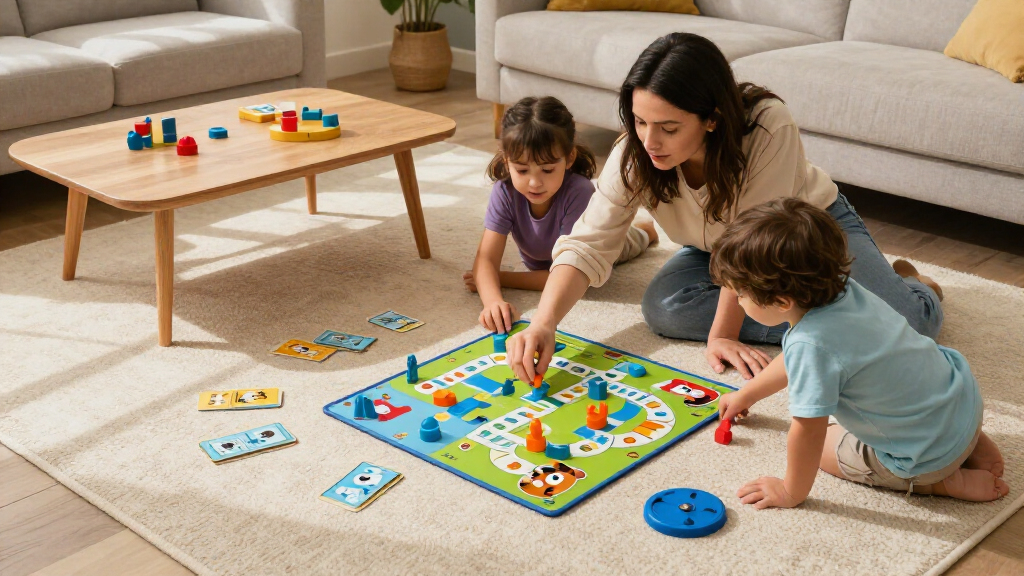
I compared these 15 Bluey games by the things that shape a family game night: how quickly players can learn the rules, how well the play style suits the intended age range, and whether children can take meaningful turns without constant adult help. I also weighed replay potential, group size, interaction between players, component-driven play, and how well each game’s format fits the Bluey theme. A familiar game mechanism can be a real advantage for families, but a new theme alone does not make a game a strong pick.
The ranking favors games that balance accessibility with a reason to play again, then accounts for the needs of more specific groups. A quick guessing game may be a better fit for a short attention span than a longer family challenge, even if it offers less strategic depth. Cooperative options earn a place for families who prefer shared goals, while active or dexterity-focused games suit a different kind of gathering. Since the titles range from preschool-friendly path games to more involved family play, I treat the best choice as the one that matches a household’s players and habits, not simply the game with the most features.
| Bluey board game | Brand |
|---|---|
| Hasbro Gaming Guess Who? Bluey | — |
| Spin Master Games Bluey Beat t | Spin Master Games |
| Hasbro Gaming Trouble: Bluey E | Hasbro Gaming |
| Operation Bluey Edition Board | — |
| Hasbro Gaming Candy Land Bluey | Hasbro Gaming |
| Bluey Shadowlands Board Game | — |
| Bluey Cooperative Scavenger Hu | — |
| Bluey The Creek Pop Around Gam | — |
| Goliath Don’t Wake Dad! Bluey | — |
| Spin Master Games Bluey Splash | — |
| Bluey’s Rubbish Run Family Boa | Moose Games |
| Ravensburger Bluey Labyrinth J | Ravensburger |
| Bluey Here Come the Grannies B | Bluey |
| Spin Master Games Bluey Hedban | Spin Master Games |
| Hasbro Gaming Monopoly Junior: | Hasbro Gaming |
Factors to Consider When Choosing Best Bluey Board Games
Before choosing from the Bluey lineup, I would match the game to how your family actually plays rather than buying by character appeal alone. These broader checks can help avoid a game that is too demanding, too short-lived, or poorly suited to the group around the table.
Match the rules to the youngest regular player
Choose around the youngest person who will play often, not just the child who is most excited about Bluey. A game can carry a low age label yet still ask for skills such as reading clues, planning moves, or handling small pieces. If a child needs frequent adult direction, the game may feel more like a guided activity than shared play. On the other hand, choosing only the simplest rules can leave older siblings with little to do. Look for a format where adults can help without taking over every turn, and check whether the game remains enjoyable when a younger player needs extra time.
Decide whether your family wants competition or cooperation
Competitive games can make turns exciting, but some preschoolers find losing frustrating or struggle to wait while others play. Cooperative formats give players a shared goal and can make it easier for adults to guide a group without singling out one child. They may be less appealing to children who enjoy winning individually or testing their strategy against another player. Think about how your family handles setbacks before choosing a game built around races, challenges, or a common task. A game that fits your group’s temperament often gets played more than one with a clever theme but a poor social fit.
Check the real group size and age mix
Player-count limits matter most when siblings, visiting cousins, or adults regularly join in. A game designed for a small group may not work for a larger family gathering, while a head-to-head format can leave other children waiting. Consider whether the youngest and oldest players will have comparable chances to participate. For a wide age spread, games with clear turns and choices that adults can scale through discussion tend to be easier to share. Also think about whether the game stays fun with only two players, since that may be the most common setup at home.
Balance play length with attention span
Short games are easier to fit into a busy evening and give children a chance to ask for another round. A longer session can feel more substantial, but it may lose younger players before the finish. Look for clues in the game’s turn structure: repeated small actions are often easier to follow than long waits between turns. If the box does not make play time clear, consider whether the rules allow a natural stopping point without spoiling the experience. Avoid choosing a game solely because it promises more content; time at the table only helps when the group stays engaged.
Treat theme pieces as a bonus, not the whole decision
Bluey artwork, familiar characters, and mini-figures can make a game immediately inviting, especially for a child who already loves the show. Those details matter, but they do not tell you whether the core activity will hold attention after the novelty fades. Ask what players will actually do each turn and whether that action suits their interests. Small pieces may be less convenient for toddlers or households that need quick cleanup. If a child mostly wants figures for pretend play, check whether the components support that use rather than assuming every game piece doubles as a toy.
Pay for replay and fit, not complexity alone
A more involved game is not automatically a better family purchase; it may simply demand more setup, explanation, or patience. A straightforward title can offer strong household value if children request repeated rounds and can play with little adult help. For a family that plays often, changing layouts, varied decisions, or different ways to interact can help keep the experience from feeling solved. For occasional play, familiar rules and quick setup may matter more than depth. Decide whether your priority is an easy first game, a repeatable family activity, or a special option for a particular kind of game night.
Frequently Asked Questions
Which Bluey board game is the easiest place to start with a preschooler?
I would start with a game whose main action is easy to explain and whose turns are simple to follow, rather than choosing by theme or age label alone. Candy Land: Bluey Edition is a natural fit for families who want a familiar, straightforward path game, while Shadowlands also targets younger players with a simple collection goal. A child who enjoys talking and identifying characters may find Guess Who? more engaging, though deduction can require adult prompts at first. Before buying, check whether your child can manage the pieces and wait through other players’ turns. The best first game is one they can participate in without an adult making every decision.
What should I choose if I want a Bluey game that older siblings will still enjoy?
Look for a game with choices, changing situations, or interaction beyond moving along a track. Labyrinth Junior offers a more spatial puzzle feel than the simplest race games, while Guess Who? gives older children a chance to use deduction and ask strategic questions. Trouble and Monopoly Junior may appeal to siblings who like familiar competitive formats, but younger players may need help with decisions or patience. Age gaps can also make a game feel uneven if older children rush through their turns. Pick a title where the older child has something to think about and the younger one can still contribute meaningfully.
Are cooperative Bluey games a better choice for children who dislike losing?
They can be a good fit because players work toward a shared result rather than competing to finish ahead of one another. That can lower the pressure for a child who gets upset when another player wins. Cooperative play is not automatically easier, though: children may still need to handle setbacks, follow a shared plan, or wait for a group decision. Adults should make room for each child to contribute instead of taking charge of the team. If your family enjoys playful rivalry, a cooperative game may feel less exciting, so match the format to how your group likes to interact.
How do I choose between a familiar Bluey edition and a game with a different play style?
Familiar mechanics are useful when you want to start playing quickly or when a child already knows a similar game. A Bluey edition of a classic path or popper-style game can reduce the time spent explaining rules. A less familiar format may offer a new kind of interaction, such as deduction, cooperative searching, or a changing maze, which can add variety if your shelf already has several race games. Compare what players do on each turn, not just the names on the box. If ease matters most, choose a known structure; if variety matters more, choose the format your family does not already own.
Should I buy a Bluey board game with mini-figures for a child who likes pretend play?
Mini-figures can make a game feel more inviting and may inspire play beyond the board, but their presence does not guarantee they will work well as standalone toys. Check how many figures are included, whether they are small, and whether they are used often during play or mostly serve as tokens. Families with toddlers may prefer larger, simpler components that are easier to handle and put away. If pretend play is the main reason for buying, look for components that support that use rather than expecting the board game itself to provide open-ended play. Choose the game first for its activity, then treat character pieces as an added benefit.
Conclusion
For the strongest balance of accessibility and replay, I would choose Bluey Labyrinth Junior as the best overall. Families seeking a simple first game should look at Candy Land: Bluey Edition as the beginner-friendly pick, while Shadowlands is a value-minded option for younger children who enjoy a clear collection goal. If you want a more involved family challenge, Bluey Beat the Parents is the premium-style pick for households ready for team competition and a longer shared activity. For specific needs, choose Guess Who? for quick, conversation-led play or the cooperative scavenger hunt for a shared-goal format. My final rule is simple: pick the game whose turn-by-turn activity fits your child and your usual group, not just the one with the most familiar characters.